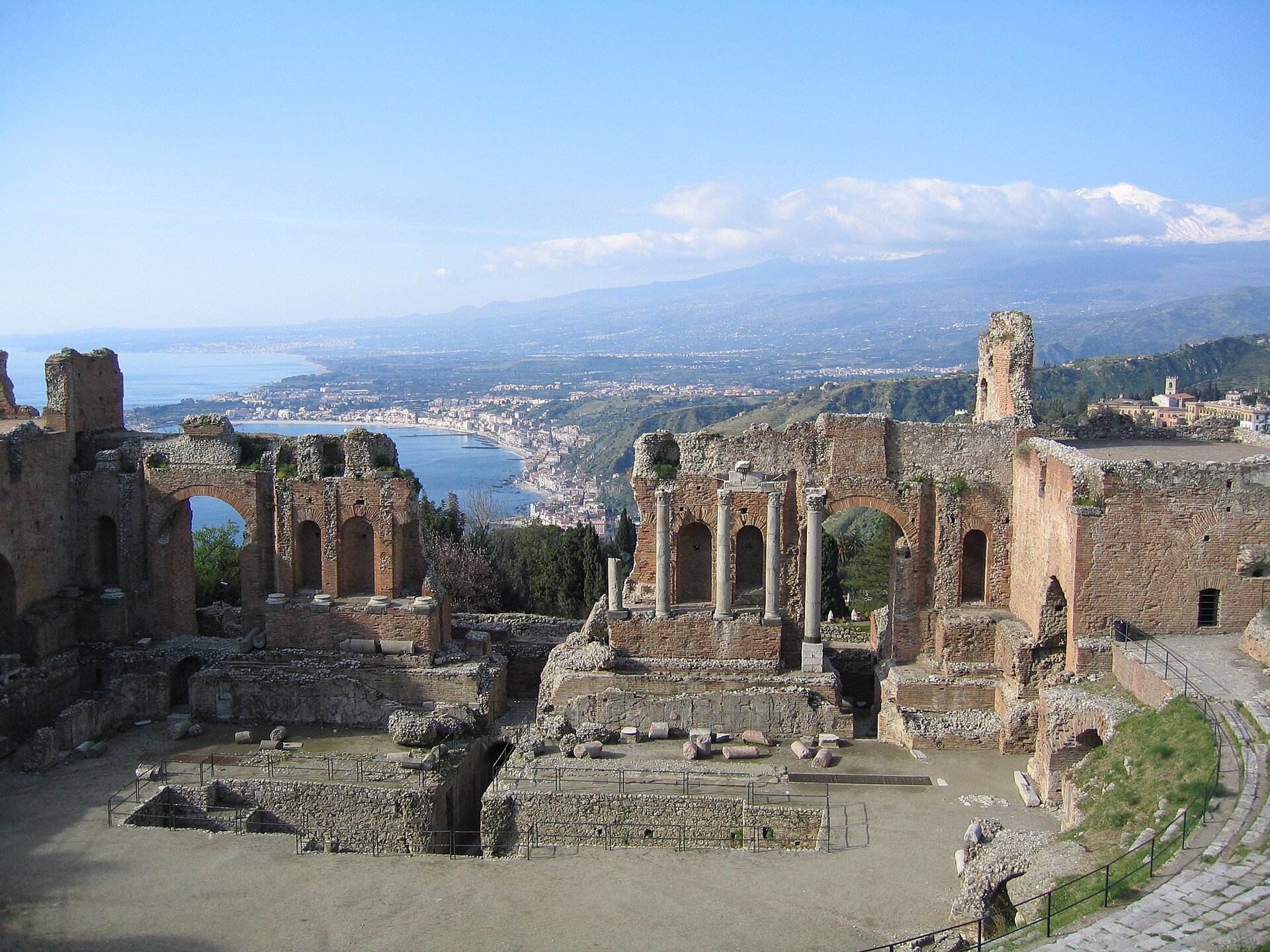
The Teatro Antico di Taormina is an ancient Greek theater located in Taormina, Sicily, carved into the hillside overlooking the Ionian Sea and Mount Etna. Originally constructed in the 3rd century BCE, the structure was significantly expanded and modified by the Romans in the 2nd century CE to accommodate gladiatorial games and theatrical performances.
The theater features a classic horseshoe-shaped cavea, which was built directly into the natural rock of the mountain. Despite the passage of millennia, the site remains remarkably well-preserved and continues to function as a venue for contemporary cultural events, including film festivals and musical performances, serving as a bridge between ancient architectural heritage and modern public use.
Key Facts
- Materials
- Taormina stone, Brick, Marble
- Civilization
- Greek and Roman
- Accessibility
- Partially accessible; steep inclines and uneven ancient stone surfaces
- Date(s)
- 3rd century BCE (Greek), 2nd century CE (Roman expansion)
- Condition
- Well-preserved, active performance venue
- Original Function
- Theatrical performances
- Key Figures
- Andromachus of Tauromenium
Hellenistic Origins
3rd century BCEThe theater was originally built by the Greeks during the Hellenistic period. It was designed to take advantage of the natural topography, with the seating area carved into the hillside to provide optimal acoustics and views of the surrounding landscape.
Roman Reconstruction
2nd century CEUnder Roman rule, the theater underwent major renovations. The stage building (scaenae frons) was rebuilt and expanded, and the seating capacity was increased to accommodate the Roman preference for gladiatorial combat and more elaborate dramatic spectacles.
Modern Preservation and Use
19th century - presentFollowing centuries of neglect, the site gained prominence during the Grand Tour era. In the modern day, it serves as one of Sicily's most significant archaeological landmarks and remains a premier venue for international cultural events.
Cultural Significance
The theater is a primary symbol of Taormina and a testament to the cultural layering of Sicily, where Greek architectural principles were adapted by Roman engineering. Its enduring use as a performance space highlights the continuity of Mediterranean cultural traditions.
Beyond its historical value, the site is central to the local economy and identity, drawing international attention through events like the Taormina Film Fest. It remains a focal point for discussions regarding the balance between archaeological preservation and the demands of modern tourism.
Interpretive Notes
Scholarly debates and areas of uncertainty
There is ongoing academic discussion regarding the extent of the original Greek layout versus the Roman modifications. Some scholars argue that the Roman reconstruction obscured significant portions of the Hellenistic design, making it difficult to reconstruct the exact original acoustics and seating configuration.
Visiting Information
Entry Rules
Open daily. Tickets are required for entry. Visitors are advised to check the official site for closures due to private events or seasonal maintenance.
Best Times to Visit
Early morning or late afternoon to avoid peak heat and large tour groups. Spring and autumn offer the most comfortable temperatures for exploring the steep stone tiers.
Photography
Personal photography is permitted. The use of tripods and professional equipment requires prior authorization from the archaeological park management.
Preservation Notes
Visitors must remain on designated paths and avoid climbing on fragile ancient masonry. The site is subject to ongoing monitoring due to its exposure to coastal weather conditions.
Nearby POIs
3 shownSources & Further Reading
- [1]The Ancient Theatre of Taormina — Maria Grazia Vanaria. Edizioni d'Arte (2015)
- [2]Greek and Roman Theatres in Sicily — Frank Sear. Oxford University Press (2006)
Key Facts
- Materials
- Taormina stone, Brick, Marble
- Civilization
- Greek and Roman
- Accessibility
- Partially accessible; steep inclines and uneven ancient stone surfaces
- Date(s)
- 3rd century BCE (Greek), 2nd century CE (Roman expansion)
- Condition
- Well-preserved, active performance venue
- Original Function
- Theatrical performances
- Key Figures
- Andromachus of Tauromenium