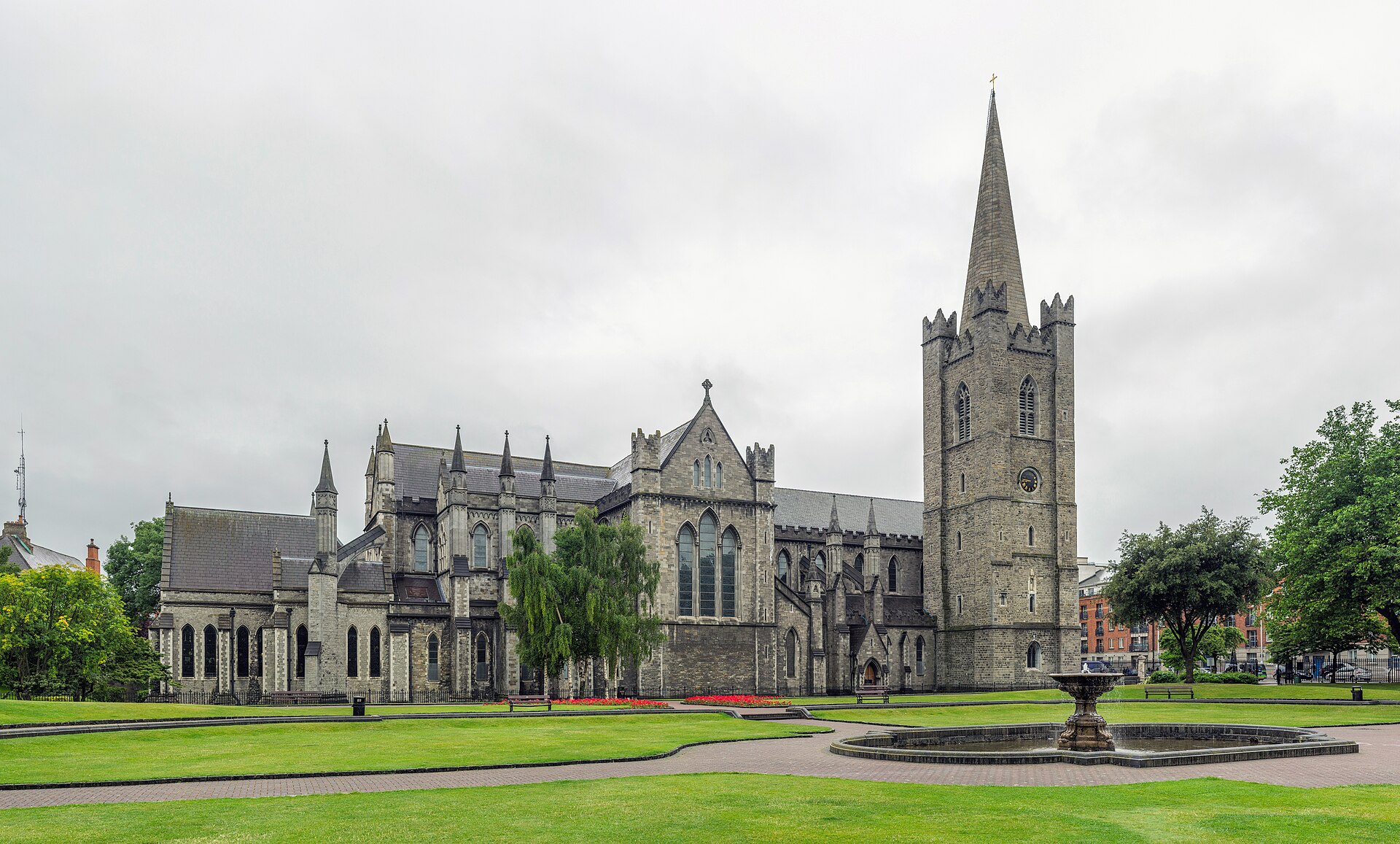
St Patrick's Cathedral in Dublin is the National Cathedral of the Church of Ireland. Founded in 1191 on the site of an ancient well where St. Patrick is said to have baptized converts, the current structure primarily dates from the 13th century. It serves as a significant example of Early English Gothic architecture and remains a central site for Irish ecclesiastical and civic life.
The cathedral is renowned for its long association with Jonathan Swift, who served as Dean from 1713 to 1745 and is buried within the building. Throughout its history, the cathedral has undergone extensive renovations, most notably the major restoration funded by Benjamin Guinness in the 1860s, which saved the structure from near-collapse and defined its current appearance.
Key Facts
- Materials
- Limestone, Sandstone
- Civilization
- Anglo-Norman
- Accessibility
- Wheelchair accessible via the north transept
- Date(s)
- 1220-1259
- Condition
- Well-preserved and active place of worship
- Original Function
- Collegiate Church
- Key Figures
- Jonathan Swift, Benjamin Guinness, Archbishop John Comyn
Foundation and Early Years
1191-1220Archbishop John Comyn established a collegiate church on the site of a wooden parish church. In 1213, it was elevated to cathedral status, though it competed for prominence with Christ Church Cathedral.
Gothic Construction
1220-1259The current stone structure was built in the Early English Gothic style. The Lady Chapel was added in 1270, and the cathedral became a focal point for the religious life of the medieval Pale.
The Deanery of Jonathan Swift
1713-1745Jonathan Swift, the satirist and author of Gulliver's Travels, served as Dean. His tenure was marked by his advocacy for the Irish poor and his complex relationship with the ecclesiastical establishment.
Guinness Restoration
1860-1865By the mid-19th century, the cathedral was in a state of severe disrepair. Benjamin Guinness, of the brewing family, funded a massive restoration project that stabilized the structure and restored many medieval features.
Cultural Significance
St Patrick's Cathedral is a cornerstone of Irish heritage, representing the historical influence of the Church of Ireland. It functions as a site of national commemoration, hosting state ceremonies and maintaining the records of the Order of St. Patrick. Its literary legacy, tied inextricably to Jonathan Swift, makes it a site of pilgrimage for scholars and tourists alike.
Interpretive Notes
Scholarly debates and areas of uncertainty
There is ongoing discussion regarding the extent of the 19th-century restoration and how much of the 'medieval' aesthetic was actually a Victorian interpretation of Gothic architecture rather than an authentic preservation of the original 13th-century fabric.
Visiting Information
Entry Rules
Open daily for visitors. Admission fees apply for tourists. As an active place of worship, visitors are requested to dress modestly and remain quiet during services.
Best Times to Visit
Early morning on weekdays to avoid large tour groups. The cathedral is particularly atmospheric during choral evensong services.
Photography
Photography is permitted for personal use without flash. Tripods and commercial photography require prior written permission.
Preservation Notes
The cathedral is a protected structure. Visitors are asked not to touch the monuments or historical stonework. Restoration work is ongoing to manage the effects of Dublin's urban environment on the limestone exterior.
Nearby POIs
5 shownSources & Further Reading
- [1]St Patrick's Cathedral: A History — Aubrey Gwynn. Four Courts Press (1991)
- [2]The Restoration of St Patrick's Cathedral — John R. H. Moorman. Irish Architectural Archive (2005)
Key Facts
- Materials
- Limestone, Sandstone
- Civilization
- Anglo-Norman
- Accessibility
- Wheelchair accessible via the north transept
- Date(s)
- 1220-1259
- Condition
- Well-preserved and active place of worship
- Original Function
- Collegiate Church
- Key Figures
- Jonathan Swift, Benjamin Guinness, Archbishop John Comyn