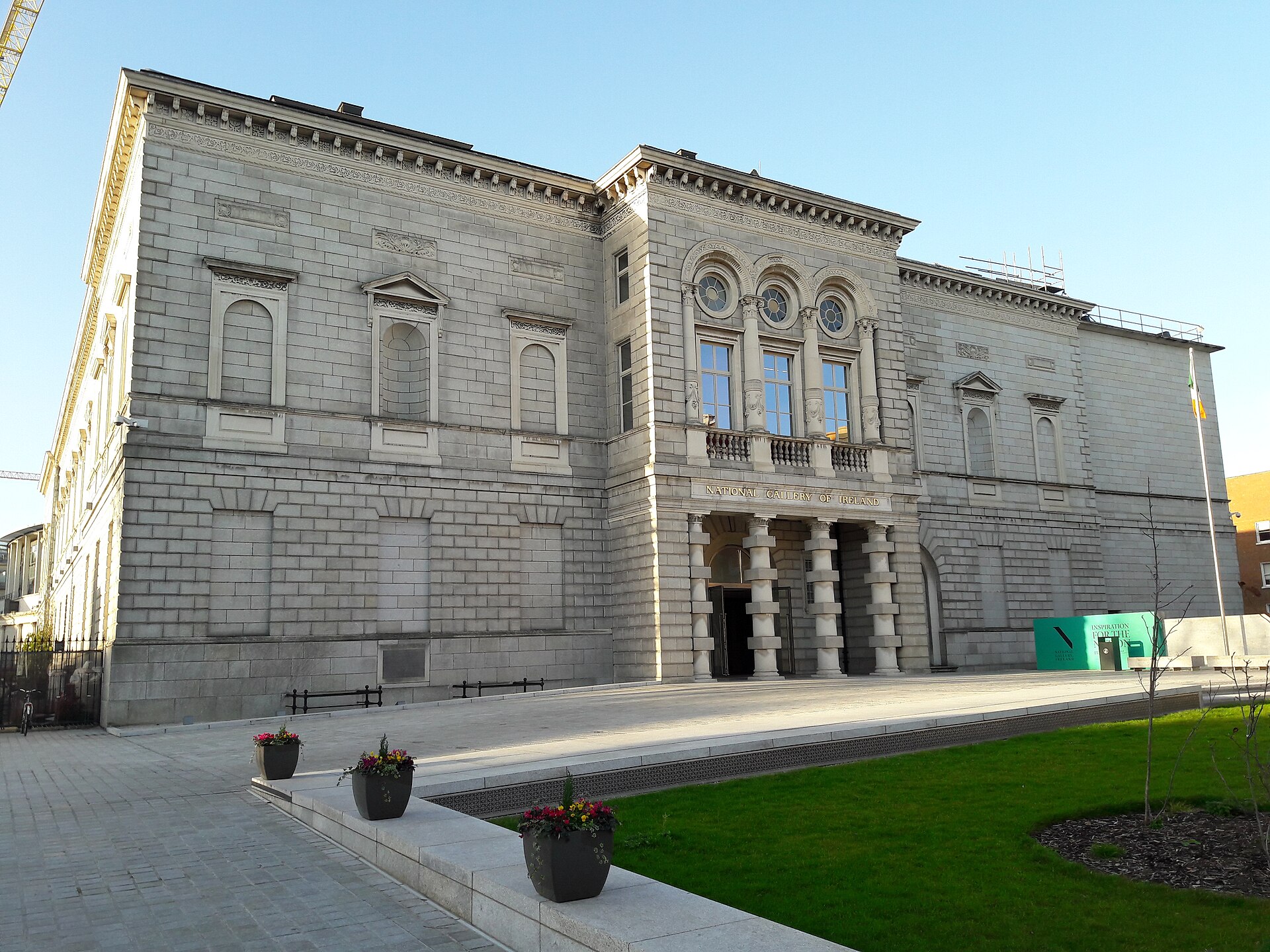
The National Gallery of Ireland, located in Dublin, houses the national collection of Irish and European art. Established by an Act of Parliament in 1854 and opened to the public in 1864, the institution serves as a repository for works spanning the 13th to the 20th centuries. The gallery complex consists of several wings, including the original Dargan Wing and the later Milltown and Millennium wings, which reflect evolving architectural styles from the 19th century to the present.
The collection includes significant holdings of Irish art, notably works by Jack B. Yeats, as well as a comprehensive selection of European masterpieces by artists such as Caravaggio, Vermeer, and Goya. Beyond its role as a display space, the gallery functions as a center for research, conservation, and public education, aiming to foster a deeper understanding of visual culture within Ireland.
Key Facts
- Materials
- Granite, Limestone, Glass, Steel
- Civilization
- Irish
- Accessibility
- Fully wheelchair accessible with elevators to all floors
- Date(s)
- 1864
- Condition
- Active, well-maintained
- Original Function
- Public art gallery
- Key Figures
- William Dargan, George Bernard Shaw, Thomas Bodkin
Foundation and Opening
1854-1864The gallery was established following the 1853 Dublin Exhibition, where the success of the fine art section prompted a movement to create a permanent national collection. The building was designed by Francis Fowke and opened in 1864.
Expansion and Development
1903-1968The Milltown Wing was added in 1903 to house the collection bequeathed by the Countess of Milltown. Further expansion occurred in 1968 with the construction of the Beit Wing, significantly increasing the gallery's exhibition space.
Modernization
2002-2017The Millennium Wing opened in 2002, providing a new entrance and modern facilities. A major multi-year renovation of the historic Dargan and Milltown wings was completed in 2017, upgrading climate control and lighting systems.
Cultural Significance
The National Gallery of Ireland is a cornerstone of Irish cultural life, representing the nation's commitment to preserving both domestic and international artistic heritage. It serves as a primary site for the study of Irish art history and plays a vital role in the public's engagement with European visual traditions.
Interpretive Notes
Scholarly debates and areas of uncertainty
Debates often center on the provenance of specific works within the collection and the ongoing discourse regarding the repatriation of cultural artifacts, though the gallery maintains a rigorous policy of transparency regarding its acquisitions.
Visiting Information
Entry Rules
Open daily. Admission to the permanent collection is free, though some temporary exhibitions may require a ticket. Visitors are encouraged to check the official website for current opening hours and any specific health and safety guidelines.
Best Times to Visit
Weekday mornings are generally quieter. The gallery is often busier during weekends and school holidays.
Photography
Non-commercial photography is permitted in most areas without flash or tripods. Some temporary exhibitions may prohibit photography entirely.
Preservation Notes
Visitors are requested not to touch artworks or frames. Large bags and umbrellas must be stored in the provided lockers. Food and drink are not permitted in the galleries.
Nearby POIs
5 shownKey Facts
- Materials
- Granite, Limestone, Glass, Steel
- Civilization
- Irish
- Accessibility
- Fully wheelchair accessible with elevators to all floors
- Date(s)
- 1864
- Condition
- Active, well-maintained
- Original Function
- Public art gallery
- Key Figures
- William Dargan, George Bernard Shaw, Thomas Bodkin