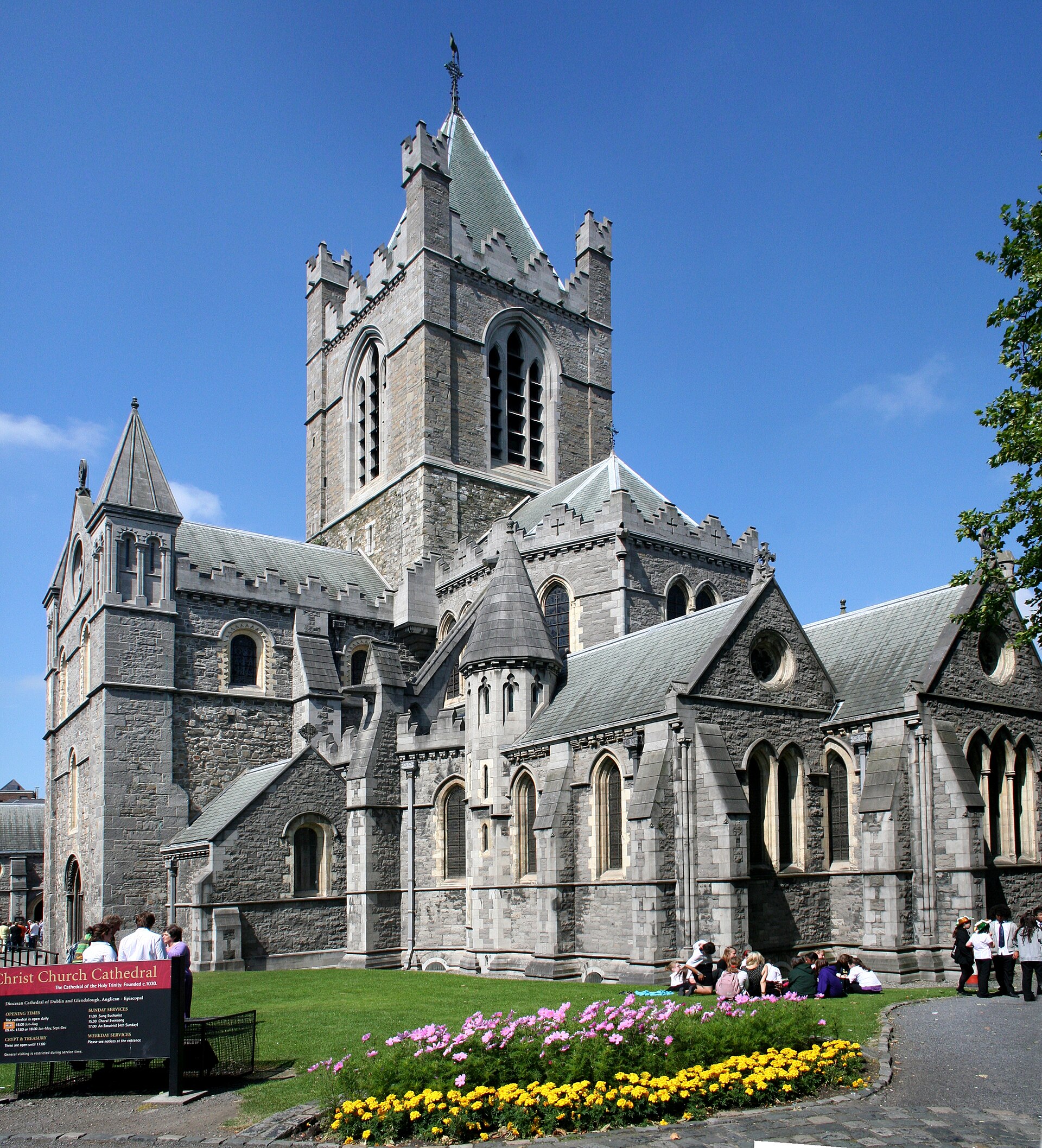
Christ Church Cathedral, formally the Cathedral of the Holy Trinity, is the oldest building in Dublin and serves as the cathedral for the United Dioceses of Dublin and Glendalough in the Church of Ireland. Founded around 1030 by Sitric Silkenbeard, the Norse king of Dublin, the site has functioned as a center of religious and civic life for nearly a millennium.
The current structure is largely the result of a comprehensive 19th-century restoration by George Edmund Street, which saved the cathedral from near-collapse. The architecture features a blend of Romanesque and Early English Gothic styles, housing a significant medieval crypt and a collection of historical artifacts that document the city's ecclesiastical evolution.
Key Facts
- Materials
- Limestone, Sandstone, Stained glass
- Civilization
- Hiberno-Norse / Anglo-Norman
- Accessibility
- Limited; some areas of the crypt are inaccessible to wheelchair users
- Date(s)
- 1030 CE (original), 1172-1240 CE (stone structure)
- Condition
- Well-preserved, active place of worship
- Original Function
- Cathedral
- Key Figures
- Sitric Silkenbeard, Strongbow, George Edmund Street
Viking Origins
1030 CEThe cathedral was established by the Hiberno-Norse King of Dublin, Sitric Silkenbeard, and the first bishop of Dublin, Dúnán. It was originally a wooden structure built on a ridge overlooking the Viking settlement.
Anglo-Norman Reconstruction
1172-1240 CEFollowing the Norman invasion, the original wooden church was replaced by a stone structure commissioned by Archbishop Laurence O'Toole and supported by Strongbow. This period saw the construction of the choir, transepts, and the nave.
Victorian Restoration
1871-1878 CEBy the 19th century, the cathedral had fallen into severe disrepair. Architect George Edmund Street undertook a massive restoration project funded by Henry Roe, which included the construction of the iconic covered bridge connecting the cathedral to the Synod Hall.
Cultural Significance
Christ Church Cathedral is a cornerstone of Dublin's identity, representing the transition from Viking settlement to Anglo-Norman city. It has historically served as the site for royal ceremonies, including the coronation of Lambert Simnel as King of England in 1487.
Today, it remains a vital site for both religious worship and cultural tourism. Its crypt is one of the largest in Britain and Ireland, housing the mummified remains of a cat and a rat, which have become iconic symbols of the cathedral's long history.
Interpretive Notes
Scholarly debates and areas of uncertainty
The extent of the 19th-century 'restoration' remains a subject of debate among architectural historians. Some argue that Street's work was an over-interpretation that obscured the original medieval fabric, while others maintain that the intervention was essential to prevent the total loss of the structure.
Visiting Information
Entry Rules
Open daily for visitors. Admission fees apply for tourists, which include access to the cathedral and the medieval crypt. Visitors are requested to respect ongoing services and maintain silence.
Best Times to Visit
Weekday mornings are generally quieter. The cathedral hosts frequent choral evensong services which are open to the public and provide a traditional experience of the space.
Photography
Photography is permitted for personal use without flash. Tripods and commercial photography require prior written permission from the cathedral authorities.
Preservation Notes
The cathedral is a protected structure. Visitors are asked not to touch the stonework or historical monuments. Due to the age of the building, floor surfaces in the crypt can be uneven.
Nearby POIs
5 shownSources & Further Reading
- [1]Christ Church Cathedral, Dublin: A History — Kenneth Milne. Four Courts Press (2000)
- [2]The Cathedral of the Holy Trinity, commonly called Christ Church Cathedral, Dublin — John L. Robinson. Journal of the Royal Society of Antiquaries of Ireland (1901)
Key Facts
- Materials
- Limestone, Sandstone, Stained glass
- Civilization
- Hiberno-Norse / Anglo-Norman
- Accessibility
- Limited; some areas of the crypt are inaccessible to wheelchair users
- Date(s)
- 1030 CE (original), 1172-1240 CE (stone structure)
- Condition
- Well-preserved, active place of worship
- Original Function
- Cathedral
- Key Figures
- Sitric Silkenbeard, Strongbow, George Edmund Street