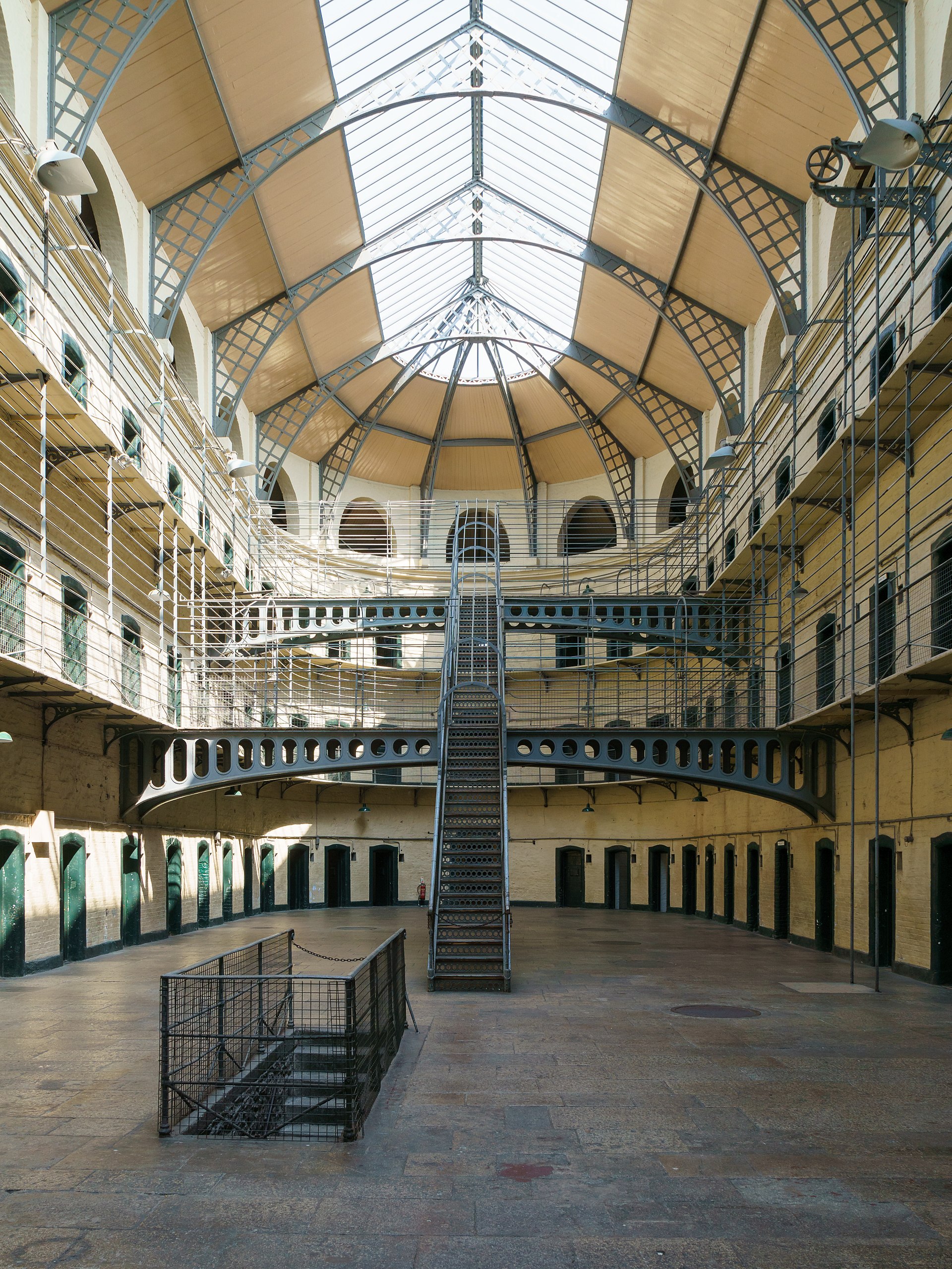
Kilmainham Gaol is a former prison located in Dublin, Ireland, that served as a site of incarceration for many of the most prominent figures in the Irish struggle for independence. Opened in 1796, the facility operated for over 140 years, housing political prisoners, common criminals, and those suffering from extreme poverty during the Great Famine.
The prison is most notably associated with the 1916 Easter Rising, as it served as the site where the leaders of the rebellion were executed by firing squad. Today, the site functions as a museum managed by the Office of Public Works, offering insight into the history of Irish nationalism and the evolution of the penal system.
Key Facts
- Materials
- Limestone, Brick, Iron
- Civilization
- Irish
- Accessibility
- Limited; some areas have restricted access due to historic architecture
- Date(s)
- 1796
- Condition
- Restored museum
- Original Function
- County Gaol
- Key Figures
- Patrick Pearse, James Connolly, Joseph Plunkett, Eamon de Valera
Establishment and Early Years
1796-1840sKilmainham Gaol replaced the older 'New Gaol' at Kilmainham. It was designed to be a modern facility, though it quickly became overcrowded, particularly during the Great Famine when many were imprisoned for petty theft in order to secure food and shelter.
The Revolutionary Period
1916Following the suppression of the Easter Rising, the prison became the site of the execution of 14 leaders of the rebellion. These events transformed the gaol from a symbol of colonial oppression into a site of national martyrdom.
War of Independence and Civil War
1919-1923The prison continued to hold significant political figures during the Irish War of Independence and the subsequent Civil War. It was one of the final locations used by the Irish Free State to hold anti-treaty prisoners before its closure in 1924.
Restoration and Museum Status
1960s-PresentAfter decades of dereliction, the Kilmainham Gaol Restoration Society was formed in the 1960s. The site was meticulously restored and reopened as a museum, serving as a primary educational resource for Irish history.
Cultural Significance
Kilmainham Gaol is widely regarded as a 'national monument' of Ireland. It serves as a physical manifestation of the transition from British colonial rule to the establishment of the Irish Free State. The site is deeply embedded in the Irish collective memory, representing the sacrifices made by those who fought for sovereignty.
Beyond its political significance, the gaol provides a stark look at the social history of 19th-century Dublin, highlighting the harsh realities of the penal system and the impact of the Great Famine on the urban poor.
Interpretive Notes
Scholarly debates and areas of uncertainty
Debate exists regarding the extent to which the prison's narrative focuses exclusively on the 1916 leaders at the expense of the thousands of ordinary criminals and women who were also incarcerated there. Recent scholarship has sought to broaden the scope of the museum's interpretation to include these marginalized groups.
Visiting Information
Entry Rules
Advance booking is mandatory due to high demand and limited capacity. Tickets are released on a rolling basis. Visitors must arrive 15 minutes before their scheduled tour time.
Best Times to Visit
Weekday mornings during the off-season (November to February) offer the most manageable crowds. The site is consistently busy year-round.
Photography
Photography is permitted in most areas, but the use of tripods and flash is prohibited to protect the historic fabric of the building.
Preservation Notes
The site is a protected structure. Visitors are required to stay with their guided tour group at all times and must not touch the original stone or ironwork.
Nearby POIs
5 shownSources & Further Reading
- [1]Kilmainham Gaol: A History — Pat Cooke. Dublin: Stationery Office (1995)
- [2]The Irish Revolution and the Prison System — Seán Enright. Merrion Press (2013)
Key Facts
- Materials
- Limestone, Brick, Iron
- Civilization
- Irish
- Accessibility
- Limited; some areas have restricted access due to historic architecture
- Date(s)
- 1796
- Condition
- Restored museum
- Original Function
- County Gaol
- Key Figures
- Patrick Pearse, James Connolly, Joseph Plunkett, Eamon de Valera