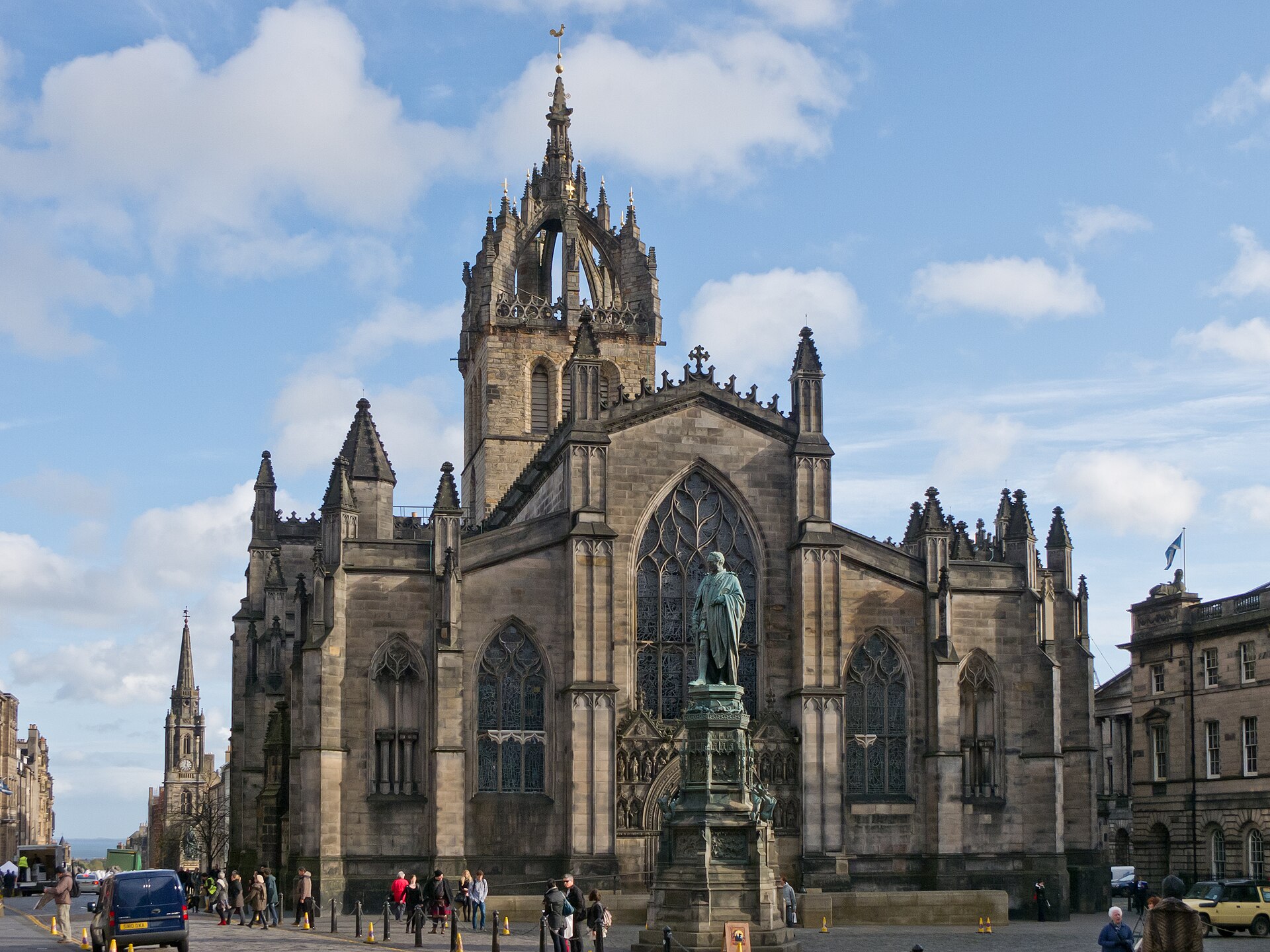
St Giles' Cathedral, also known as the High Kirk of Edinburgh, stands as a prominent landmark on the Royal Mile. While its origins date back to the 12th century, the current structure is primarily a product of 14th to 16th-century construction, featuring a distinctive crown spire that has defined the Edinburgh skyline for centuries.
Historically, the cathedral served as the focal point of the Scottish Reformation, most notably through the ministry of John Knox. It has functioned as the mother church of Presbyterianism and remains a site of significant national importance, hosting state events and serving as the burial place for notable figures in Scottish history.
Key Facts
- Materials
- Sandstone
- Civilization
- Scottish
- Accessibility
- Wheelchair accessible via the main entrance
- Date(s)
- 1124 CE - 16th century
- Condition
- Active place of worship and heritage site
- Original Function
- Catholic Parish Church
- Key Figures
- John Knox, King James VI, Jenny Geddes
Medieval Foundations
12th - 14th centuryThe original church was founded in 1124 by King David I. Following damage during the Wars of Scottish Independence, the structure was largely rebuilt in the 14th century, establishing the core of the current building.
The Reformation
16th centurySt Giles' became the center of the Scottish Reformation. John Knox was appointed minister in 1559, and the interior was stripped of its Catholic ornamentation to reflect the new Presbyterian theology.
The Covenanters and Restoration
17th centuryThe cathedral was the site of the 1637 riot sparked by the introduction of a new prayer book, an event that helped trigger the Wars of the Three Kingdoms. It was briefly elevated to cathedral status during the episcopalian periods.
Victorian Restoration
19th centuryExtensive restoration work was carried out by William Hay between 1872 and 1883, which removed internal partitions and sought to restore the medieval character of the interior.
Cultural Significance
St Giles' is deeply embedded in Scottish national identity. It is the site where the National Covenant was signed and remains the primary venue for major national services in Scotland. The building represents the evolution of Scottish religious life from medieval Catholicism to the austere traditions of the Church of Scotland.
Beyond its religious role, the cathedral houses the Thistle Chapel, the home of the Order of the Thistle, Scotland's highest order of chivalry. This connection to the monarchy and the state reinforces its status as a symbol of Scottish heritage and political history.
Interpretive Notes
Scholarly debates and areas of uncertainty
There is ongoing academic discussion regarding the extent of the 19th-century 'restoration' and how much of the medieval fabric was lost or altered during the Victorian era. Additionally, the exact layout of the church during the pre-Reformation period remains a subject of archaeological interest due to the extensive internal modifications made in the 16th and 19th centuries.
Visiting Information
Entry Rules
Open daily to the public. Entry is free, though donations are encouraged. Visitors are asked to respect the building as an active place of worship; photography is permitted without flash, but is prohibited during services.
Best Times to Visit
Early mornings on weekdays are best to avoid the heavy tourist traffic of the Royal Mile. Visiting during the Edinburgh Festival in August allows for unique musical performances, though the cathedral is significantly more crowded.
Photography
Photography is allowed for personal use. Tripods and flash are strictly prohibited. Commercial photography requires prior written permission from the cathedral office.
Preservation Notes
The sandstone exterior is subject to erosion from urban pollution and weather. Ongoing maintenance is required to preserve the crown spire and the intricate stained glass windows. Visitors should refrain from touching the historic monuments and effigies.
Nearby POIs
5 shownSources & Further Reading
- [1]St Giles' Cathedral: A History — Charles J. Smith. Edinburgh University Press (1994)
- [2]The High Kirk of Edinburgh: A Guide — St Giles' Cathedral Trust. St Giles' Cathedral Publications (2018)
Key Facts
- Materials
- Sandstone
- Civilization
- Scottish
- Accessibility
- Wheelchair accessible via the main entrance
- Date(s)
- 1124 CE - 16th century
- Condition
- Active place of worship and heritage site
- Original Function
- Catholic Parish Church
- Key Figures
- John Knox, King James VI, Jenny Geddes