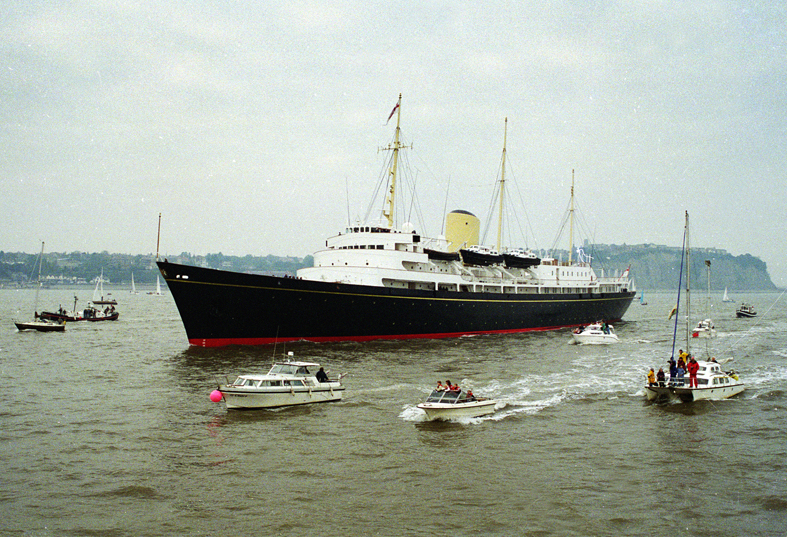
HMY Britannia served as the royal yacht for Queen Elizabeth II from 1954 until its decommissioning in 1997. Constructed by John Brown & Co. in Clydebank, Scotland, the vessel functioned as a mobile royal residence and a venue for state diplomacy, hosting numerous world leaders, heads of state, and royal family members during its 44 years of service. It traveled over one million nautical miles across the globe, serving as a symbol of British maritime tradition and postwar soft power.
Following its decommissioning, the ship was permanently berthed at the Ocean Terminal in Leith, Edinburgh. It now operates as a maritime museum, allowing visitors to tour the royal apartments, the crew's quarters, and the engine room. The vessel remains a significant example of mid-20th-century naval engineering and royal history, preserved to reflect its operational state during the late 20th century.
Key Facts
- Materials
- Steel, Teak decking
- Civilization
- United Kingdom
- Accessibility
- Partially accessible; some decks and lower areas require stair navigation
- Date(s)
- 1953
- Condition
- Well-preserved, active museum ship
- Original Function
- Royal Yacht and state diplomatic vessel
- Key Figures
- Queen Elizabeth II, Prince Philip, Duke of Edinburgh
Design and Launch
1951-1953Commissioned during the reign of King George VI, the ship was designed to serve as a royal yacht in peacetime and a hospital ship in the event of war. It was launched by Queen Elizabeth II in April 1953, shortly after her accession to the throne.
Royal Service
1954-1997Britannia served as the primary vessel for royal travel and state diplomacy. It hosted official visits to over 135 countries and served as the venue for the honeymoon of several royal family members, including Prince Charles and Princess Diana.
Decommissioning and Museum Conversion
1997-presentThe yacht was decommissioned in December 1997 following a government decision to retire the vessel. It was subsequently moved to Leith, Edinburgh, where it was converted into a public museum and tourist attraction, managed by the Royal Yacht Britannia Trust.
Cultural Significance
HMY Britannia represents the transition of the British monarchy in the late 20th century, moving from a colonial-era institution to a modern diplomatic entity. It is viewed as a floating embassy that facilitated international relations during the Cold War and the post-imperial era.
In Scotland, the ship's presence in Leith is a significant element of the area's urban regeneration. It serves as a cultural touchstone for the British public, representing both the personal history of the royal family and the broader maritime heritage of the United Kingdom.
Interpretive Notes
Scholarly debates and areas of uncertainty
Debates surrounding the vessel often focus on the cost of its maintenance during its final years of service and the political decision to decommission it without a direct replacement. Historians also discuss the extent to which the ship's diplomatic utility was overstated compared to its role as a private royal residence.
Visiting Information
Entry Rules
Open daily. Tickets can be purchased online or at the visitor center. Visitors are encouraged to book in advance during peak tourist seasons. Audio guides are included with admission.
Best Times to Visit
Weekdays during the shoulder seasons (April-May or September-October) to avoid heavy cruise ship traffic and school holiday crowds.
Photography
Personal photography is permitted throughout the ship. Commercial photography requires prior written permission from the Royal Yacht Britannia Trust.
Preservation Notes
The ship is maintained in a climate-controlled environment to preserve original interiors and artifacts. Visitors are asked to refrain from touching displays and to follow marked routes to protect the historic fabric of the vessel.
Nearby POIs
5 shownSources & Further Reading
- [1]Britannia: The Official History of the Royal Yacht — Richard Johnstone-Bryden. Conway Maritime Press (2003)
- [2]The Royal Yacht Britannia: A History — Brian Hoey. Chatto & Windus (2002)
Key Facts
- Materials
- Steel, Teak decking
- Civilization
- United Kingdom
- Accessibility
- Partially accessible; some decks and lower areas require stair navigation
- Date(s)
- 1953
- Condition
- Well-preserved, active museum ship
- Original Function
- Royal Yacht and state diplomatic vessel
- Key Figures
- Queen Elizabeth II, Prince Philip, Duke of Edinburgh