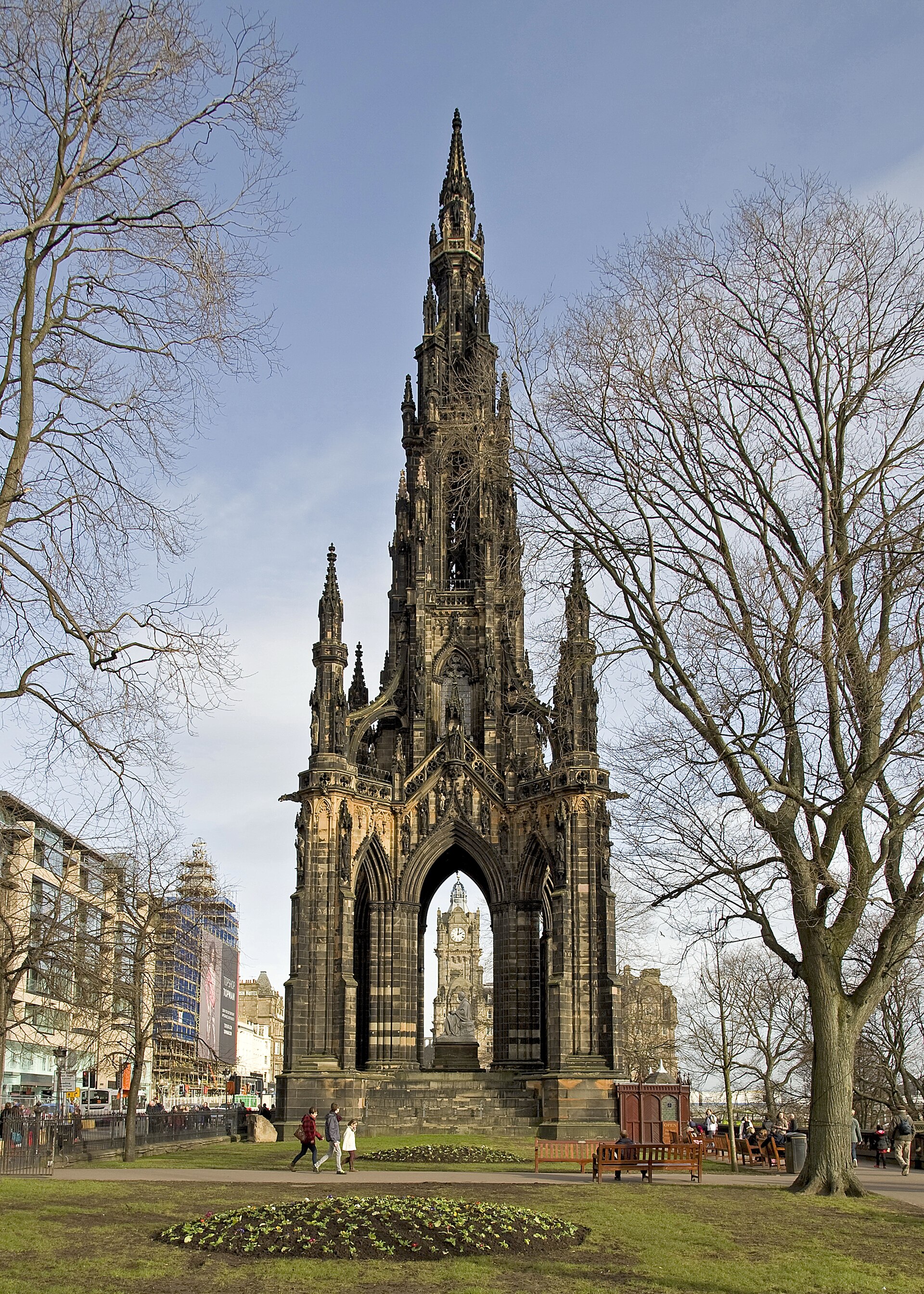
The Scott Monument is a Victorian Gothic monument to Scottish author Sir Walter Scott. Located in Princes Street Gardens in Edinburgh, it stands as the largest monument to a writer in the world, reaching a height of 61.1 meters. The structure was designed by George Meikle Kemp, a self-taught architect whose winning design was inspired by the ruins of Melrose Abbey.
Constructed between 1840 and 1844, the monument features a central spire adorned with 64 statues of characters from Scott's novels and various Scottish historical figures. The tower is built from Binny sandstone, which has darkened over time due to the city's coal smoke, contributing to its distinct, somber appearance.
Key Facts
- Materials
- Binny sandstone, Carrara marble
- Civilization
- Scottish
- Accessibility
- Limited; narrow spiral staircase access only
- Date(s)
- 1840-1844
- Condition
- Well-preserved, open to the public
- Original Function
- Commemorative monument
- Key Figures
- Sir Walter Scott, George Meikle Kemp, John Steell
Conception and Competition
1832-1836Following the death of Sir Walter Scott in 1832, a public subscription was launched to fund a monument in his honor. A design competition was held in 1836, which was won by George Meikle Kemp, a carpenter and draftsman who entered under the pseudonym 'John Morvo'.
Construction
1840-1844The foundation stone was laid in 1840. Kemp oversaw the construction until his accidental death in 1844, shortly before the monument's completion. The structure was officially inaugurated in August 1846.
Restoration
1998-1999The monument underwent a major restoration project in the late 1990s. The sandstone was cleaned and repaired, and the white Carrara marble statue of Scott was restored to its original luster.
Cultural Significance
The Scott Monument is a defining feature of the Edinburgh skyline and a symbol of the Scottish literary tradition. It reflects the 19th-century obsession with Gothic architecture and the romanticization of Scottish history that Scott's own novels helped to foster.
Beyond its architectural value, the monument serves as a focal point for literary tourism in Scotland. It remains a testament to the profound impact of Sir Walter Scott on the development of the historical novel and the cultural identity of 19th-century Scotland.
Interpretive Notes
Scholarly debates and areas of uncertainty
There is ongoing discussion regarding the 'Gothic' classification of the monument, with some architectural historians arguing that its verticality and structural logic lean more towards a unique Victorian interpretation of ecclesiastical architecture rather than a strict revivalist style.
Visiting Information
Entry Rules
Open daily. Admission fee required to climb the tower. Visitors must be physically capable of ascending 287 narrow, winding steps to reach the top viewing platform.
Best Times to Visit
Early morning or late afternoon to avoid peak tourist crowds and to capture the best light on the sandstone facade.
Photography
Personal photography is permitted. Commercial photography requires prior arrangement with the City of Edinburgh Council.
Preservation Notes
The sandstone is porous and sensitive to environmental pollutants. Visitors are requested not to touch the carvings or the marble statue.
Nearby POIs
5 shownSources & Further Reading
- [1]The Scott Monument: A Guide — Charles McKean. Edinburgh City Council (1999)
- [2]George Meikle Kemp and the Scott Monument — Alex F. Young. Scottish Cultural Press (1996)
Key Facts
- Materials
- Binny sandstone, Carrara marble
- Civilization
- Scottish
- Accessibility
- Limited; narrow spiral staircase access only
- Date(s)
- 1840-1844
- Condition
- Well-preserved, open to the public
- Original Function
- Commemorative monument
- Key Figures
- Sir Walter Scott, George Meikle Kemp, John Steell