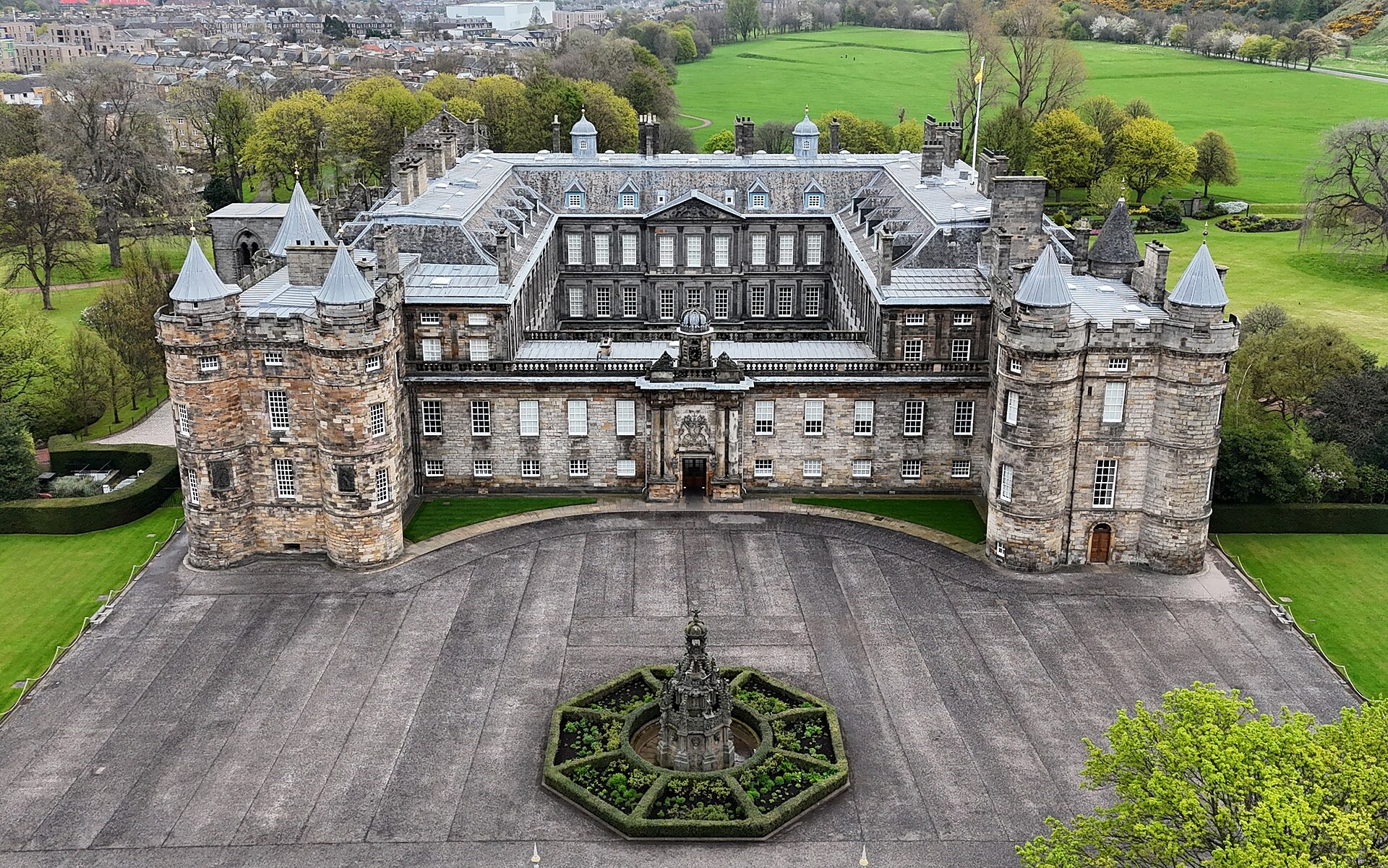
The Palace of Holyroodhouse serves as the official residence of the British monarch in Scotland. Situated at the end of Edinburgh's Royal Mile, the site originated as an Augustinian monastery founded by King David I in 1128. The current palace structure primarily dates to the 17th century, following extensive rebuilding commissioned by King Charles II, which integrated the surviving 16th-century tower built by James IV.
The palace is historically significant for its association with the Stewart dynasty, particularly Mary, Queen of Scots, who resided here during her turbulent reign. The historic apartments, including the Queen's Bedchamber and the Outer Chamber, remain preserved and are open to the public, offering insight into the royal court life and political intrigue of the 16th century.
Key Facts
- Materials
- Sandstone, Oak
- Civilization
- Scottish
- Accessibility
- Partially accessible; historic stairs limit access to some upper floors
- Date(s)
- 1501-1505 (Tower), 1671-1678 (Palace)
- Condition
- Well-preserved, active royal residence
- Original Function
- Royal residence and monastic guest house
- Key Figures
- Mary, Queen of Scots, King Charles II, King David I, Bonnie Prince Charlie
Monastic Origins
1128The site began as the Holyrood Abbey, an Augustinian monastery founded by King David I. The name derives from the 'Holy Rood' or True Cross, which was reportedly gifted to the abbey.
The Stewart Palace
16th CenturyKing James IV transformed the monastic guest house into a royal palace. His son, James V, expanded the structure, adding the northwest tower that housed the apartments later occupied by Mary, Queen of Scots.
Restoration and Expansion
1671-1678Following the Restoration of the monarchy, King Charles II commissioned Sir William Bruce to rebuild the palace in the Baroque style, creating the quadrangle and state apartments that define the current exterior.
Modern Era
20th Century - PresentThe palace continues to serve as the official royal residence in Scotland, hosting state ceremonies, investitures, and garden parties. It remains a major site for the Royal Collection Trust.
Cultural Significance
Holyrood Palace is the primary symbol of the British monarchy's presence in Scotland. It serves as a focal point for national identity and state functions, bridging the gap between Scotland's medieval history and its modern constitutional role. The palace is deeply embedded in Scottish folklore, particularly regarding the tragic history of Mary, Queen of Scots, whose presence continues to define the visitor experience.
Interpretive Notes
Scholarly debates and areas of uncertainty
The extent of the original medieval abbey's influence on the layout of the current palace remains a subject of architectural study. Additionally, the exact sequence of interior modifications during the 17th-century reconstruction by William Bruce is frequently analyzed to determine how much of the earlier Renaissance-era floor plan was intentionally preserved versus demolished.
Visiting Information
Entry Rules
Open to the public daily, except for periods when the palace is in use for official royal engagements. Tickets should be booked in advance via the Royal Collection Trust website. Security screening is mandatory for all visitors.
Best Times to Visit
Early morning or late afternoon to avoid peak tourist crowds on the Royal Mile. Visiting during the shoulder seasons (spring and autumn) provides a quieter experience.
Photography
Photography is permitted for personal use in the palace grounds and the Abbey ruins. Photography is strictly prohibited inside the State Apartments and the historic chambers of Mary, Queen of Scots.
Preservation Notes
The palace is a working royal residence; visitors must remain within designated areas. Touching of tapestries, furniture, and wall surfaces is strictly prohibited to prevent degradation of historic materials.
Nearby POIs
5 shownSources & Further Reading
- [1]
- [2]The Architecture of the Palace of Holyroodhouse — John G. Dunbar. Society of Antiquaries of Scotland (1999)
Key Facts
- Materials
- Sandstone, Oak
- Civilization
- Scottish
- Accessibility
- Partially accessible; historic stairs limit access to some upper floors
- Date(s)
- 1501-1505 (Tower), 1671-1678 (Palace)
- Condition
- Well-preserved, active royal residence
- Original Function
- Royal residence and monastic guest house
- Key Figures
- Mary, Queen of Scots, King Charles II, King David I, Bonnie Prince Charlie