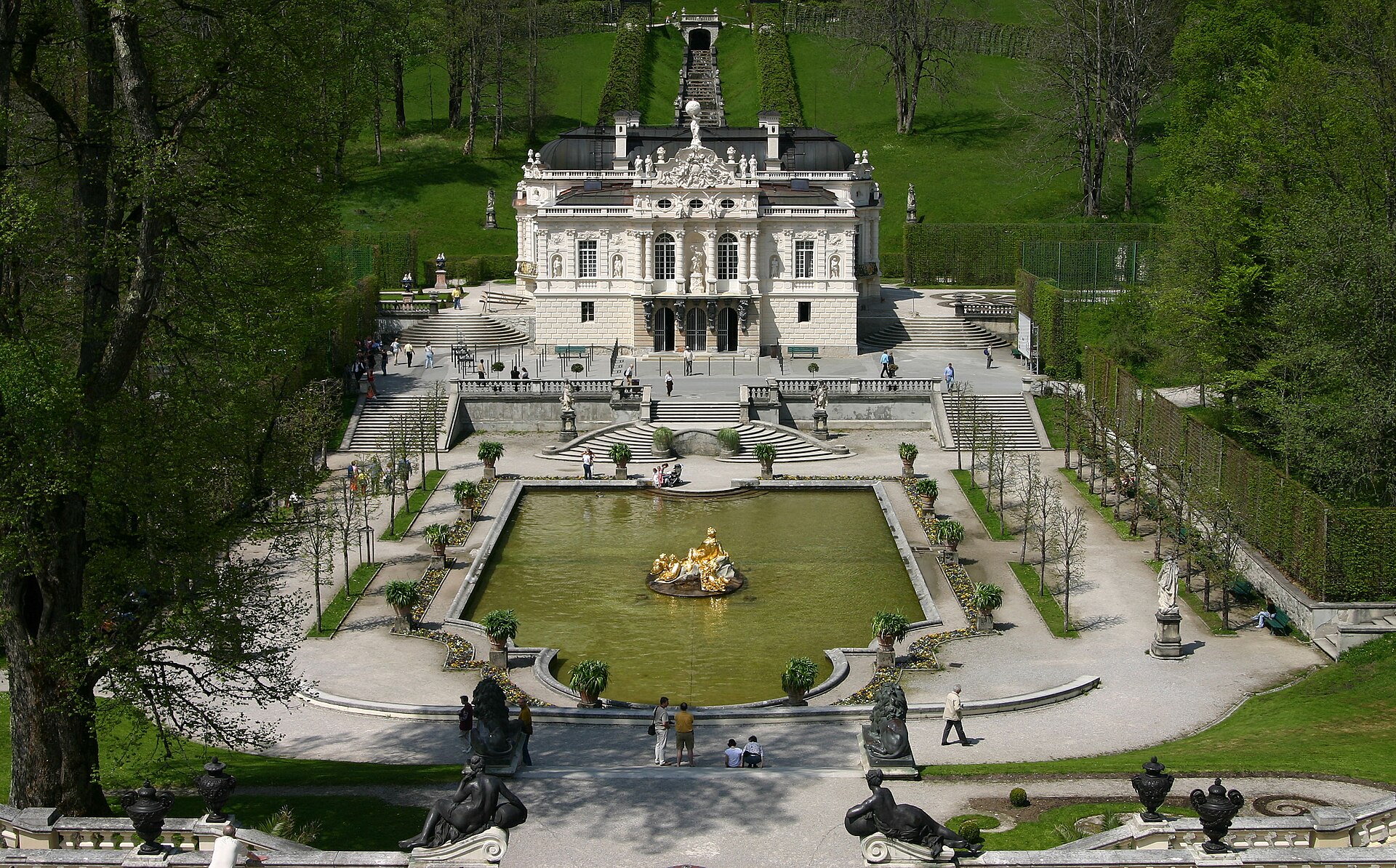
Schloss Linderhof is the smallest of the three palaces built by King Ludwig II of Bavaria and the only one he lived to see completed. Located near Ettal in the Graswang Valley, the palace was constructed between 1874 and 1878 on the site of his father's former hunting lodge. The design is heavily influenced by the French Rococo style, serving as a private retreat for the monarch rather than a center for state administration.
The palace is renowned for its opulent interiors, which feature extensive gold leaf, mirrors, and intricate wood carvings. The surrounding grounds are equally significant, designed by landscape architect Carl von Effner to include formal terraced gardens, a man-made Venus Grotto, and a Moorish Kiosk, reflecting Ludwig's fascination with theatricality and historical romanticism.
Key Facts
- Materials
- Stone, Stucco, Gold leaf, Marble
- Civilization
- Bavarian
- Accessibility
- Limited; palace interior involves stairs
- Date(s)
- 1874-1878
- Condition
- Well-preserved, museum
- Original Function
- Royal private residence
- Key Figures
- King Ludwig II, Carl von Effner, Georg von Dollmann
Origins and Planning
1869-1874King Ludwig II initially planned a larger palace modeled after Versailles in the Graswang Valley. Due to space constraints and the king's desire for a more intimate retreat, the plans were scaled down to a villa-style structure centered around the existing hunting lodge.
Construction Phase
1874-1878Architect Georg von Dollmann oversaw the construction, which replaced the original wooden lodge with a stone structure. The interior decoration was executed by a team of prominent Munich artists, focusing on the Neo-Rococo aesthetic favored by the King.
Garden Development
1870-1886The park was developed concurrently with the palace. It features a complex system of waterworks and unique structures like the Venus Grotto, an artificial cave inspired by Wagnerian opera, and the Moorish Kiosk, which was purchased from the 1867 Paris World Exhibition.
Modern Preservation
20th Century - PresentFollowing the death of Ludwig II, the palace was opened to the public. It is currently managed by the Bavarian Palace Department, which conducts ongoing restoration of the delicate interior gilding and the complex hydraulic systems of the park.
Cultural Significance
Linderhof serves as a primary example of 19th-century 'Dream Architecture,' illustrating the psychological landscape of King Ludwig II. It represents the intersection of absolute monarchy, romanticism, and the emerging influence of mass media and theatrical production in royal life.
For the Bavarian public, the site is a major cultural landmark that draws millions of visitors, contributing significantly to the regional economy and the preservation of 19th-century decorative arts.
Interpretive Notes
Scholarly debates and areas of uncertainty
Scholars frequently debate the extent to which Linderhof was intended as a private sanctuary versus a performative space for the King's solitary 'audience.' There is also ongoing discussion regarding the technical preservation of the Venus Grotto, specifically how to maintain the original 19th-century lighting effects and water systems without compromising the structural integrity of the artificial cave.
Visiting Information
Entry Rules
Palace interior accessible via guided tour only. Tickets are time-slotted and must be purchased in advance or at the visitor center. The park and outbuildings are open seasonally.
Best Times to Visit
Late spring and early autumn to experience the gardens in bloom while avoiding the peak summer tourist crowds. Weekdays are significantly quieter than weekends.
Photography
Photography is strictly prohibited inside the palace. Personal photography is permitted in the gardens and park structures.
Preservation Notes
The palace interior is highly sensitive to humidity and light; flash photography and large bags are prohibited. Visitors must follow the designated path during guided tours.
Nearby POIs
3 shownSources & Further Reading
- [1]Linderhof Palace: Official Guide — Bavarian Palace Department. Bayerische Verwaltung der staatlichen Schlösser, Gärten und Seen (2021)View
- [2]Ludwig II of Bavaria: The Swan King — Christopher McIntosh. I.B. Tauris (2012)
Key Facts
- Materials
- Stone, Stucco, Gold leaf, Marble
- Civilization
- Bavarian
- Accessibility
- Limited; palace interior involves stairs
- Date(s)
- 1874-1878
- Condition
- Well-preserved, museum
- Original Function
- Royal private residence
- Key Figures
- King Ludwig II, Carl von Effner, Georg von Dollmann