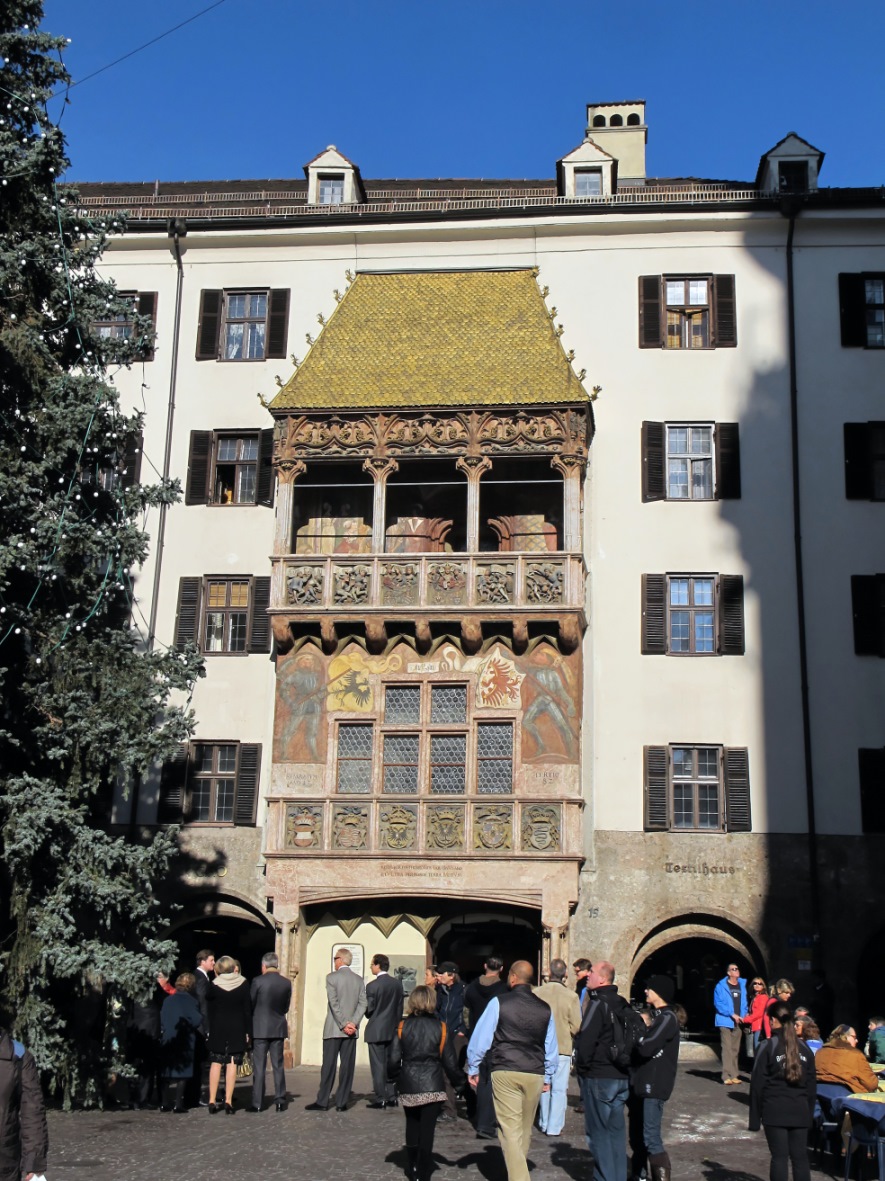
The Goldenes Dachl, or Golden Roof, is a landmark structure located in the Old Town of Innsbruck, Austria. It consists of a late Gothic oriel balcony adorned with 2,657 fire-gilded copper tiles. The structure was commissioned by Emperor Maximilian I to serve as a royal box from which he could observe festivals and tournaments in the square below.
Completed in 1500, the roof commemorates the Emperor's marriage to Bianca Maria Sforza. The relief carvings on the balcony depict the Emperor, his wives, his chancellor, and court jesters, reflecting the political and dynastic aspirations of the Habsburg monarchy at the turn of the 16th century.
Key Facts
- Materials
- Fire-gilded copper tiles, Sandstone, Limestone
- Civilization
- Habsburg Empire
- Accessibility
- Accessible via elevator in the museum section
- Date(s)
- 1496-1500
- Condition
- Well-preserved, houses a museum
- Original Function
- Royal viewing gallery
- Key Figures
- Emperor Maximilian I, Bianca Maria Sforza
Commission and Construction
1496-1500The structure was commissioned by Emperor Maximilian I as part of the renovation of the existing ducal residence. The architect Niklas Türing the Elder oversaw the construction, while the gilded tiles were crafted to symbolize the Emperor's wealth and status.
Imperial Usage
16th centuryMaximilian I used the balcony as a private box to watch public events in the town square. It served as a visual manifestation of his power and his connection to the city of Innsbruck, which he favored as a residence.
Modern Preservation
20th century - presentThe building now houses the Golden Roof Museum, which provides historical context regarding the life of Maximilian I and the significance of the site. Periodic restoration of the gilded tiles ensures the preservation of the landmark's iconic appearance.
Cultural Significance
The Goldenes Dachl is the primary symbol of Innsbruck and a testament to the influence of the Habsburg dynasty in the Tyrol region. It represents the transition from the medieval period to the Renaissance in Alpine architecture, blending courtly display with civic urban design.
Beyond its architectural value, the site is a focal point for local identity and tourism. It serves as a permanent reminder of the era when Innsbruck functioned as a major political center of the Holy Roman Empire.
Interpretive Notes
Scholarly debates and areas of uncertainty
There is ongoing academic discussion regarding the exact symbolic meaning of the relief carvings. While most scholars interpret them as a display of dynastic legitimacy, some suggest the inclusion of specific court figures may contain hidden political allegories related to the Emperor's complex relationships with his European allies.
Visiting Information
Entry Rules
The exterior is viewable from the public square at all times. The interior museum requires a ticket and follows standard operating hours. No specific dress code is enforced.
Best Times to Visit
Early morning or late evening to avoid the high volume of pedestrian traffic in the Old Town. The site is particularly atmospheric during the winter months when the Christmas market is held in the square.
Photography
Photography is permitted for personal use. Commercial photography requires prior authorization from the museum administration.
Preservation Notes
The gilded tiles are fragile and subject to environmental wear. Visitors are requested to maintain a respectful distance from the historical facade and refrain from touching the relief carvings.
Nearby POIs
3 shownSources & Further Reading
- [1]Maximilian I: The Last Knight — John Mandeville. Habsburg Historical Press (2015)
- [2]The Golden Roof: Architecture and Symbolism — Elisabeth Gruber. Innsbruck University Press (2019)
Key Facts
- Materials
- Fire-gilded copper tiles, Sandstone, Limestone
- Civilization
- Habsburg Empire
- Accessibility
- Accessible via elevator in the museum section
- Date(s)
- 1496-1500
- Condition
- Well-preserved, houses a museum
- Original Function
- Royal viewing gallery
- Key Figures
- Emperor Maximilian I, Bianca Maria Sforza