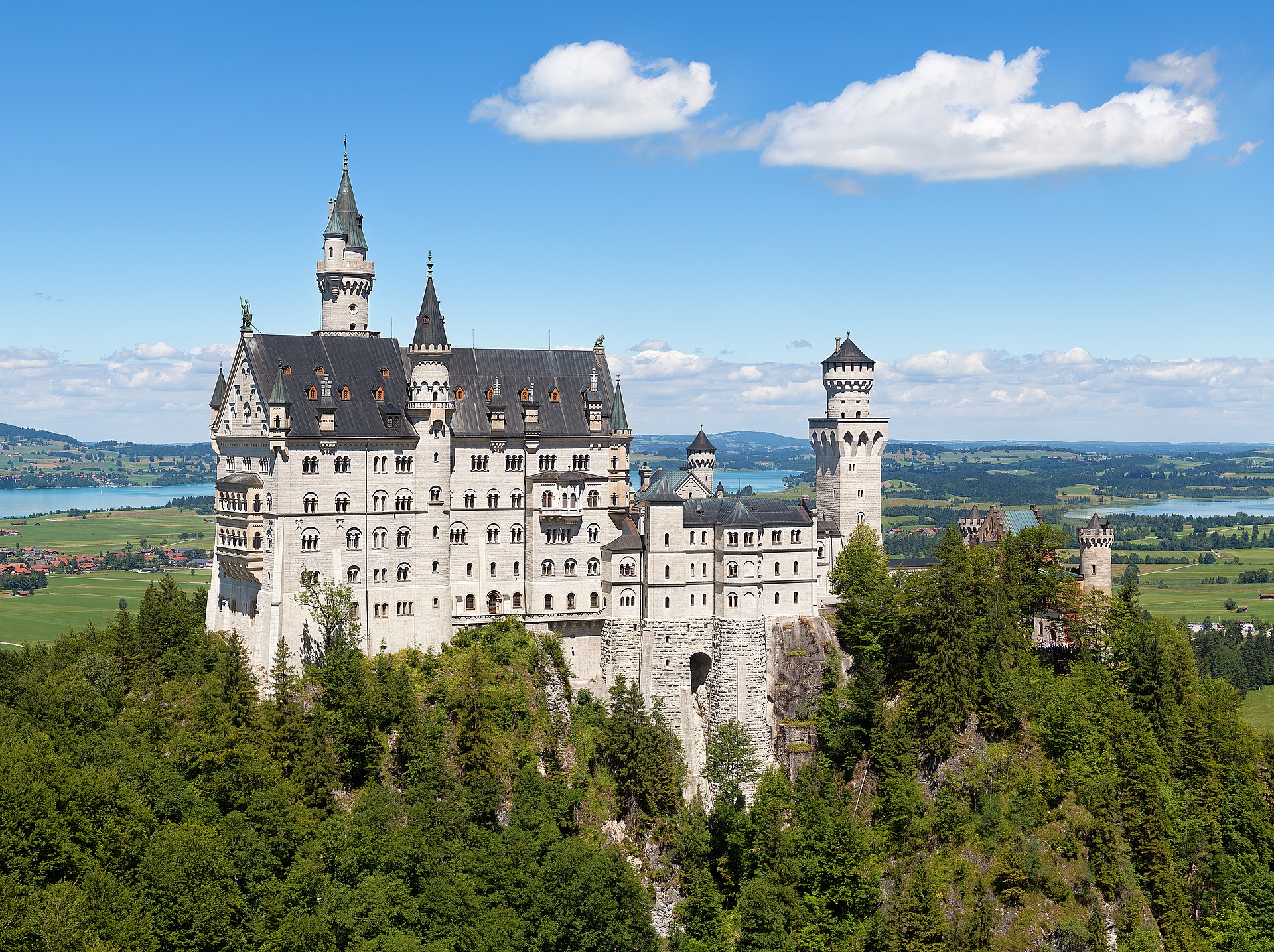
Schloss Neuschwanstein is a 19th-century Romanesque Revival palace situated on a rugged hill above the village of Hohenschwangau in southwest Bavaria, Germany. Commissioned by King Ludwig II of Bavaria as a personal retreat and a theatrical homage to the operas of Richard Wagner, the structure was intended to serve as an idealized vision of a medieval knight's castle rather than a functional royal residence.
The palace is characterized by its dramatic multi-towered limestone facade and elaborate interior design, which incorporates themes from Germanic mythology and Wagnerian legend. Despite its medieval appearance, the castle was equipped with state-of-the-art technology for its time, including central heating, running water, and an electric bell system, reflecting the King's fascination with both historical romanticism and modern innovation.
Key Facts
- Materials
- Limestone, Brick, Sandstone
- Civilization
- Bavarian
- Accessibility
- Limited; steep incline and many stairs
- Date(s)
- 1869-1886
- Condition
- Well-preserved, major tourist site
- Original Function
- Private royal retreat
- Key Figures
- King Ludwig II, Richard Wagner, Christian Jank, Eduard Riedel
Conception and Design
1868Following his loss of sovereignty in 1866, King Ludwig II began planning a private refuge. He commissioned stage designer Christian Jank to create a romanticized vision of a medieval castle, which was then translated into architectural plans by Eduard Riedel.
Construction Phase
1869-1886The foundation stone was laid in September 1869. Construction was an immense engineering challenge, requiring the leveling of the hilltop and the installation of modern infrastructure. By the time of the King's death in 1886, the main building and the gatehouse were largely complete, though many interior rooms remained unfinished.
Public Opening
1886Only seven weeks after the death of King Ludwig II, the unfinished castle was opened to the paying public. The Bavarian government sought to recoup the massive debts incurred by the King's building projects, transforming the private retreat into a significant source of revenue.
Modern Preservation
20th century - presentThe castle survived both World Wars intact. Today, it is managed by the Bavarian Administration of State-Owned Palaces, Gardens and Lakes, which conducts ongoing structural stabilization and restoration of the ornate interior decorations.
Cultural Significance
Neuschwanstein serves as the ultimate architectural manifestation of 19th-century Romanticism. It represents the intersection of political decline and artistic obsession, symbolizing the 'fairy-tale' image of Germany that has influenced global popular culture, most notably serving as a visual inspiration for Disney's Sleeping Beauty Castle.
Beyond its aesthetic impact, the site is a critical case study in the history of European monarchy and the transition of royal assets into public heritage. It remains a focal point for discussions regarding the legacy of King Ludwig II and the economic impact of heritage tourism in the Alpine region.
Interpretive Notes
Scholarly debates and areas of uncertainty
Debate persists regarding the extent to which the castle was intended as a 'theatrical set' versus a habitable residence. Some scholars argue the interior design reflects a psychological projection of the King's isolation, while others emphasize the technical sophistication of the building as evidence of a forward-thinking monarch.
Visiting Information
Entry Rules
Access is strictly by guided tour only. Tickets must be purchased in advance via the official website, as they frequently sell out. Visitors must arrive at the ticket center at least 90 minutes before the tour time to allow for the ascent to the castle.
Best Times to Visit
Early morning or late afternoon during the shoulder seasons (April-May or October-November) to avoid peak summer crowds. Winter visits offer a distinct atmosphere but access to certain exterior paths may be restricted due to snow.
Photography
Photography and filming are strictly prohibited inside the castle rooms. Exterior photography is permitted.
Preservation Notes
The castle is built on a limestone foundation that requires constant monitoring for stability. Visitors must adhere to the strict tour path and are prohibited from touching the tapestries, furniture, or wall paintings.
Nearby POIs
1 shownSources & Further Reading
- [1]Neuschwanstein Castle: King Ludwig II and his Palace — Marcus Spangenberg. Bavarian Palace Department (2018)View
- [2]The Mad King: A Biography of Ludwig II of Bavaria — Christopher McIntosh. I.B. Tauris (2012)
Key Facts
- Materials
- Limestone, Brick, Sandstone
- Civilization
- Bavarian
- Accessibility
- Limited; steep incline and many stairs
- Date(s)
- 1869-1886
- Condition
- Well-preserved, major tourist site
- Original Function
- Private royal retreat
- Key Figures
- King Ludwig II, Richard Wagner, Christian Jank, Eduard Riedel