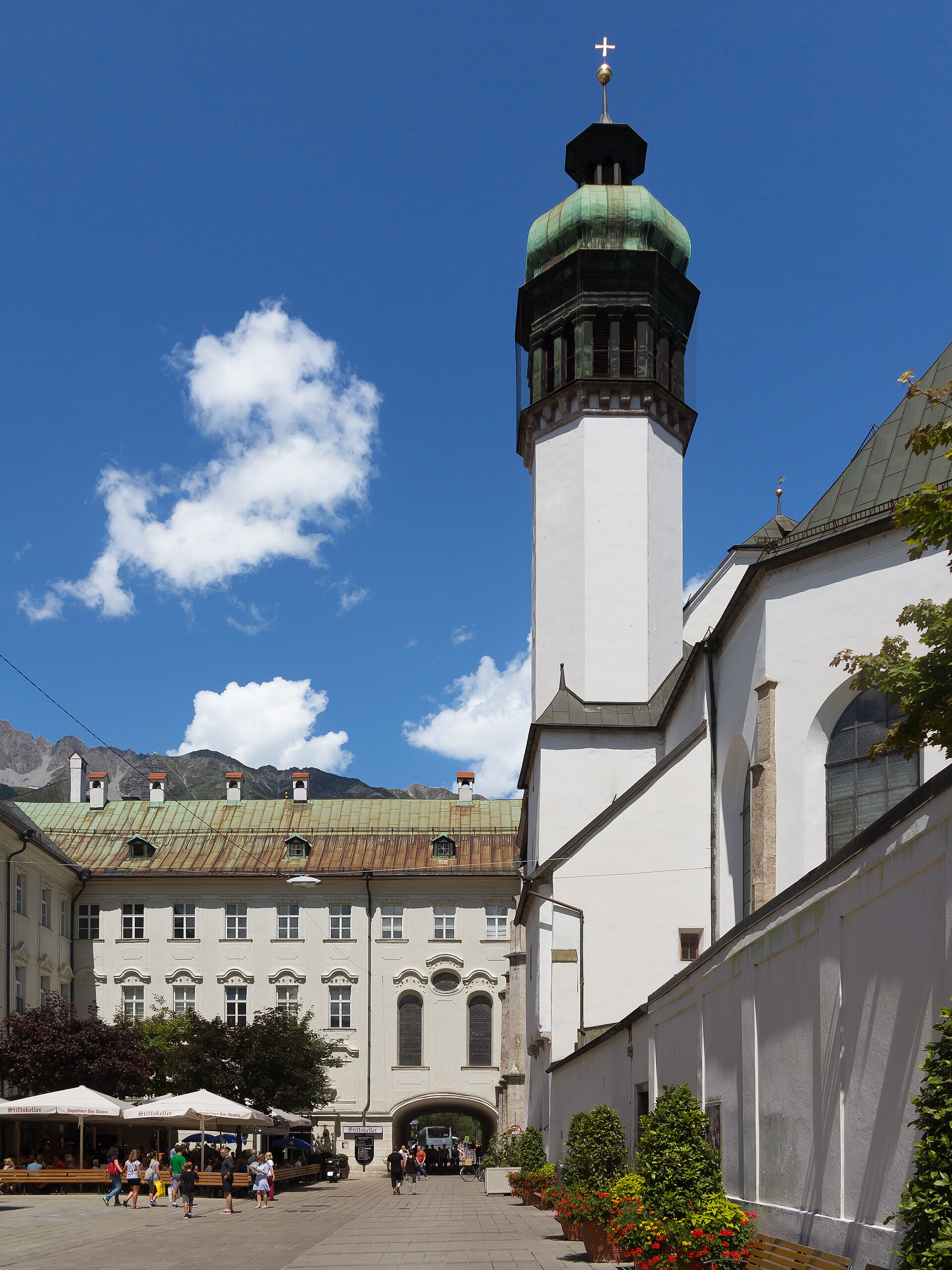
The Hofkirche, or Court Church, is a historic church located in the old town of Innsbruck, Austria. It was commissioned in 1553 by Emperor Ferdinand I to serve as a memorial to his grandfather, Emperor Maximilian I. The church is renowned for its elaborate cenotaph, which stands as a masterpiece of German Renaissance sculpture, surrounded by 28 larger-than-life bronze statues known as the 'Schwarze Mander' (Black Men).
Beyond its imperial significance, the church serves as the final resting place for Andreas Hofer, the Tyrolean national hero who led the rebellion against Napoleonic forces in 1809. The interior architecture blends late Gothic structural elements with Renaissance decorative motifs, reflecting the transition of artistic styles during the 16th century in the Habsburg territories.
Key Facts
- Materials
- Marble, Bronze, Sandstone
- Civilization
- Habsburg Monarchy
- Accessibility
- Ground level accessible, limited access to upper choir
- Date(s)
- 1553-1563
- Condition
- Well-preserved, active religious and museum site
- Original Function
- Imperial memorial church
- Key Figures
- Emperor Maximilian I, Emperor Ferdinand I, Andreas Hofer
Commission and Construction
1553-1563Emperor Ferdinand I ordered the construction of the church to house the cenotaph of Maximilian I, which had been designed decades earlier. The building was constructed by architect Andrea Crivelli to provide a fitting setting for the imperial tomb.
The Imperial Cenotaph
16th CenturyThe centerpiece of the church is the massive cenotaph of Maximilian I. Although the Emperor is buried in Wiener Neustadt, this monument features 28 bronze statues of his ancestors and relatives, representing the height of Renaissance metal casting.
The Hofer Tomb
1823In 1823, the remains of Andreas Hofer, the leader of the Tyrolean uprising against Bavaria and France, were transferred to the Hofkirche. His tomb has since become a site of significant national pilgrimage for the people of Tyrol.
Cultural Significance
The Hofkirche is a primary symbol of Tyrolean identity and Habsburg historical legacy. It bridges the gap between the imperial history of the Holy Roman Empire and the regional patriotic history of Tyrol. The 'Schwarze Mander' statues are considered some of the most important bronze works of the European Renaissance.
Interpretive Notes
Scholarly debates and areas of uncertainty
There is ongoing academic discussion regarding the original intended placement of the 28 bronze statues, as the current arrangement reflects a later configuration rather than the initial design by Maximilian I's court artists.
Visiting Information
Entry Rules
Open daily. Tickets are required for entry to the church and the adjacent Tyrolean Folk Art Museum. Visitors are expected to maintain a quiet demeanor as the site is a place of historical commemoration.
Best Times to Visit
Weekday mornings are generally quieter. The church is less crowded during the shoulder seasons of spring and autumn.
Photography
Personal photography is permitted without flash or tripods. Commercial photography requires prior authorization from the museum administration.
Preservation Notes
The bronze statues are sensitive to environmental conditions; visitors are strictly prohibited from touching the metal surfaces. Restoration of the marble and bronze elements is conducted periodically by the Tyrolean State Museums.
Nearby POIs
3 shownSources & Further Reading
- [1]
- [2]Maximilian I and the Art of the Renaissance — Larry Silver. University of Chicago Press (2008)
Key Facts
- Materials
- Marble, Bronze, Sandstone
- Civilization
- Habsburg Monarchy
- Accessibility
- Ground level accessible, limited access to upper choir
- Date(s)
- 1553-1563
- Condition
- Well-preserved, active religious and museum site
- Original Function
- Imperial memorial church
- Key Figures
- Emperor Maximilian I, Emperor Ferdinand I, Andreas Hofer