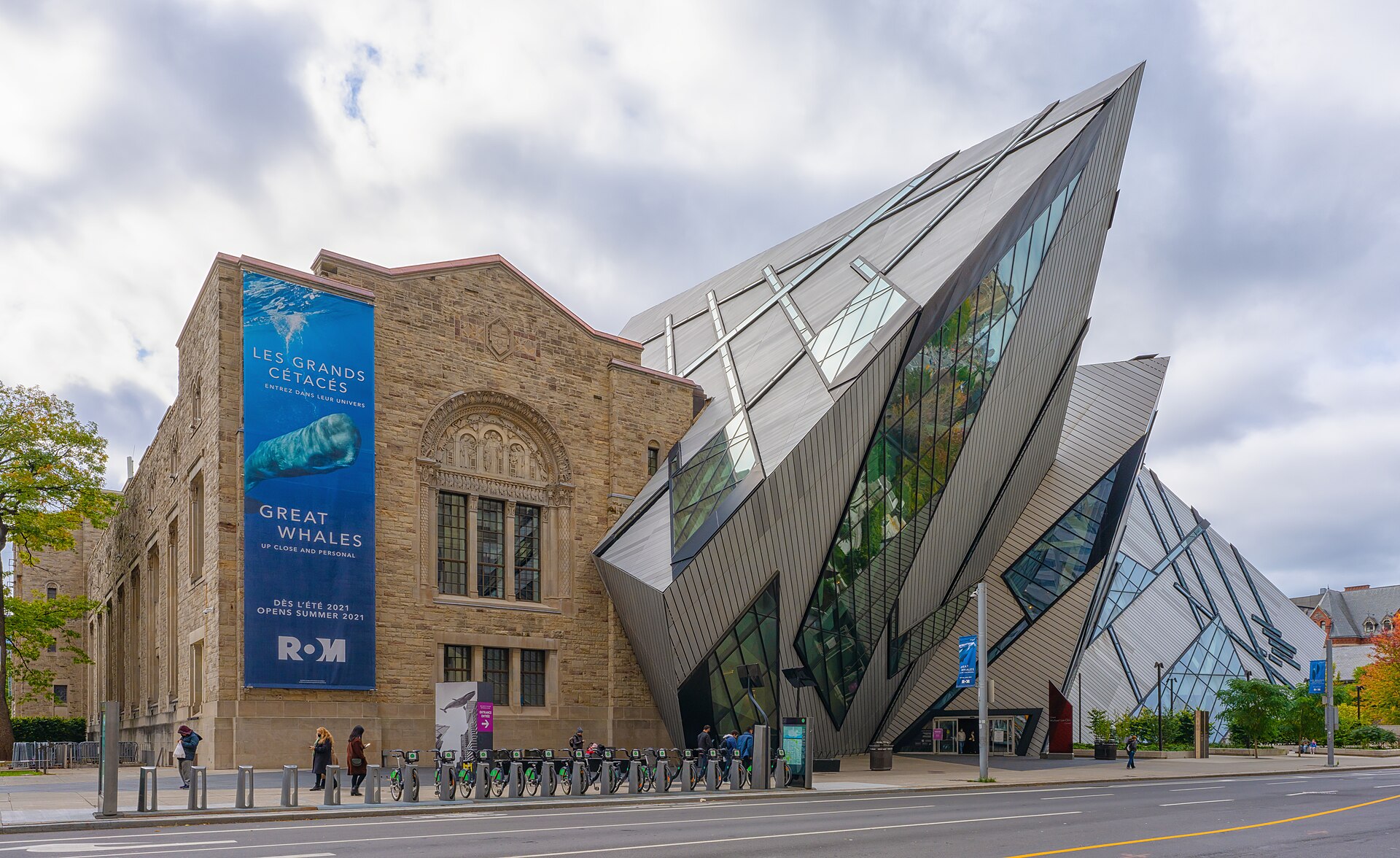
The Royal Ontario Museum (ROM) is the largest museum of world culture and natural history in Canada. Located in Toronto, it serves as a major research institution with extensive collections spanning art, archaeology, and natural sciences. The museum's architecture is a notable blend of historical and contemporary styles, featuring the original 1914 neo-Romanesque building and the 2007 Michael Lee-Chin Crystal addition.
The institution houses over 13 million objects and 40 galleries, ranging from dinosaur fossils and minerals to diverse cultural artifacts from across the globe. It functions as both a public exhibition space and a center for academic research, playing a central role in the cultural life of Ontario and the broader Canadian museum landscape.
Key Facts
- Materials
- Tyndall limestone, Glass, Aluminum, Steel
- Civilization
- Canadian
- Accessibility
- Fully wheelchair accessible
- Date(s)
- 1914 (original building), 2007 (Crystal addition)
- Condition
- Active, fully operational
- Original Function
- Museum of natural history and fine arts
- Key Figures
- Daniel Libeskind, Frank Darling, John A. Pearson
Founding and Early Years
1912-1914The museum was established by the provincial government of Ontario and opened to the public in 1914. It was originally managed by the University of Toronto, reflecting its dual mission of public education and academic research.
Expansion and Independence
1968-1982The museum underwent significant expansion and administrative changes, eventually becoming an independent institution separate from the University of Toronto in 1968. Further renovations in the 1970s and 80s modernized its facilities.
The Crystal Era
2007-PresentThe museum underwent a major transformation with the opening of the Michael Lee-Chin Crystal, designed by architect Daniel Libeskind. This controversial and iconic addition significantly increased exhibition space and redefined the museum's presence in downtown Toronto.
Cultural Significance
The Royal Ontario Museum is a cornerstone of Canadian cultural heritage, acting as a repository for both global history and local natural science. It serves as a primary educational resource for the public and a hub for international scholarly collaboration.
The museum's architecture, particularly the juxtaposition of the historic stone facade with the sharp, angular glass of the Crystal, has become a symbol of Toronto's urban evolution and its willingness to embrace bold, contemporary design within a traditional civic context.
Interpretive Notes
Scholarly debates and areas of uncertainty
The 2007 expansion sparked significant architectural debate regarding the integration of modern, deconstructivist design with heritage structures. Critics and proponents continue to discuss the impact of the 'Crystal' on the museum's internal flow and its relationship with the surrounding urban environment.
Visiting Information
Entry Rules
Open daily. Tickets can be purchased online or at the door. Members receive free admission. Visitors are encouraged to check the official website for current exhibition schedules and holiday hours.
Best Times to Visit
Weekday mornings are generally quieter. The museum is busiest during school holidays and weekends.
Photography
Personal photography is permitted for non-commercial use. Flash and tripods are prohibited in most galleries. Specific temporary exhibitions may have restricted photography policies.
Preservation Notes
Do not touch artifacts or display cases. Food and drink are restricted to designated areas. Large bags must be checked at the coat check.
Nearby POIs
5 shownSources & Further Reading
- [1]The Royal Ontario Museum: An Architectural History — John R. English. University of Toronto Press (2014)
- [2]
Key Facts
- Materials
- Tyndall limestone, Glass, Aluminum, Steel
- Civilization
- Canadian
- Accessibility
- Fully wheelchair accessible
- Date(s)
- 1914 (original building), 2007 (Crystal addition)
- Condition
- Active, fully operational
- Original Function
- Museum of natural history and fine arts
- Key Figures
- Daniel Libeskind, Frank Darling, John A. Pearson