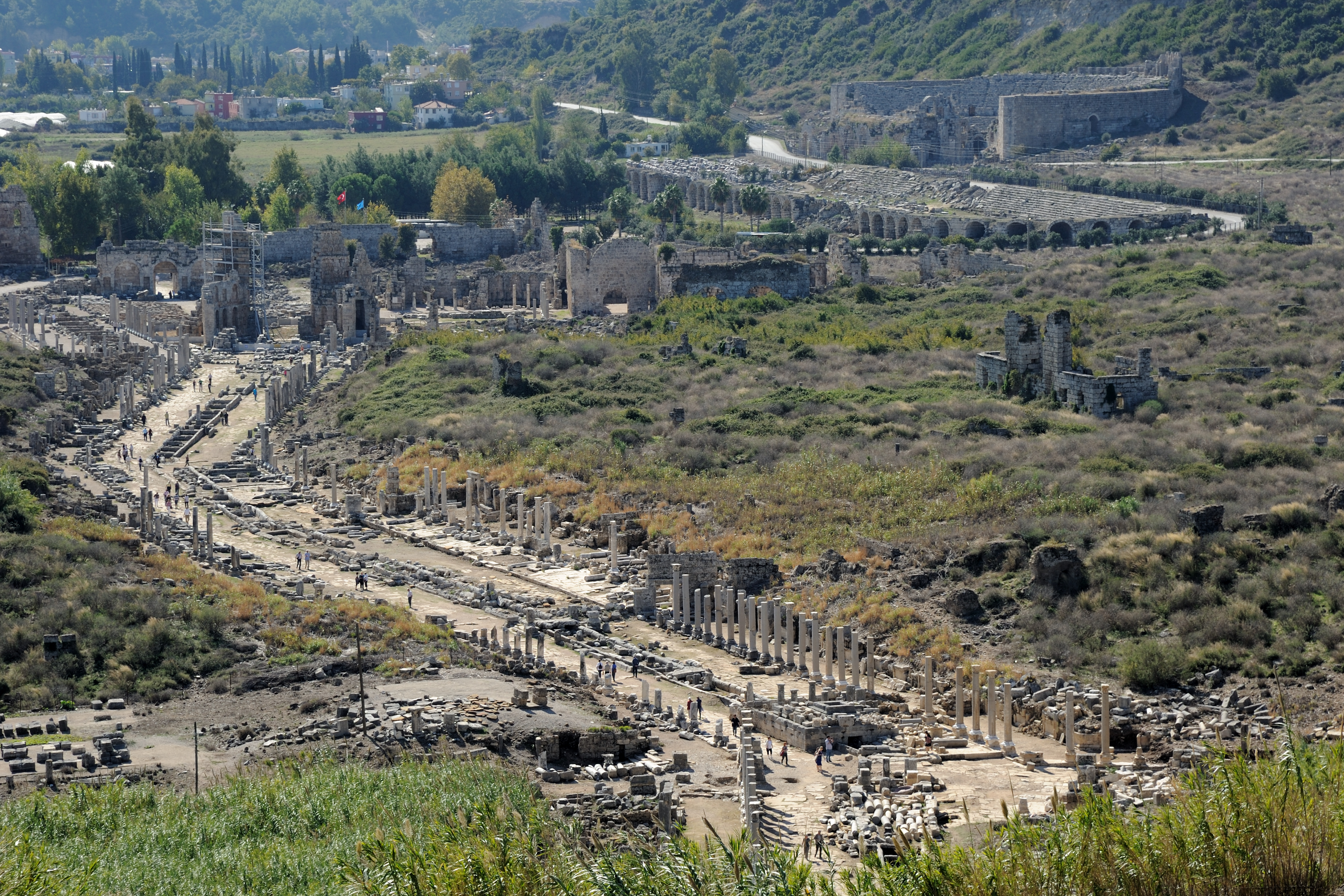
Perga was an ancient Greek city in Anatolia and the capital of Pamphylia. Situated on the coastal plain between the Catarrhactes and Cestrus rivers, the city rose to prominence during the Hellenistic period and flourished under Roman rule. It is noted for its well-preserved urban layout, including a grand colonnaded street, a monumental gate, and extensive public infrastructure.
The site is particularly significant for its architectural remains, which demonstrate the transition from Hellenistic fortification styles to the monumental civic planning characteristic of the Roman Empire. Excavations have revealed a large theater, a stadium capable of seating 12,000 spectators, and a nymphaeum, all of which reflect the city's former status as a major cultural and economic hub in the Mediterranean region.
Key Facts
- Materials
- Limestone, Marble
- Civilization
- Greek, Roman
- Accessibility
- Partially accessible; uneven terrain
- Date(s)
- 1000 BCE - 600 CE
- Condition
- Extensive archaeological ruins
- Original Function
- City-state and administrative capital
- Key Figures
- Apollonius of Perga, Saint Paul the Apostle
Foundation and Hellenistic Era
1000 BCE - 133 BCEFounded according to legend by Greek colonists after the Trojan War, Perga grew into a significant city-state. It became a center of learning, most notably as the birthplace of the mathematician Apollonius of Perga.
Roman Prosperity
133 BCE - 395 CEUnder Roman administration, the city underwent a massive building program. The monumental gate, the colonnaded street with its central water channel, and the theater were constructed during this period of peak economic growth.
Christianity and Decline
4th century - 7th century CEPerga became an important center for early Christianity, visited by Saint Paul during his first missionary journey. The city remained active through the Byzantine period but gradually declined due to silting of the river and Arab raids.
Cultural Significance
Perga served as a vital bridge between Greek intellectual traditions and Roman civic engineering. Its history is deeply intertwined with the spread of Christianity in Asia Minor, serving as a key stop for early apostles. Today, it remains a primary site for studying the urban development of Pamphylian cities.
Interpretive Notes
Scholarly debates and areas of uncertainty
The exact extent of the city's influence on the surrounding Pamphylian region during the Hellenistic period remains a subject of ongoing archaeological investigation, particularly regarding the degree of autonomy held by local rulers versus central Greek authorities.
Visiting Information
Entry Rules
Open daily. Ticket required for entry. Visitors should follow marked paths and respect all cordoned-off excavation areas.
Best Times to Visit
Spring and autumn are ideal to avoid the extreme heat of the Antalya summer. Early morning visits are recommended to explore the expansive site comfortably.
Photography
Personal photography is permitted. Commercial photography requires prior authorization from the local museum directorate.
Nearby POIs
8 shownSources & Further Reading
- [1]The Cities of Pamphylia — George E. Bean. Ernest Benn Ltd (1968)
- [2]Perge: A History of the City — Hüseyin Sabri Alanyalı. Archaeology and Art Publications (2010)
Key Facts
- Materials
- Limestone, Marble
- Civilization
- Greek, Roman
- Accessibility
- Partially accessible; uneven terrain