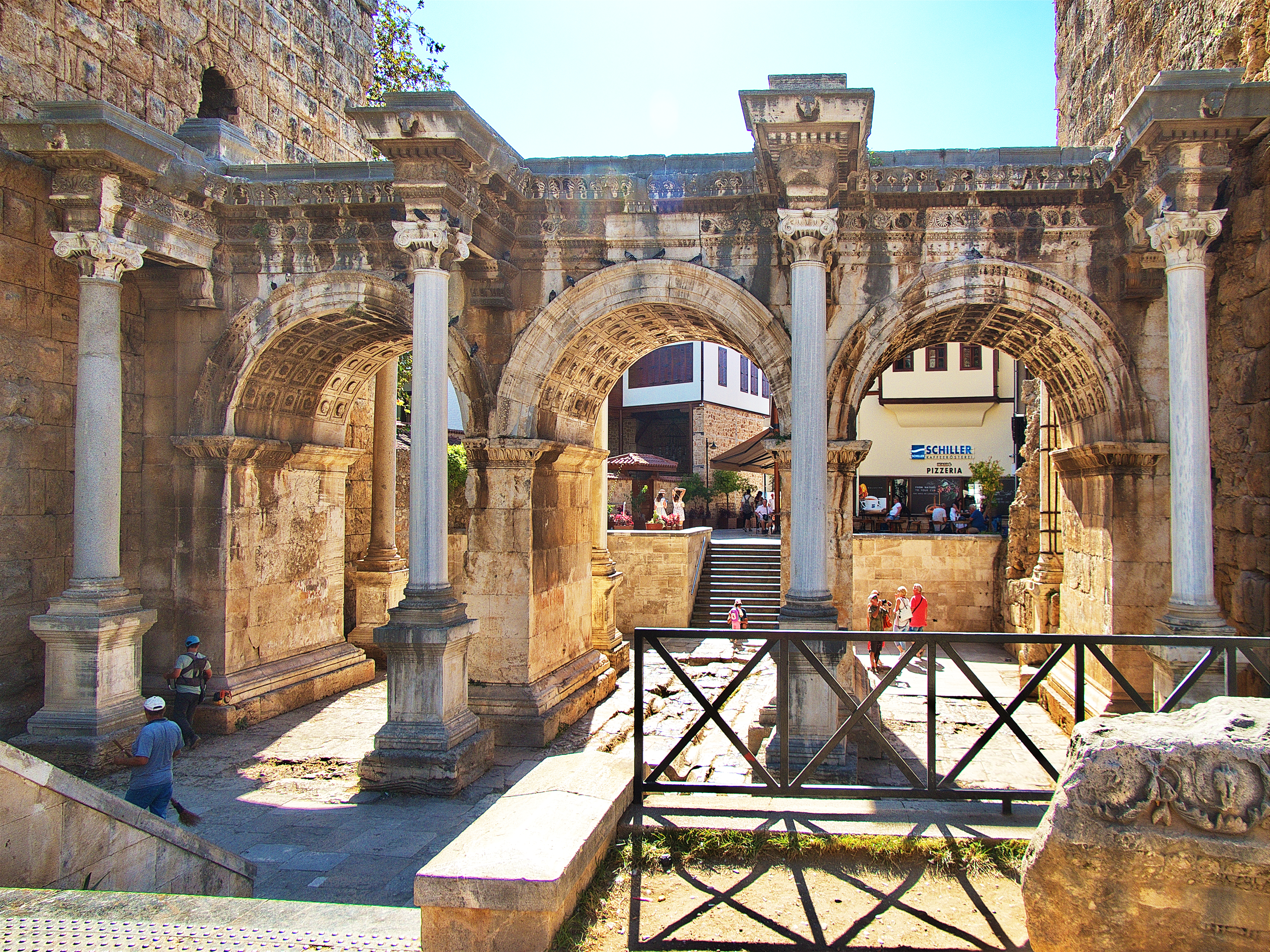
Hadrian's Gate, also known as Üçkapılar (The Three Gates), is a monumental triumphal arch located in Antalya, Turkey. Constructed in 130 CE to commemorate the visit of Roman Emperor Hadrian to the city, the structure served as the primary entrance to the ancient city of Attaleia. It is built entirely of white marble, with the exception of its columns, which are made of granite.
The gate features three arched openings of equal size, flanked by two towers that were once part of the city's defensive walls. The structure is noted for its elaborate decorative program, including intricate floral carvings on the soffits and a series of friezes. While the upper story of the gate is no longer extant, the lower portion remains remarkably well-preserved, having been protected for centuries by the city walls that were built around it.
Key Facts
- Materials
- White marble, Granite
- Civilization
- Roman
- Accessibility
- Ground level access, pedestrianized area
- Date(s)
- 130 CE
- Condition
- Well-preserved, integrated into modern urban fabric
- Original Function
- Triumphal arch and city gate
- Key Figures
- Emperor Hadrian
Construction and Purpose
130 CEThe gate was commissioned to honor the visit of Emperor Hadrian to Attaleia. It functioned as a ceremonial entrance, demonstrating the city's loyalty to the Roman Empire and the Emperor's divine status.
Integration into City Walls
3rd - 13th centuryFor much of its history, the gate was largely obscured by the surrounding city walls. This isolation from the elements and lack of use as a primary thoroughfare during the Byzantine and Seljuk periods contributed significantly to its preservation.
Modern Restoration
20th centuryFollowing the removal of the surrounding walls in the 20th century, the gate was fully exposed and restored. It now serves as the main pedestrian entrance to Kaleiçi, the historic old town of Antalya.
Cultural Significance
Hadrian's Gate stands as the most significant Roman architectural remnant in Antalya. It symbolizes the historical integration of the region into the Roman Empire and serves as a physical bridge between the ancient city of Attaleia and the modern urban center of Antalya.
Locally, the gate is a central landmark for the Kaleiçi district. It is frequently used as a meeting point and a focal point for tourism, representing the city's layered history and its transition from a Roman port to a modern Mediterranean hub.
Interpretive Notes
Scholarly debates and areas of uncertainty
There is ongoing academic discussion regarding the original height and appearance of the gate's upper story. While some scholars suggest it may have featured statues of the imperial family, the lack of definitive archaeological evidence leaves the exact configuration of the second level a subject of conjecture.
Visiting Information
Entry Rules
The site is located in a public pedestrian area and is accessible 24 hours a day. There is no entry fee.
Best Times to Visit
Early morning or late evening to avoid the high foot traffic of the Kaleiçi district and to view the architectural details in softer light.
Photography
None. The site is in a public space.
Nearby POIs
8 shownSources & Further Reading
- [1]The Roman Architecture of Asia Minor — George E. Bean. Ernest Benn Ltd (1968)
- [2]Antalya: The History of a Mediterranean City — Suna İnan Kıraç. Koç University Press (2015)
Key Facts
- Materials
- White marble, Granite
- Civilization
- Roman
- Accessibility
- Ground level access, pedestrianized area