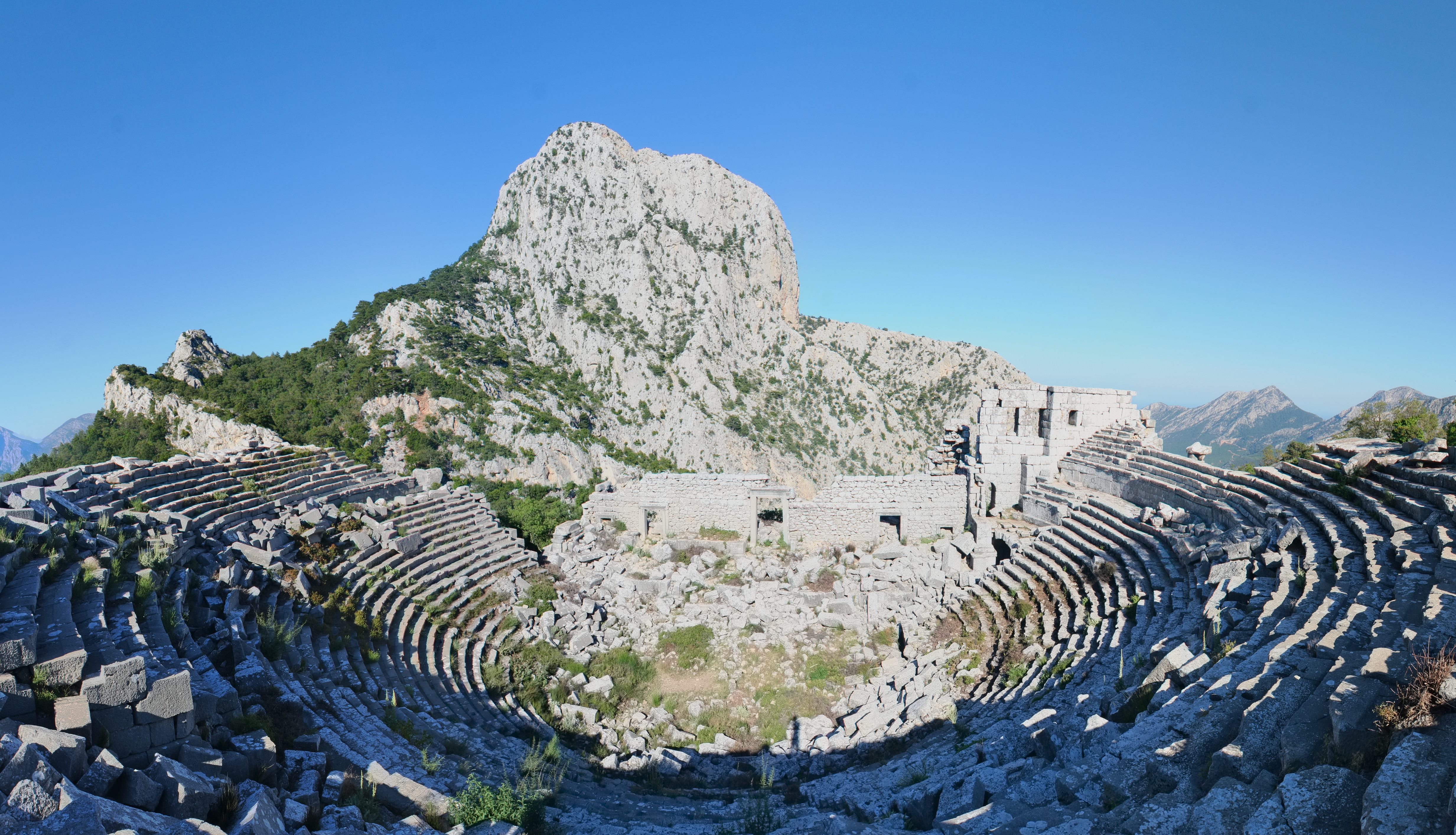
Termessos is an ancient Pisidian city located in the Taurus Mountains of Antalya, Turkey, at an elevation of over 1,000 meters. Known as one of the best-preserved ancient cities in the region, it is uniquely situated within the Güllük Dağı-Termessos National Park, which protects both its archaeological remains and the surrounding rugged mountain ecosystem.
The city is historically renowned for its strategic defensive position and its successful resistance against Alexander the Great in 333 BCE, who famously described the city as an 'eagle's nest' that was impossible to capture. The site features a well-preserved theater, a colonnaded street, and an extensive necropolis with rock-cut tombs, reflecting a blend of Hellenistic and Roman architectural influences.
Key Facts
- Materials
- Limestone, Local mountain stone
- Civilization
- Pisidian
- Accessibility
- Requires hiking on uneven mountain terrain
- Date(s)
- 6th century BCE - 3rd century CE
- Condition
- Well-preserved ruins in a natural park setting
- Original Function
- Fortified city and mountain stronghold
- Key Figures
- Alexander the Great
Founding and Early History
6th century BCETermessos was established by the Solymians, a people of Pisidian origin. Its remote mountain location provided natural defenses that allowed the city to maintain significant autonomy throughout its history.
Resistance to Alexander the Great
333 BCEDuring his campaign in Asia Minor, Alexander the Great attempted to besiege Termessos. The city's formidable natural defenses and the tactical skill of its inhabitants forced Alexander to abandon the siege, a rare failure in his military career.
Roman Integration
1st century BCE - 3rd century CEThe city eventually entered into a formal alliance with Rome, which granted it a degree of independence and the right to self-governance. During this period, the city underwent significant architectural expansion, including the construction of its theater and public buildings.
Abandonment
5th century CEThe city was gradually abandoned, likely due to a combination of seismic activity, water supply issues, and the shifting economic focus of the region toward coastal settlements.
Cultural Significance
Termessos serves as a symbol of Pisidian resilience and independence. Its unique location in a national park highlights the intersection of cultural heritage and biodiversity, making it a significant site for both historical study and environmental conservation in the Antalya region.
Interpretive Notes
Scholarly debates and areas of uncertainty
The exact linguistic origins of the Solymians and their relationship to other Anatolian peoples remain a subject of academic discussion. Additionally, the precise mechanisms of the city's water management systems in such a high-altitude, arid environment continue to be studied by archaeologists.
Visiting Information
Entry Rules
The site is located within a National Park; an entrance fee is required at the park gate. The ruins are spread across rugged terrain and require significant walking. No facilities are available within the archaeological zone.
Best Times to Visit
Spring (April-May) and Autumn (September-October) offer the most temperate weather for hiking the site. Avoid summer afternoons due to extreme heat and lack of shade.
Photography
Personal photography is permitted. Commercial photography requires prior authorization from the Turkish Ministry of Culture and Tourism.
Nearby POIs
7 shownSources & Further Reading
- [1]Termessos: The Eagle's Nest — George E. Bean. Turkey's Southern Shore (1968)
- [2]The Pisidian City of Termessos — S. Mitchell. Journal of Roman Studies (1991)
Key Facts
- Materials
- Limestone, Local mountain stone
- Civilization
- Pisidian
- Accessibility
- Requires hiking on uneven mountain terrain