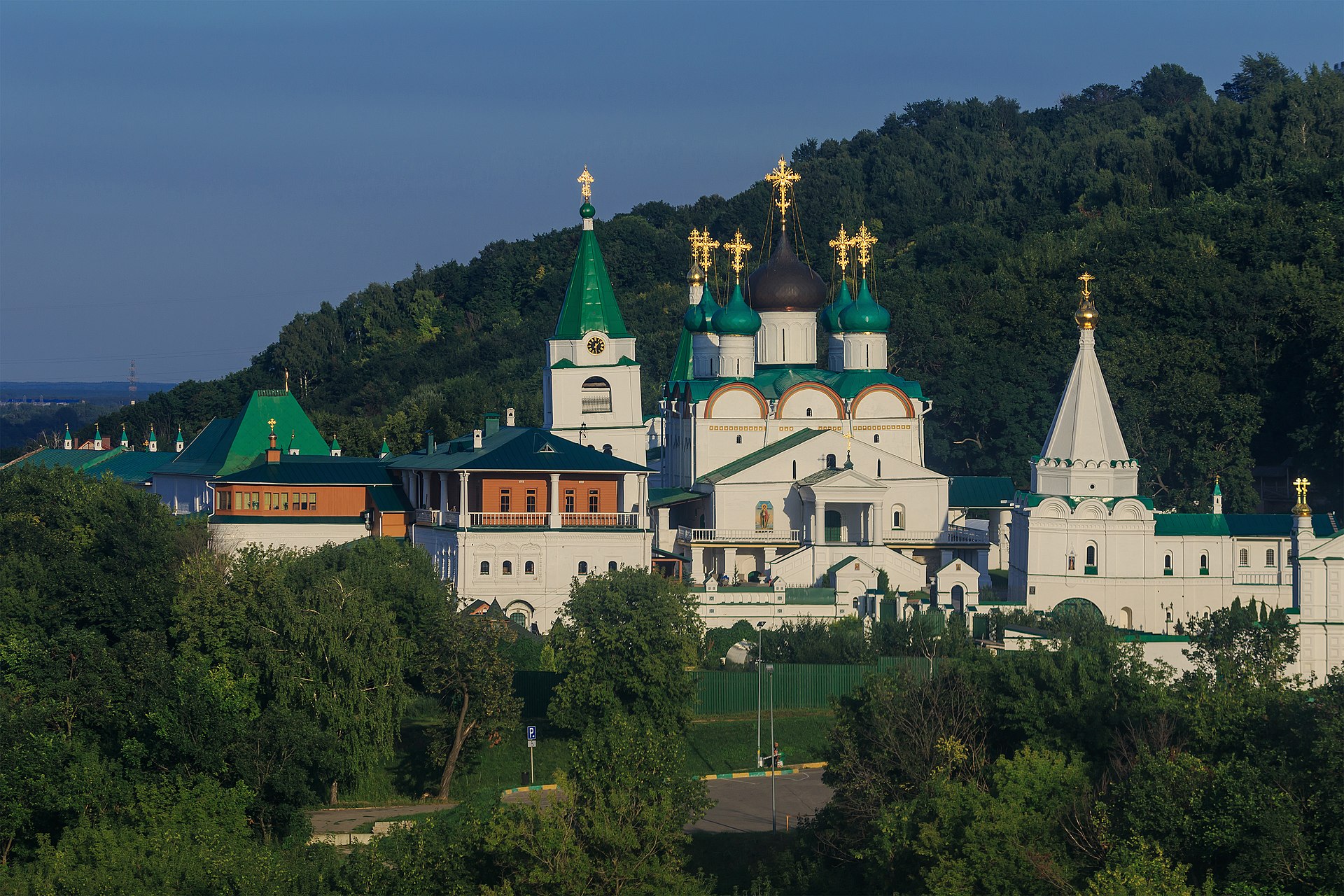
Pechersky Ascension Monastery
The Pechersky Ascension Monastery, located on the banks of the Volga River in Nizhny Novgorod, was founded in 1328 by Saint Dionysius of Suzdal. Historically serving as a major spiritual and cultural center for the region, the monastery has undergone several relocations and reconstructions, most notably following a devastating landslide in 1597 that destroyed the original medieval structures.
The current architectural ensemble dates primarily to the 17th century, featuring the distinctive Ascension Cathedral and several smaller churches characterized by traditional Russian ecclesiastical styles. As the principal monastery of the Nizhny Novgorod Eparchy, it remains an active religious site, housing a significant collection of icons and historical artifacts within its museum.
Key Facts
- Materials
- Brick, White stone, Limestone
- Civilization
- Russian
- Accessibility
- Grounds are accessible; some church interiors have steps
- Date(s)
- 1630-1648
- Condition
- Active, well-preserved
- Original Function
- Orthodox Monastery
- Key Figures
- Saint Dionysius of Suzdal, Patriarch Nikon
Founding and Early Years
1328The monastery was established by Saint Dionysius of Suzdal, who arrived from the Kiev Pechersk Lavra. It quickly became a center for monastic life and manuscript copying in the Nizhny Novgorod region.
The Great Landslide
1597A massive landslide destroyed the original monastery buildings located on the steep riverbank. The community was forced to relocate to a safer site further upstream, where the current complex was eventually constructed.
17th Century Reconstruction
1630-1648Under the direction of the monk Anthony and with the support of the Tsar, the new stone ensemble was built. This period defined the current architectural layout, including the Ascension Cathedral.
Soviet Era and Restoration
20th CenturyThe monastery was closed by Soviet authorities in the 1920s and repurposed for secular use. Systematic restoration of the site began in the 1960s, and it was returned to the Russian Orthodox Church in 1994.
Cultural Significance
The Pechersky Ascension Monastery is a cornerstone of Nizhny Novgorod's religious identity. It serves as a living repository of Russian Orthodox history, maintaining traditions of monastic life that have persisted for nearly seven centuries despite political and environmental challenges.
Interpretive Notes
Scholarly debates and areas of uncertainty
There is ongoing academic discussion regarding the exact architectural influence of the 17th-century builders, specifically the extent to which they incorporated elements from the Moscow school versus local Nizhny Novgorod traditions.
Visiting Information
Entry Rules
Open daily. Free entry to the grounds and cathedral. Visitors are expected to dress modestly; women should cover their heads and men should remove hats when entering church buildings.
Best Times to Visit
Late spring and early autumn offer the best weather for walking the monastery grounds and viewing the Volga River. Avoid major religious holidays if seeking a quiet atmosphere.
Photography
Photography is permitted in the courtyard. Inside the churches, photography is generally prohibited or requires prior permission from the monastery office.
Preservation Notes
The monastery is situated on a geologically active slope; visitors should stay on marked paths and respect all safety barriers near the riverbank.
Nearby POIs
3 shownSources & Further Reading
- [1]History of the Nizhny Novgorod Eparchy — A. V. Morozov. Nizhny Novgorod University Press (2015)
- [2]Monasteries of the Volga Region — Elena Ivanova. Russian Heritage Journal (2019)
Key Facts
- Materials
- Brick, White stone, Limestone
- Civilization
- Russian
- Accessibility
- Grounds are accessible; some church interiors have steps
- Date(s)
- 1630-1648
- Condition
- Active, well-preserved
- Original Function
- Orthodox Monastery
- Key Figures
- Saint Dionysius of Suzdal, Patriarch Nikon