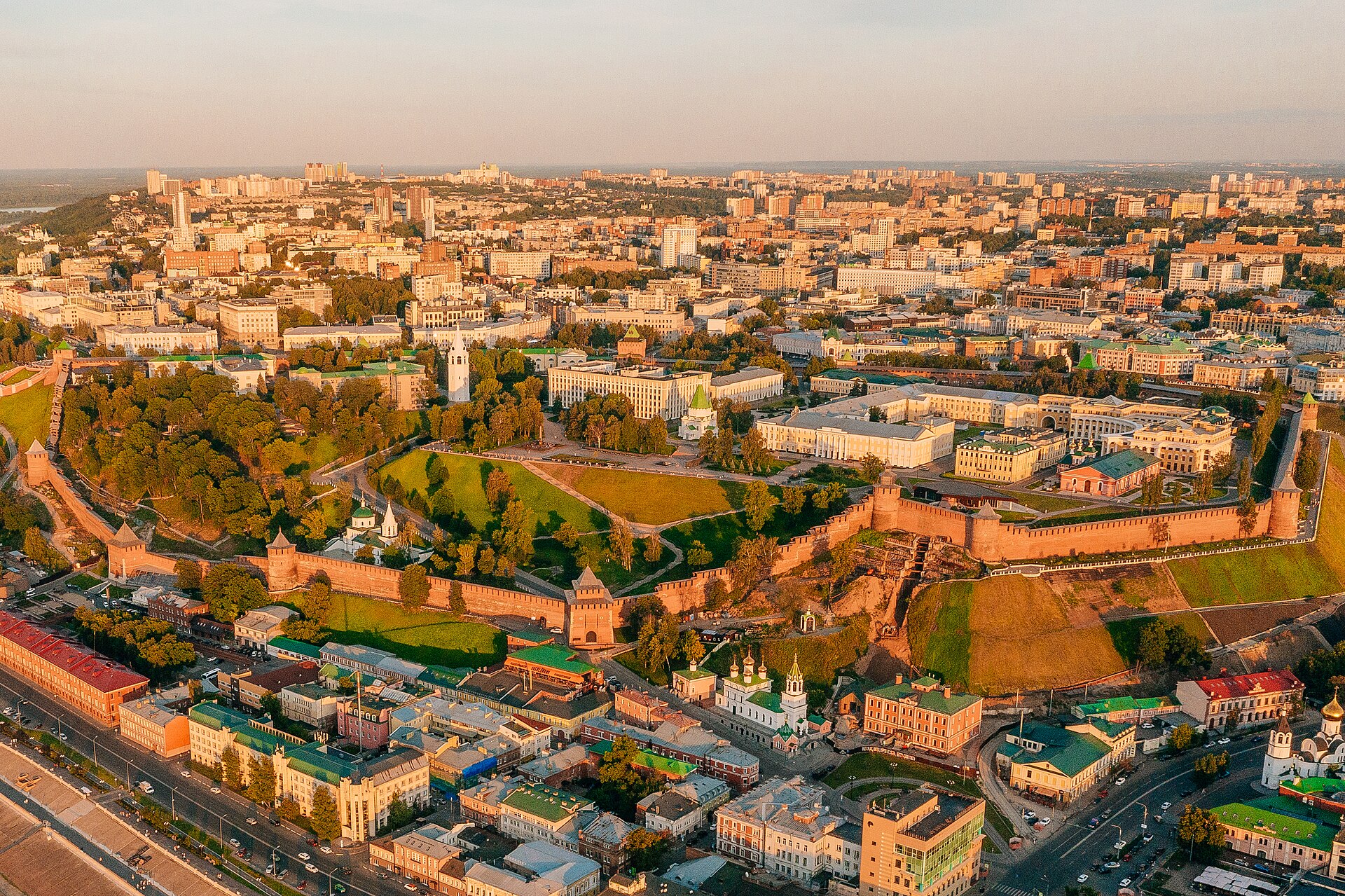
The Nizhny Novgorod Kremlin is a historic stone fortress located at the confluence of the Volga and Oka rivers. Originally constructed in the early 16th century to defend the Grand Duchy of Moscow against the Khanate of Kazan, the citadel features a two-kilometer-long defensive wall punctuated by thirteen distinct towers. Its strategic position on the high bank of the Volga made it a vital military outpost during the expansion of the Russian state.
Today, the Kremlin serves as the administrative center of the Nizhny Novgorod region. Within its walls, the site preserves significant landmarks including the Archangel Michael Cathedral, which houses the remains of Kuzma Minin, and various government buildings. The complex remains a central public space, blending its military heritage with its contemporary role in regional governance and cultural life.
Key Facts
- Materials
- Red brick, Limestone
- Civilization
- Grand Duchy of Moscow
- Accessibility
- Partially accessible; some ramparts and towers require stairs
- Date(s)
- 1500-1515
- Condition
- Well-preserved and active administrative site
- Original Function
- Military fortress and administrative center
- Key Figures
- Vasili III, Pietro Francesco, Kuzma Minin
Foundations and Construction
1500-1515Following the destruction of earlier wooden fortifications, Grand Prince Vasili III ordered the construction of a stone citadel. The project was overseen by the Italian architect Pietro Francesco, who utilized advanced European fortification techniques to create a formidable defensive line.
Military Significance
16th-17th centuryThe Kremlin successfully withstood several sieges by the Khanate of Kazan. Following the annexation of Kazan by Ivan the Terrible, the fortress lost its primary military function as the Russian border moved eastward, though it remained a key regional administrative hub.
Modern Restoration and Use
20th century - presentExtensive restoration efforts were conducted throughout the 20th century to stabilize the walls and towers. In 2021, the site underwent a major renovation to mark the 800th anniversary of the city, including the restoration of the full wall circuit for pedestrian access.
Cultural Significance
The Nizhny Novgorod Kremlin is a symbol of Russian statehood and the unification of the Russian lands. It is inextricably linked to the events of 1612, when the volunteer army led by Kuzma Minin and Prince Dmitry Pozharsky gathered here to liberate Moscow from Polish-Lithuanian forces during the Time of Troubles.
Beyond its historical military role, the site is a focal point for local identity. The Archangel Michael Cathedral serves as a memorial to the city's history, and the Kremlin grounds are frequently used for state ceremonies, public exhibitions, and civic gatherings.
Interpretive Notes
Scholarly debates and areas of uncertainty
There is ongoing academic discussion regarding the extent of Italian influence on the architectural design of the towers. While the layout follows traditional Russian defensive principles, the specific masonry techniques and vaulting styles suggest a significant synthesis of Italian Renaissance engineering and local building traditions.
Visiting Information
Entry Rules
The Kremlin grounds are open daily to the public. Access to the wall circuit and specific museums requires a ticket. Security checkpoints are located at the main entrances; visitors are subject to inspection.
Best Times to Visit
Late spring and early autumn offer the best weather for walking the two-kilometer wall circuit. Weekdays are recommended to avoid heavy weekend crowds.
Photography
Personal photography is permitted throughout the grounds. Professional photography or filming for commercial purposes requires prior authorization from the administration.
Preservation Notes
Visitors are requested to stay on designated paths and refrain from climbing on the historic brickwork. Restoration work is ongoing in various sections; please respect all safety barriers.
Nearby POIs
3 shownSources & Further Reading
- [1]The Nizhny Novgorod Kremlin: History and Architecture — N. V. Filatov. Volgo-Vyatskoye Publishing (1994)
- [2]Russian Fortifications of the 16th Century — A. V. Kuzmin. Moscow State University Press (2008)
Key Facts
- Materials
- Red brick, Limestone
- Civilization
- Grand Duchy of Moscow
- Accessibility
- Partially accessible; some ramparts and towers require stairs
- Date(s)
- 1500-1515
- Condition
- Well-preserved and active administrative site
- Original Function
- Military fortress and administrative center
- Key Figures
- Vasili III, Pietro Francesco, Kuzma Minin