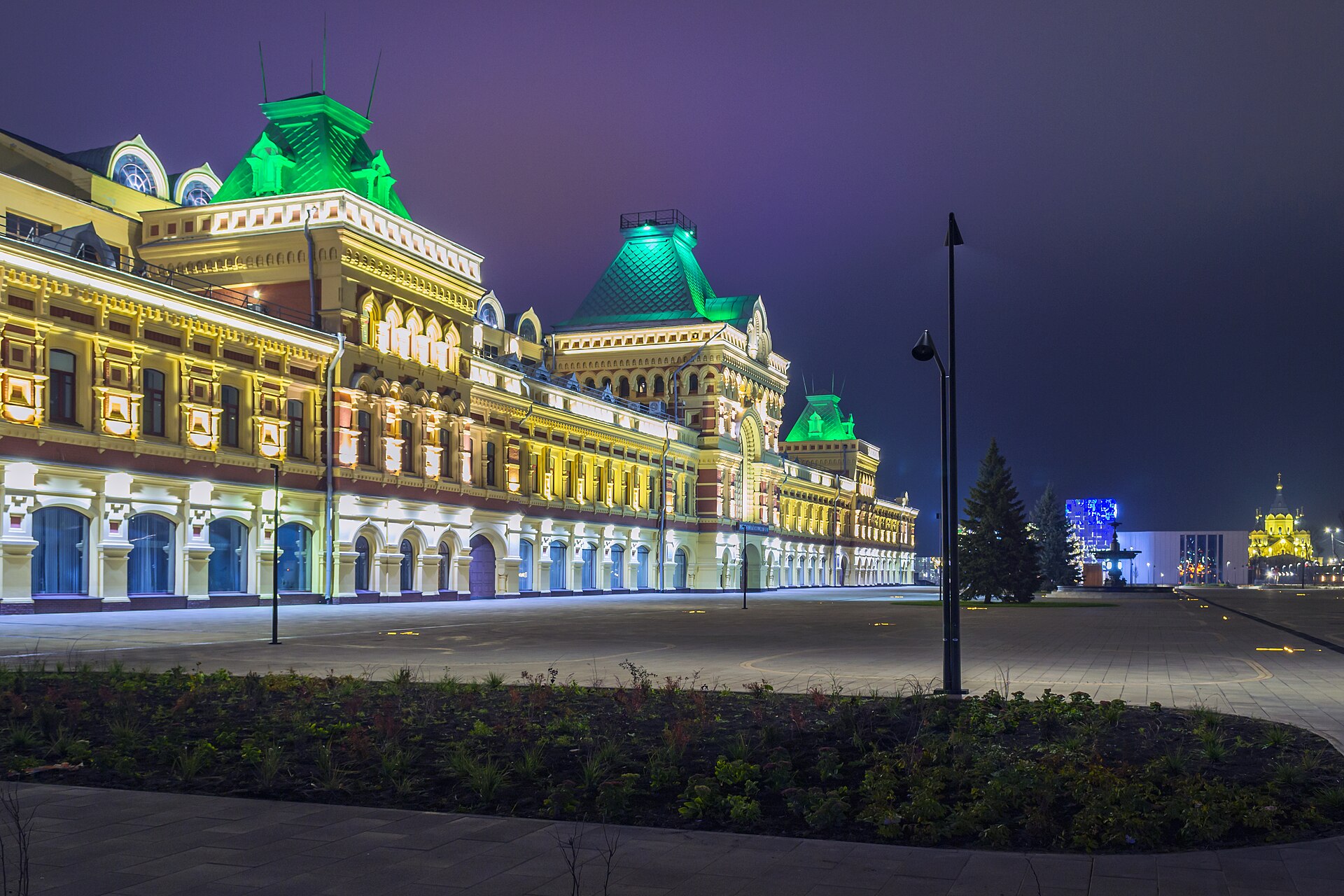
The Nizhny Novgorod Fair was one of the most significant commercial hubs in the Russian Empire during the 19th and early 20th centuries. Located at the confluence of the Volga and Oka rivers, the site served as a vital bridge between European and Asian trade, hosting merchants from across the globe to exchange goods ranging from tea and silk to iron and furs.
The current complex features the historic Main Fair House, designed by architects August Weber and Lev Dahl in a Neo-Russian style. Following its decline after the 1917 Revolution and subsequent restoration in the 1990s, the site now functions as a modern exhibition center and museum, preserving the legacy of the region's commercial history and its deep roots dating back to the indigenous Finnic peoples of the Volga region.
Key Facts
- Materials
- Brick, Stone, Metal
- Civilization
- Russian
- Accessibility
- Wheelchair accessible
- Date(s)
- 1817-1822 (original), 1890-1896 (Main Fair House)
- Condition
- Restored and active exhibition center
- Original Function
- International trade fair and commercial exchange
- Key Figures
- August Weber, Lev Dahl, Alexander II
Establishment and Growth
1817-1822Following a fire at the Makaryev Fair, the Russian government relocated the event to Nizhny Novgorod. The site was developed with a massive infrastructure project, including canals and stone buildings, to accommodate the growing volume of international trade.
The Golden Age
19th CenturyThe fair became the economic heart of Russia, earning the title 'The Pocket of Russia.' It facilitated the exchange of goods between the industrializing West and the resource-rich East, peaking in importance during the late 1800s.
Soviet Era and Decline
1917-1990After the Russian Revolution, the fair was liquidated as private trade was suppressed. The site was repurposed for various administrative and residential uses, leading to a period of architectural neglect.
Modern Restoration
1991-PresentFollowing the dissolution of the Soviet Union, the Main Fair House was restored to its former glory. It reopened as a major exhibition and cultural center, once again serving as a venue for international economic forums and historical exhibitions.
Cultural Significance
The Nizhny Novgorod Fair is a symbol of Russia's historical role as a Eurasian trade power. It fostered a unique cosmopolitan atmosphere where diverse cultures, including Tatar, Persian, and European merchants, interacted, significantly influencing the social and economic development of the Volga region.
Today, the site serves as a cultural anchor for Nizhny Novgorod, bridging the gap between its ancient history as a territory of Finnic tribes and its modern identity as a center for industry and commerce.
Interpretive Notes
Scholarly debates and areas of uncertainty
Debates persist regarding the extent to which the fair's infrastructure contributed to the environmental degradation of the Oka riverbank during the 19th century, as well as the degree to which the 1990s restoration prioritized aesthetic appeal over the preservation of original interior structural integrity.
Visiting Information
Entry Rules
The grounds are open to the public. Exhibition halls have varying hours depending on current events. Admission fees apply for specific museum exhibitions and trade shows.
Best Times to Visit
Late spring and early autumn offer the best weather for walking the grounds. The site is particularly significant during the annual Nizhny Novgorod City Day celebrations in August.
Photography
Personal photography is permitted in public areas. Professional photography or filming inside the exhibition halls may require prior authorization from the administration.
Preservation Notes
The Main Fair House is a protected cultural heritage site. Visitors are requested to respect the historic architecture and refrain from touching displays in the museum sections.
Nearby POIs
3 shownSources & Further Reading
- [1]The Nizhny Novgorod Fair: A History of Trade — S. V. Morozov. Nizhny Novgorod University Press (2010)
- [2]Russian Trade and the Volga River — Elena Ivanova. Journal of Imperial Economic History (2015)
Key Facts
- Materials
- Brick, Stone, Metal
- Civilization
- Russian
- Accessibility
- Wheelchair accessible
- Date(s)
- 1817-1822 (original), 1890-1896 (Main Fair House)
- Condition
- Restored and active exhibition center
- Original Function
- International trade fair and commercial exchange
- Key Figures
- August Weber, Lev Dahl, Alexander II