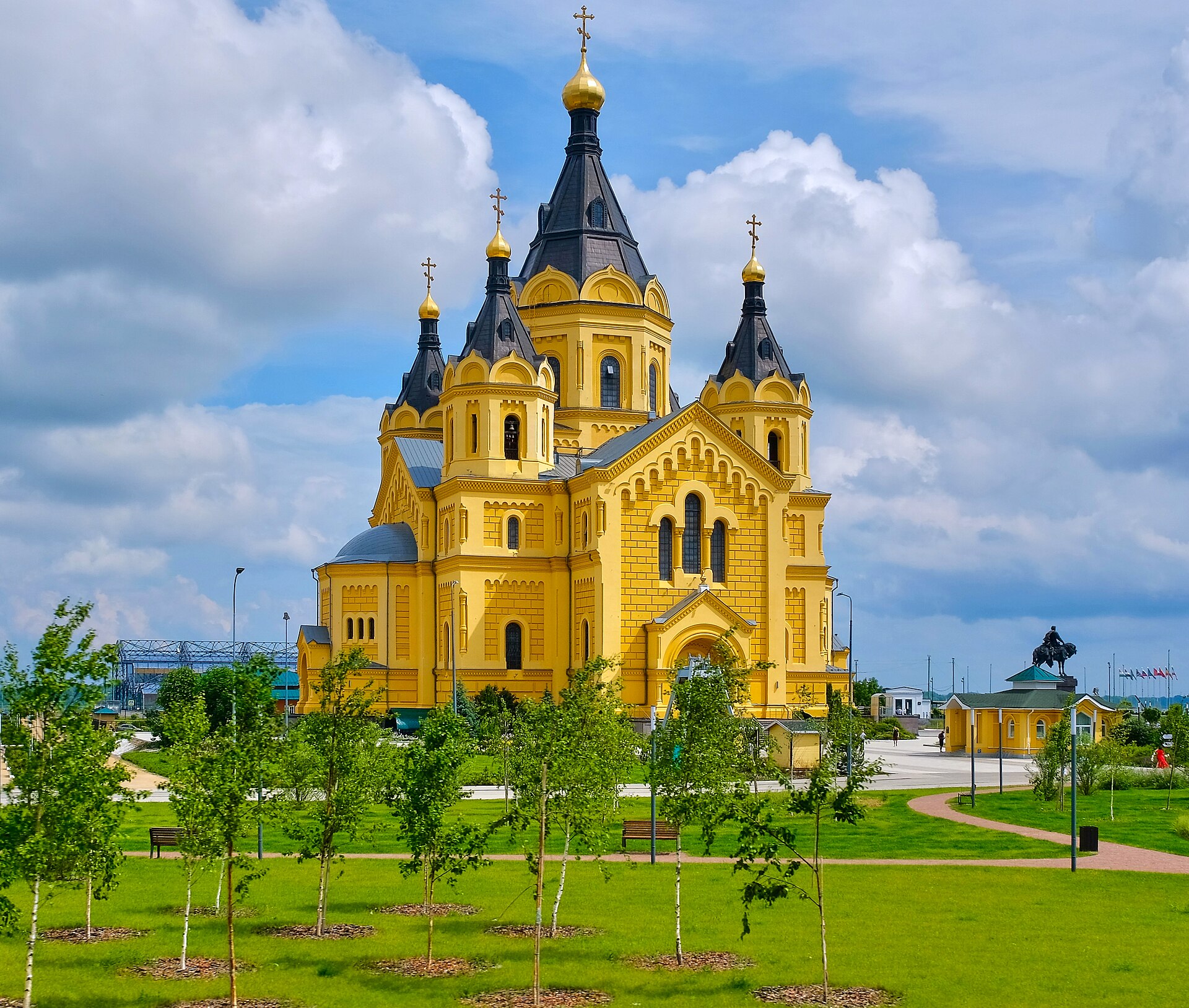
Cathedral of Saint Alexander Nevsky
The Cathedral of Saint Alexander Nevsky in Nizhny Novgorod is a prominent Russian Orthodox church situated at the confluence of the Volga and Oka rivers. Constructed between 1868 and 1881, the cathedral was designed by architect Robert Kilewein in a neo-Byzantine style, characterized by its massive central dome and four smaller corner towers. It was built to commemorate the visit of Emperor Alexander II to the city and to serve as a spiritual center for the merchants of the nearby Nizhny Novgorod Fair.
Following the Russian Revolution, the cathedral was closed by Soviet authorities in 1929 and repurposed for various secular functions, including a warehouse and housing. The building suffered significant interior damage during this period. Restoration efforts began in the late 1980s, and the cathedral was returned to the Russian Orthodox Church in 1992, subsequently regaining its status as a major religious and architectural landmark of the region.
Key Facts
- Materials
- Red brick, White stone
- Civilization
- Russian Empire
- Accessibility
- Ground level access available
- Date(s)
- 1868-1881
- Condition
- Fully restored and active
- Original Function
- Cathedral
- Key Figures
- Robert Kilewein, Alexander II of Russia
Conception and Construction
1868-1881The cathedral was commissioned to honor the memory of Alexander Nevsky and to mark the visit of Emperor Alexander II. It was built primarily through donations from the merchant community associated with the Nizhny Novgorod Fair, reflecting the city's economic importance at the time.
Soviet Era Secularization
1929-1991In 1929, the cathedral was closed by the Soviet government. The interior was stripped of its religious icons and frescoes, and the structure was utilized as a warehouse. During World War II, anti-aircraft batteries were installed on the roof to protect the city's bridges.
Restoration and Revival
1992-PresentFollowing the collapse of the Soviet Union, the building was returned to the Russian Orthodox Church. Extensive restoration work was undertaken to repair the structural damage and restore the interior iconography. In 2009, it was granted the status of a cathedral of the Nizhny Novgorod Diocese.
Cultural Significance
The cathedral serves as a symbol of the historical intersection between commerce and faith in Nizhny Novgorod. Its location at the 'Strelka' (the confluence of the two major rivers) makes it a visual anchor for the city's skyline, representing the resurgence of Orthodox Christianity in post-Soviet Russia.
Interpretive Notes
Scholarly debates and areas of uncertainty
There is ongoing discussion among architectural historians regarding the extent to which the neo-Byzantine design was influenced by the contemporary construction of the Cathedral of Christ the Saviour in Moscow, specifically concerning the adaptation of traditional Russian motifs within 19th-century imperial architectural standards.
Visiting Information
Entry Rules
Open daily. Free entry. Visitors are expected to dress modestly; women may be asked to cover their heads, and men should remove hats. Photography is permitted, but please respect ongoing services.
Best Times to Visit
Early morning or late afternoon for the best light on the exterior facade. The surrounding Strelka area is particularly popular during summer evenings.
Photography
Personal photography is allowed without flash. Professional photography or video equipment requires prior permission from the cathedral administration.
Preservation Notes
The site is a protected cultural heritage monument. Visitors are requested to remain in designated areas and refrain from touching the restored frescoes.
Nearby POIs
3 shownSources & Further Reading
- [1]Nizhny Novgorod: A History of the City — N. V. Morozov. Nizhny Novgorod Publishing House (2010)
- [2]Russian Orthodox Architecture of the 19th Century — A. I. Komech. Nauka Press (2005)
Key Facts
- Materials
- Red brick, White stone
- Civilization
- Russian Empire
- Accessibility
- Ground level access available
- Date(s)
- 1868-1881
- Condition
- Fully restored and active
- Original Function
- Cathedral
- Key Figures
- Robert Kilewein, Alexander II of Russia