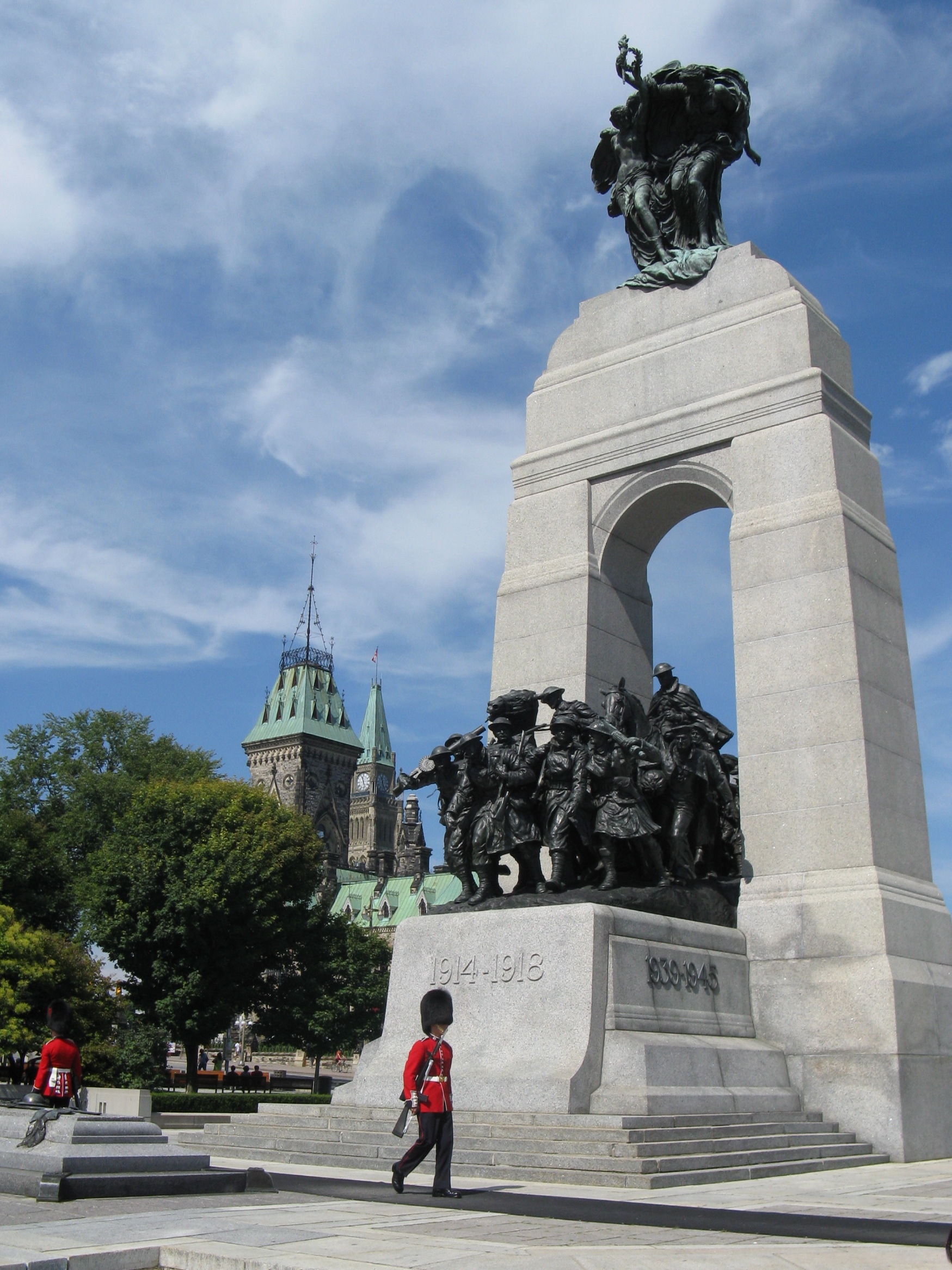
The National War Memorial, located in Confederation Square in Ottawa, serves as the primary cenotaph for Canada's war dead. Originally commissioned to commemorate the service of Canadians in the First World War, it has since been rededicated to honor those who served in the Second World War, the Korean War, and subsequent conflicts and peacekeeping missions.
The monument features a massive granite archway topped with bronze allegorical figures representing Peace and Liberty. At its base, a cenotaph design incorporates bronze sculptures depicting various branches of the Canadian military, reflecting the nation's evolving role in global security and its commitment to remembrance.
Key Facts
- Materials
- Granite, Bronze
- Civilization
- Canadian
- Accessibility
- Fully accessible at ground level
- Date(s)
- 1937-1939
- Condition
- Well-maintained, active site of national ceremony
- Original Function
- Commemoration of First World War service
- Key Figures
- Vernon March, King George VI
Design and Competition
1925-1933Following a national design competition in 1925, British sculptor Vernon March was selected to create the memorial. His design was chosen for its allegorical representation of the 'Response' of the people to the call of duty.
Construction and Unveiling
1937-1939Construction began in 1937 in the newly created Confederation Square. The monument was officially unveiled by King George VI on May 21, 1939, just months before the outbreak of the Second World War.
Rededication and Expansion
1982-2014The memorial was rededicated in 1982 to include the Second World War and the Korean War. In 2000, the Tomb of the Unknown Soldier was added to the site, and in 2014, the memorial was further rededicated to include all Canadian conflicts.
Cultural Significance
The National War Memorial is the focal point for Remembrance Day ceremonies in Canada. It represents the collective national identity regarding sacrifice and military service, serving as a site of pilgrimage for veterans and their families. The inclusion of the Tomb of the Unknown Soldier has deepened its role as a site of national mourning and reflection.
Interpretive Notes
Scholarly debates and areas of uncertainty
Debates have occasionally surfaced regarding the memorial's original focus on 'The Response' versus the later addition of specific conflict dates, with some historians arguing that the monument's symbolic meaning has shifted from a specific historical commemoration to a broader, perpetual symbol of state-sanctioned sacrifice.
Visiting Information
Entry Rules
Open to the public 24 hours a day. No tickets required. Visitors are expected to maintain a respectful demeanor as it is a site of national significance.
Best Times to Visit
November 11th for the national Remembrance Day ceremony, or early morning for a quiet, reflective visit.
Photography
Photography is permitted. Commercial filming requires a permit from the National Capital Commission.
Preservation Notes
The site is under the care of the National Capital Commission. Please refrain from climbing on the cenotaph or placing items on the monument other than authorized wreaths.
Nearby POIs
7 shownSources & Further Reading
- [1]
- [2]The National War Memorial in Ottawa — Robert Shipley. Canadian Historical Association (1995)
Key Facts
- Materials
- Granite, Bronze
- Civilization
- Canadian
- Accessibility
- Fully accessible at ground level
- Date(s)
- 1937-1939
- Condition
- Well-maintained, active site of national ceremony
- Original Function
- Commemoration of First World War service
- Key Figures
- Vernon March, King George VI