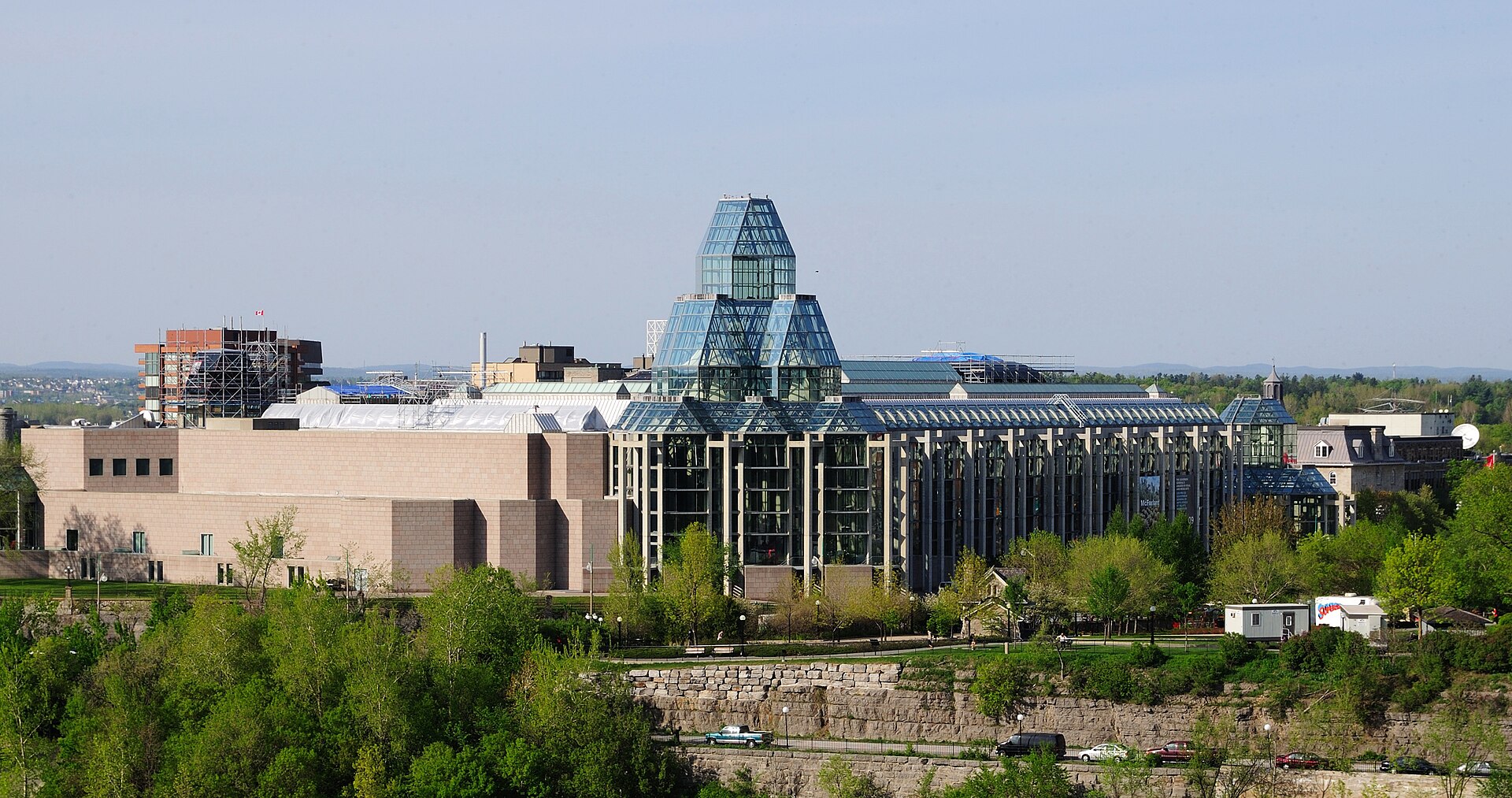
The National Gallery of Canada, located in Ottawa, is one of the country's premier visual arts institutions. Established in 1880, the gallery houses an extensive collection of over 93,000 works, ranging from historical European masterpieces to significant contemporary Canadian and Indigenous art. The institution serves as a primary repository for the nation's artistic heritage and a center for scholarly research and public education.
The current building, designed by architect Moshe Safdie and opened in 1988, is a landmark of Canadian architecture. Characterized by its glass-clad Great Hall and granite-clad towers, the structure integrates natural light and geometric forms to create a distinct environment for viewing art. It is situated along the Ottawa River, overlooking the Parliament Buildings.
Key Facts
- Materials
- Glass, Granite, Concrete
- Civilization
- Canadian
- Accessibility
- Fully wheelchair accessible
- Date(s)
- 1988
- Condition
- Active, well-maintained
- Original Function
- National Art Museum
- Key Figures
- Moshe Safdie, John Douglas Sutherland Campbell
Founding and Early Years
1880The National Gallery of Canada was founded by the Marquess of Lorne, then Governor General of Canada. It was initially housed in the Clarendon Hotel in Ottawa before moving to the Supreme Court building in 1882.
Expansion and Relocation
1911-1960The gallery moved to the Victoria Memorial Museum Building in 1911, where it shared space with the National Museum of Canada. During this period, the collection grew significantly through acquisitions and the establishment of a dedicated curatorial staff.
The Safdie Building
1988To accommodate its expanding collection, the gallery moved to its current purpose-built facility on Sussex Drive. Designed by Moshe Safdie, the building was praised for its innovative use of light and its iconic glass-enclosed Great Hall.
Cultural Significance
The National Gallery of Canada is central to the Canadian cultural identity, acting as the primary steward of the nation's visual history. It plays a critical role in the recognition and preservation of Indigenous art, providing a platform for First Nations, Inuit, and Métis artists within a national context.
Beyond its role as a museum, the gallery serves as a site for national discourse on art, history, and social issues. Its architecture and location in the capital city reinforce its status as a symbol of Canadian institutional stability and cultural ambition.
Interpretive Notes
Scholarly debates and areas of uncertainty
There is ongoing academic discussion regarding the gallery's historical approach to the categorization of Indigenous art, specifically the transition from viewing these works as ethnographic artifacts to recognizing them as fine art. Curatorial strategies continue to evolve to better represent diverse perspectives within the Canadian narrative.
Visiting Information
Entry Rules
Open Tuesday through Sunday. Admission fees apply for special exhibitions, while the permanent collection often has designated free access periods. Visitors are subject to security screening upon entry.
Best Times to Visit
Weekday mornings are generally quieter. The gallery is a popular destination during the summer months and on national holidays.
Photography
Personal photography is permitted in most galleries without flash or tripods. Commercial photography requires prior authorization from the gallery's communications department.
Preservation Notes
Maintain a respectful distance from all artworks. Food and drink are prohibited in the galleries. Large bags must be checked at the coat check.
Nearby POIs
7 shownKey Facts
- Materials
- Glass, Granite, Concrete
- Civilization
- Canadian
- Accessibility
- Fully wheelchair accessible
- Date(s)
- 1988
- Condition
- Active, well-maintained
- Original Function
- National Art Museum
- Key Figures
- Moshe Safdie, John Douglas Sutherland Campbell