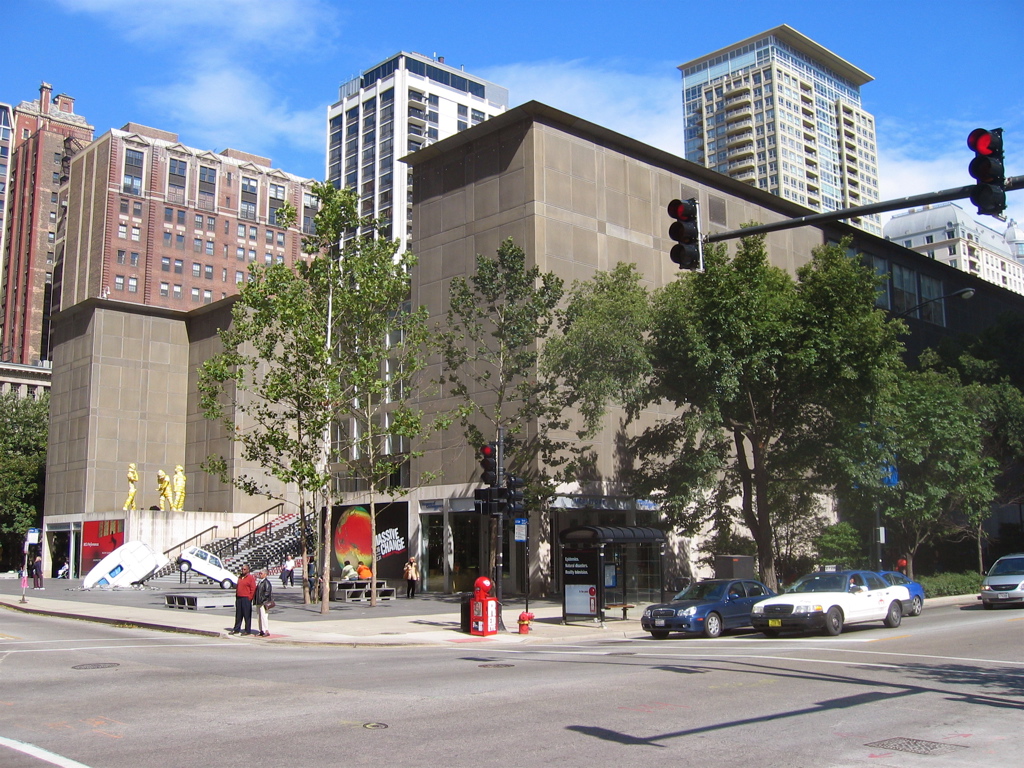
The Museum of Contemporary Art (MCA) Chicago is one of the largest institutions in the United States dedicated to the art of our time. Founded in 1967, the museum serves as a platform for contemporary visual culture, featuring a collection that spans thousands of objects created since 1945, including painting, sculpture, photography, video, and performance art.
The current building, designed by German architect Josef Paul Kleihues, opened in 1996. Located near the Magnificent Mile, the structure is characterized by its limestone facade and a prominent grand staircase, serving as a landmark of modern institutional architecture in Chicago.
Key Facts
- Materials
- Limestone, Aluminum, Glass
- Civilization
- Modern American
- Accessibility
- Fully wheelchair accessible
- Date(s)
- 1996
- Condition
- Active
- Original Function
- Art Museum
- Key Figures
- Josef Paul Kleihues, Joseph Randall Shapiro
Founding and Early Years
1967The museum was established by a group of collectors and art patrons who sought to create a space for contemporary art in Chicago, distinct from the traditional focus of the Art Institute of Chicago. It was originally housed in a former bakery on Ontario Street.
Expansion and New Building
1996To accommodate its growing collection and exhibition needs, the museum commissioned architect Josef Paul Kleihues to design a new facility. The current building on Chicago Avenue was inaugurated in 1996, providing significantly more gallery space and a dedicated theater.
Modern Evolution
21st CenturyIn recent years, the museum has undergone interior renovations to enhance visitor experience and public engagement, including the redesign of the lobby and the addition of new social spaces to foster community interaction.
Cultural Significance
The MCA Chicago plays a vital role in the cultural landscape of the Midwest, acting as a catalyst for dialogue on contemporary social and political issues through art. It is recognized for its commitment to experimental work and its support for emerging artists, often hosting site-specific installations that challenge traditional museum boundaries.
Interpretive Notes
Scholarly debates and areas of uncertainty
Discussions surrounding the museum often focus on the tension between its role as a global institution and its responsibility to the local Chicago art community. Scholars also debate the efficacy of its architectural design in balancing the 'white cube' gallery aesthetic with the need for more flexible, multi-use public spaces.
Visiting Information
Entry Rules
Open Tuesday through Sunday. Tickets can be purchased online or at the door. Admission is free for Illinois residents on Tuesdays.
Best Times to Visit
Weekday mornings are generally quieter. The museum often hosts special events on Tuesday evenings.
Photography
Non-commercial photography is permitted in most galleries for personal use. Flash, tripods, and selfie sticks are prohibited.
Preservation Notes
Do not touch artwork. Maintain a respectful distance from installations. Large bags must be checked at the coat check.
Nearby POIs
10 shown- Driehaus Museum0.6 km
- Cloud Gate1.6 km
- Art Institute of Chicago2 km
- Field Museum of Natural History3.5 km
- Peggy Notebaert Nature Museum3.5 km
- Adler Planetarium3.6 km
- National Museum of Mexican Art6.3 km
- DuSable Black History Museum and Education Center11.8 km
- Institute for the Study of Ancient Cultures12.1 km
- Griffin Museum of Science and Industry12.2 km
Sources & Further Reading
- [1]Museum of Contemporary Art Chicago: The First Twenty Years — Lynne Warren. MCA Chicago (1987)
- [2]Josef Paul Kleihues: The Museum of Contemporary Art, Chicago — Josef Paul Kleihues. Birkhäuser (1996)
Key Facts
- Materials
- Limestone, Aluminum, Glass
- Civilization
- Modern American
- Accessibility
- Fully wheelchair accessible
- Date(s)
- 1996
- Condition
- Active
- Original Function
- Art Museum
- Key Figures
- Josef Paul Kleihues, Joseph Randall Shapiro
Nearby POIs
10 shown- Driehaus Museum0.6 km
- Cloud Gate1.6 km
- Art Institute of Chicago2 km
- Field Museum of Natural History3.5 km
- Peggy Notebaert Nature Museum3.5 km
- Adler Planetarium3.6 km
- National Museum of Mexican Art6.3 km
- DuSable Black History Museum and Education Center11.8 km
- Institute for the Study of Ancient Cultures12.1 km
- Griffin Museum of Science and Industry12.2 km