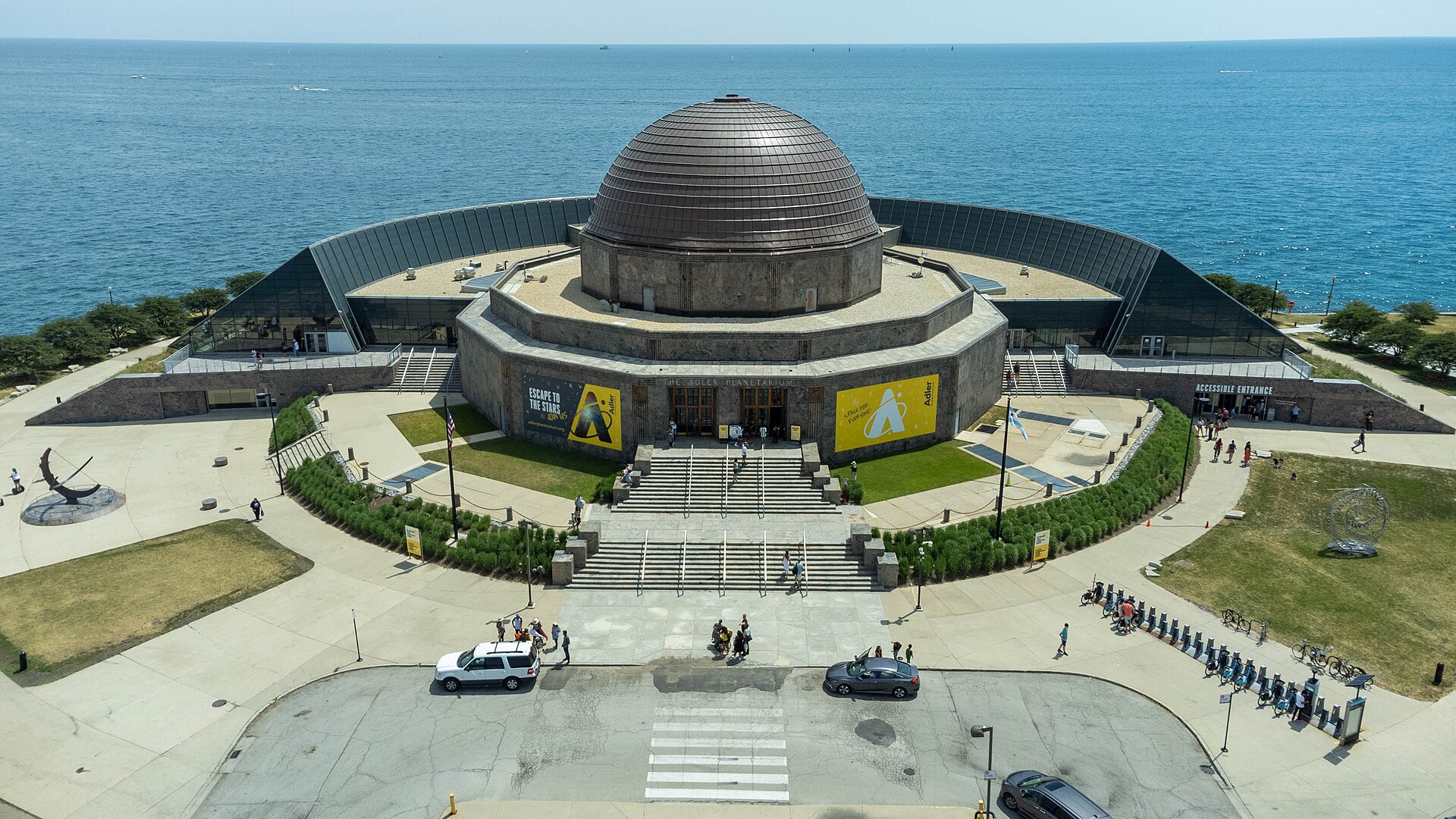
The Adler Planetarium is a public museum dedicated to the study of astronomy and astrophysics, located on the northeastern tip of Northerly Island in Chicago. Founded in 1930 by philanthropist Max Adler, it holds the distinction of being the first planetarium built in the Western Hemisphere. The building is a notable example of Art Deco architecture, designed by architect Ernest A. Grunsfeld Jr., and is listed on the National Register of Historic Places.
The museum houses three full-size theaters, extensive space science exhibitions, and the historic Gemini 12 space capsule. Its collection includes one of the world's most significant assemblages of antique scientific instruments, including astrolabes, sundials, and early telescopes, which document the history of human observation of the cosmos.
Key Facts
- Materials
- Indiana limestone, Bronze, Steel
- Civilization
- United States
- Accessibility
- Fully wheelchair accessible
- Date(s)
- 1930
- Condition
- Active museum and research facility
- Original Function
- Planetarium and astronomical museum
- Key Figures
- Max Adler, Ernest A. Grunsfeld Jr.
Founding and Architecture
1930The Adler Planetarium was commissioned by Max Adler and designed by Ernest A. Grunsfeld Jr. It opened to the public on May 12, 1930, as the first planetarium in the United States, utilizing a Zeiss Planetarium projector imported from Germany.
Expansion and Modernization
1999-2011The museum underwent a major expansion with the addition of the Sky Pavilion, which houses modern exhibition galleries and the Grainger Sky Theater. This period marked a shift toward interactive digital displays and contemporary space science education.
Current Status
PresentToday, the Adler serves as a center for public outreach, space science research, and the preservation of historical astronomical artifacts. It remains a key cultural institution on Chicago's Museum Campus.
Cultural Significance
The Adler Planetarium serves as a cornerstone of Chicago's scientific and cultural landscape. By bridging the gap between historical instrumentation and modern space exploration, it plays a vital role in STEM education and public engagement with the cosmos. Its location on the lakefront makes it a prominent landmark in the city's architectural skyline.
Interpretive Notes
Scholarly debates and areas of uncertainty
Discussions within the museum community often focus on the balance between maintaining the integrity of the historic Art Deco structure and the necessity of upgrading facilities to accommodate modern, high-resolution digital projection technologies.
Visiting Information
Entry Rules
Open daily. Tickets are required for entry and can be purchased online in advance. Chicago residents may be eligible for discounted admission with valid proof of residency.
Best Times to Visit
Weekday mornings are generally less crowded. Evening events or 'After Hours' programs offer unique opportunities for telescope viewing.
Photography
Personal photography is permitted in most galleries. Flash photography and tripods are prohibited in the theaters and certain sensitive exhibition areas.
Preservation Notes
Visitors are asked not to touch the antique scientific instruments or display cases. Please follow all posted signage regarding interactive exhibits.
Nearby POIs
10 shown- Field Museum of Natural History0.8 km
- Art Institute of Chicago2 km
- Cloud Gate2.3 km
- Driehaus Museum3.5 km
- Museum Of Contemporary Art Chicago3.6 km
- National Museum of Mexican Art5.6 km
- Peggy Notebaert Nature Museum7.1 km
- DuSable Black History Museum and Education Center8.3 km
- Institute for the Study of Ancient Cultures8.6 km
- Griffin Museum of Science and Industry8.6 km
Sources & Further Reading
- [1]
- [2]Chicago's Museum Campus: An Architectural Guide — John Zukowsky. University of Chicago Press (2015)
Key Facts
- Materials
- Indiana limestone, Bronze, Steel
- Civilization
- United States
- Accessibility
- Fully wheelchair accessible
- Date(s)
- 1930
- Condition
- Active museum and research facility
- Original Function
- Planetarium and astronomical museum
- Key Figures
- Max Adler, Ernest A. Grunsfeld Jr.
Nearby POIs
10 shown- Field Museum of Natural History0.8 km
- Art Institute of Chicago2 km
- Cloud Gate2.3 km
- Driehaus Museum3.5 km
- Museum Of Contemporary Art Chicago3.6 km
- National Museum of Mexican Art5.6 km
- Peggy Notebaert Nature Museum7.1 km
- DuSable Black History Museum and Education Center8.3 km
- Institute for the Study of Ancient Cultures8.6 km
- Griffin Museum of Science and Industry8.6 km