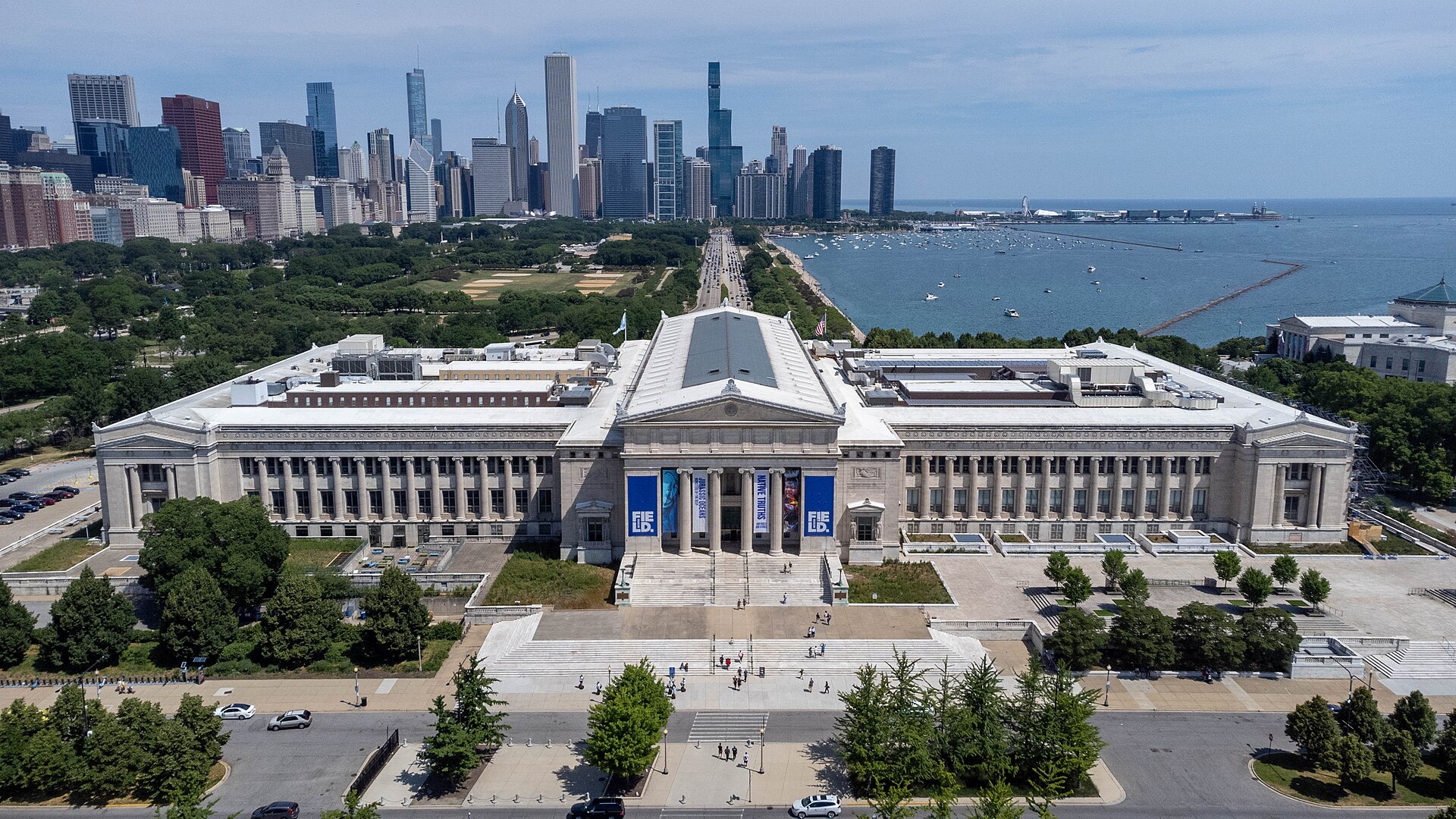
The Field Museum of Natural History is a premier scientific institution located on Chicago's Museum Campus. Founded in 1893 following the World's Columbian Exposition, the museum houses a vast collection of over 24 million specimens and cultural artifacts, ranging from biological and geological samples to extensive anthropological collections.
The museum's current neoclassical building, designed by Daniel Burnham and his firm, opened in 1921. It serves as a center for global research and public education, featuring iconic exhibits such as 'Sue,' the most complete Tyrannosaurus rex specimen ever discovered, and the 'Inside Ancient Egypt' exhibition.
Key Facts
- Materials
- Georgia marble, Steel, Concrete
- Civilization
- American
- Accessibility
- Fully wheelchair accessible
- Date(s)
- 1915-1921
- Condition
- Active, well-maintained
- Original Function
- Natural History Museum
- Key Figures
- Marshall Field, Daniel Burnham, Carl Akeley
Founding and the World's Fair
1893The museum was established as the Columbian Museum of Chicago to house the collections from the 1893 World's Columbian Exposition. Marshall Field provided the initial endowment, and the institution was renamed in his honor in 1905.
Relocation to Museum Campus
1921The museum moved from its original location in Jackson Park to its current site on the Chicago lakefront. The new building was designed by Daniel Burnham's firm in the Beaux-Arts style, intended to anchor the city's developing Museum Campus.
Scientific Expansion
20th CenturyThroughout the 20th century, the museum expanded its research capabilities, sending numerous expeditions worldwide to collect biological and anthropological specimens, cementing its status as a global leader in natural history research.
Modern Era and Renovations
21st CenturyRecent decades have seen significant updates to exhibition spaces, including the acquisition of 'Sue' in 1997 and the ongoing digitization of its massive collections to increase accessibility for researchers and the public.
Cultural Significance
The Field Museum is a cornerstone of Chicago's cultural identity and a major hub for scientific literacy in the United States. It plays a critical role in preserving global biodiversity and cultural heritage, serving as a repository for indigenous artifacts and natural specimens that facilitate ongoing academic research.
Interpretive Notes
Scholarly debates and areas of uncertainty
There is ongoing academic discourse regarding the repatriation of cultural artifacts within the museum's anthropological collections. The institution actively engages in provenance research and collaborative projects with indigenous communities to address historical collection practices.
Visiting Information
Entry Rules
Open daily. Tickets are required for entry, with discounted rates available for Chicago residents. Visitors must pass through security screening upon arrival.
Best Times to Visit
Weekday mornings are generally less crowded. The museum is busiest during summer months and school holidays.
Photography
Personal photography is permitted in most galleries. Flash and tripods are prohibited. Commercial photography requires prior authorization.
Preservation Notes
Do not touch specimens or display cases. Maintain a quiet environment in gallery spaces. Food and drink are restricted to designated areas.
Nearby POIs
10 shown- Adler Planetarium0.8 km
- Art Institute of Chicago1.6 km
- Cloud Gate1.9 km
- Driehaus Museum3.2 km
- Museum Of Contemporary Art Chicago3.5 km
- National Museum of Mexican Art4.8 km
- Peggy Notebaert Nature Museum6.9 km
- DuSable Black History Museum and Education Center8.3 km
- Institute for the Study of Ancient Cultures8.7 km
- Griffin Museum of Science and Industry8.8 km
Key Facts
- Materials
- Georgia marble, Steel, Concrete
- Civilization
- American
- Accessibility
- Fully wheelchair accessible
- Date(s)
- 1915-1921
- Condition
- Active, well-maintained
- Original Function
- Natural History Museum
- Key Figures
- Marshall Field, Daniel Burnham, Carl Akeley
Nearby POIs
10 shown- Adler Planetarium0.8 km
- Art Institute of Chicago1.6 km
- Cloud Gate1.9 km
- Driehaus Museum3.2 km
- Museum Of Contemporary Art Chicago3.5 km
- National Museum of Mexican Art4.8 km
- Peggy Notebaert Nature Museum6.9 km
- DuSable Black History Museum and Education Center8.3 km
- Institute for the Study of Ancient Cultures8.7 km
- Griffin Museum of Science and Industry8.8 km