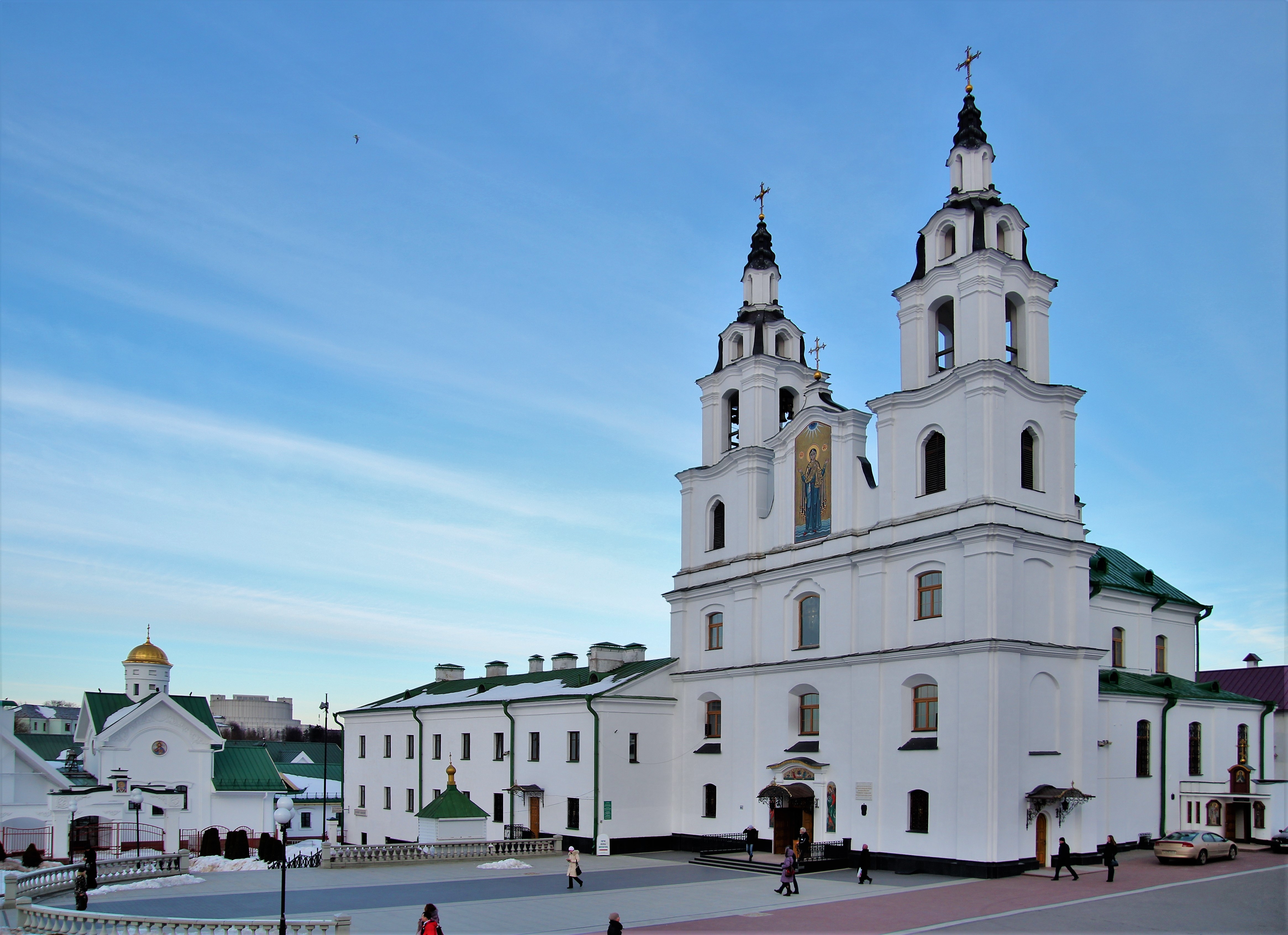
The Holy Spirit Cathedral in Minsk is a prominent Orthodox cathedral located in the city's Upper Town. Originally constructed between 1633 and 1642 as part of a Bernardine monastery complex, the structure was built in the Vilna Baroque style. It served as a Catholic church for over two centuries before being transferred to the Orthodox Church in the mid-19th century following the suppression of the monastery.
The cathedral is architecturally notable for its two-towered facade and its role as the spiritual center of the Belarusian Orthodox Church. It houses several significant religious relics, most notably the miraculous Minsk Icon of the Mother of God, which is believed to have appeared in the city in 1500. The interior features a gilded iconostasis and extensive frescoes that reflect its long history of religious transition.
Key Facts
- Materials
- Brick, Plaster, Wood
- Civilization
- Polish-Lithuanian Commonwealth
- Accessibility
- Ground level access, limited interior mobility due to historic layout
- Date(s)
- 1633-1642
- Condition
- Active Orthodox Cathedral
- Original Function
- Catholic Church and Monastery
- Key Figures
- Bernardine Order
Founding and Catholic Era
1633-1852The church was built as part of a Bernardine monastery complex. It functioned as a Catholic place of worship for over 200 years, serving the local Catholic community during the period of the Polish-Lithuanian Commonwealth.
Conversion to Orthodoxy
1860sFollowing the closure of the Bernardine monastery by Russian imperial authorities, the building was repurposed as an Orthodox cathedral. It was consecrated in honor of the Holy Spirit and underwent interior modifications to suit Orthodox liturgical requirements.
Soviet Era and Restoration
1920s-1980sThe cathedral was closed by Soviet authorities in the 1930s and used for secular purposes, including as a gymnasium and an archive. It was returned to the Orthodox Church in 1943 during the German occupation and has remained an active religious site since.
Cultural Significance
The Holy Spirit Cathedral serves as the primary cathedral of the Belarusian Exarchate of the Russian Orthodox Church. It is a focal point for major religious holidays and state-sanctioned religious events in Minsk. The presence of the Minsk Icon of the Mother of God makes it a major site of pilgrimage for Orthodox Christians in Belarus.
Interpretive Notes
Scholarly debates and areas of uncertainty
There is ongoing discussion among architectural historians regarding the extent of the original 17th-century interior design versus the modifications made during the 19th-century conversion to Orthodoxy, as many original Catholic decorative elements were removed or obscured.
Visiting Information
Entry Rules
Open daily. Free entry. Visitors are expected to dress modestly; women are encouraged to cover their heads, and men should remove hats. Photography is generally prohibited during services.
Best Times to Visit
Early morning on weekdays to avoid large crowds. Sunday mornings are very busy due to Divine Liturgy.
Photography
Photography is strictly prohibited during religious services. Outside of services, photography may be permitted with discretion, but flash is forbidden.
Preservation Notes
The building is a protected historical monument. Visitors should remain in designated areas and avoid touching the icons or frescoes.
Nearby POIs
11 shown- Minsk City History Museum0.2 km
- Maksim Bahdanovich Literary Museum0.3 km
- Mini Museum0.5 km
- Belarusian National Arts Museum0.8 km
- Belarusian National History and Culture Museum0.9 km
- Church of Saints Simon and Helena1.1 km
- Government House1.2 km
- Belarusian Great Patriotic War Museum1.7 km
- St Elisabeth Convent5.8 km
- Loshitsa Manor6.2 km
- National Library of Belarus6.6 km
Sources & Further Reading
- [1]The Orthodox Church in Belarus — N. V. Kuleshov. Minsk Historical Press (2015)
- [2]Baroque Architecture in the Grand Duchy of Lithuania — A. J. Kliuchevsky. Academic Journal of Eastern European History (2018)
Key Facts
- Materials
- Brick, Plaster, Wood
- Civilization
- Polish-Lithuanian Commonwealth
- Accessibility
- Ground level access, limited interior mobility due to historic layout
- Date(s)
- 1633-1642
- Condition
- Active Orthodox Cathedral
- Original Function
- Catholic Church and Monastery
- Key Figures
- Bernardine Order
Nearby POIs
11 shown- Minsk City History Museum0.2 km
- Maksim Bahdanovich Literary Museum0.3 km
- Mini Museum0.5 km
- Belarusian National Arts Museum0.8 km
- Belarusian National History and Culture Museum0.9 km
- Church of Saints Simon and Helena1.1 km
- Government House1.2 km
- Belarusian Great Patriotic War Museum1.7 km
- St Elisabeth Convent5.8 km
- Loshitsa Manor6.2 km
- National Library of Belarus6.6 km