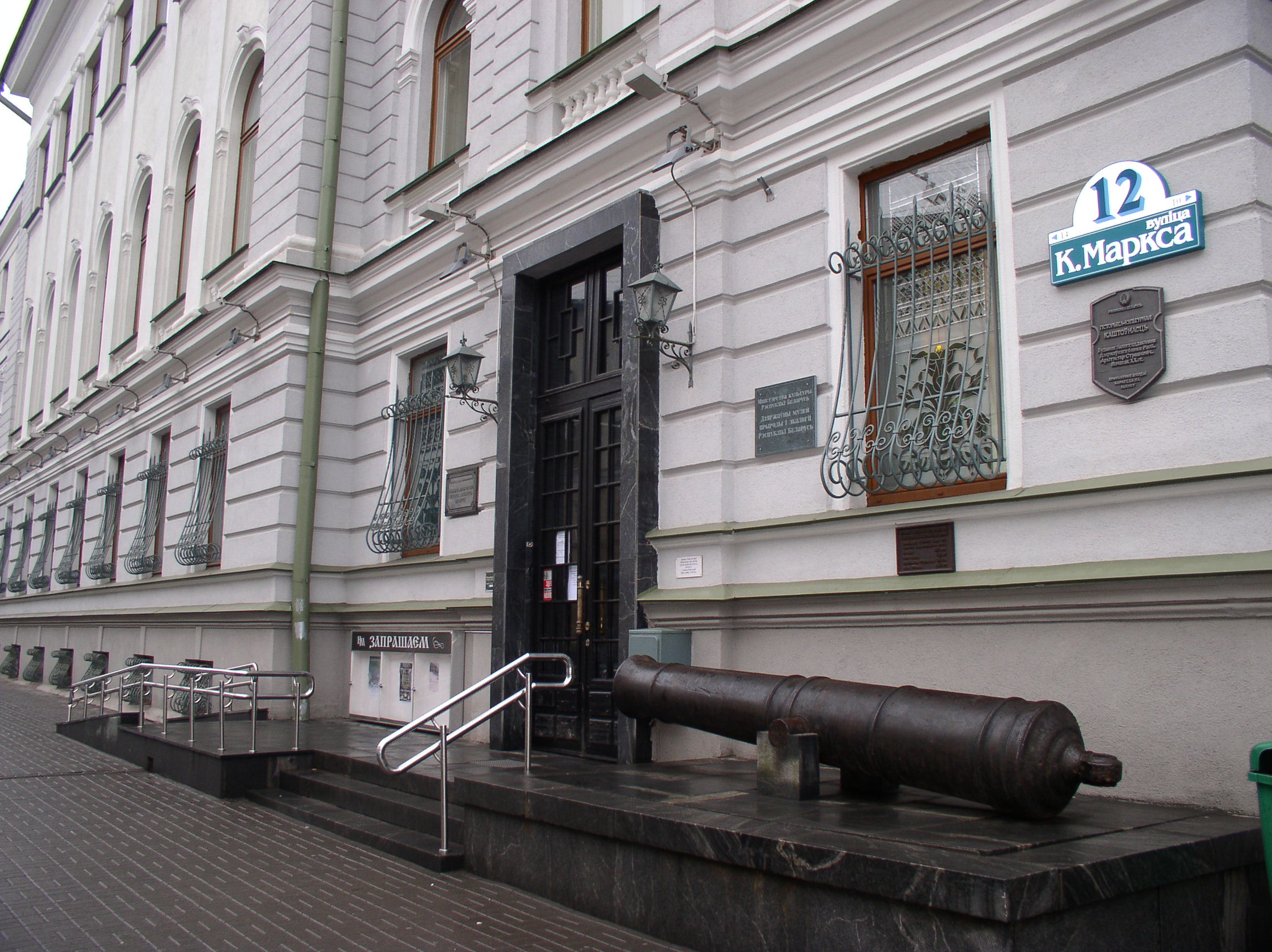
The Belarusian National History Museum, located in Minsk, serves as the primary institution for the preservation and exhibition of the nation's historical and cultural heritage. Its extensive collection spans from archaeological findings dating to the prehistoric era to artifacts representing the socio-political developments of the 20th and 21st centuries.
The museum is housed in a historic building that reflects the architectural evolution of Minsk. It functions as a research center, hosting diverse exhibitions that cover ethnography, numismatics, and the development of Belarusian statehood, providing a comprehensive overview of the region's complex historical trajectory.
Key Facts
- Materials
- Brick, Concrete, Stucco
- Civilization
- Belarusian
- Accessibility
- Limited wheelchair access to upper floors
- Date(s)
- 1950s (current building)
- Condition
- Active, well-maintained
- Original Function
- Museum
- Key Figures
- Ivan Lutskevich
Founding and Early Collections
1908-1920sThe museum's origins trace back to the early 20th century with the establishment of the 'Our Past' museum in Vilnius by Ivan Lutskevich. Following the geopolitical shifts after World War I, these collections were relocated and reorganized.
Soviet Era Development
1920s-1980sDuring the Soviet period, the institution underwent several reorganizations and name changes, eventually consolidating various regional collections into a centralized state repository of Belarusian history.
National Independence
1991-PresentFollowing the independence of Belarus in 1991, the museum was rebranded as the National History Museum. It has since focused on re-evaluating historical narratives and expanding its collection to include contemporary Belarusian history.
Cultural Significance
The museum is the central repository for Belarusian national identity. It plays a critical role in educating the public on the distinct cultural, linguistic, and historical markers that define the Belarusian people, often serving as a venue for state-sponsored cultural events and historical commemorations.
Interpretive Notes
Scholarly debates and areas of uncertainty
There is ongoing academic discussion regarding the interpretation of the Soviet period within the museum's exhibits, specifically concerning the balance between the Soviet-era industrialization narrative and the history of the Belarusian national movement.
Visiting Information
Entry Rules
Open daily except for certain public holidays. Tickets can be purchased at the entrance. Photography of specific temporary exhibits may be restricted.
Best Times to Visit
Weekday mornings to avoid school group tours and weekend crowds.
Photography
Personal photography allowed without flash. Professional photography requires prior administrative approval.
Preservation Notes
Flash photography is prohibited to protect light-sensitive artifacts. Visitors are requested to refrain from touching display cases.
Nearby POIs
11 shown- Belarusian National Arts Museum0.4 km
- Church of Saints Simon and Helena0.5 km
- Government House0.7 km
- Minsk City History Museum0.8 km
- Mini Museum0.9 km
- Holy Spirit Cathedral0.9 km
- Maksim Bahdanovich Literary Museum1.3 km
- Belarusian Great Patriotic War Museum2.5 km
- Loshitsa Manor5.3 km
- St Elisabeth Convent6.7 km
- National Library of Belarus7.1 km
Sources & Further Reading
- [1]National History Museum of the Republic of Belarus: Official Guide — Ministry of Culture of Belarus. State Publishing House (2018)View
- [2]Museums of Belarus: A Historical Overview — A. A. Smirnov. Belarusian Science Press (2015)
Key Facts
- Materials
- Brick, Concrete, Stucco
- Civilization
- Belarusian
- Accessibility
- Limited wheelchair access to upper floors
- Date(s)
- 1950s (current building)
- Condition
- Active, well-maintained
- Original Function
- Museum
- Key Figures
- Ivan Lutskevich
Nearby POIs
11 shown- Belarusian National Arts Museum0.4 km
- Church of Saints Simon and Helena0.5 km
- Government House0.7 km
- Minsk City History Museum0.8 km
- Mini Museum0.9 km
- Holy Spirit Cathedral0.9 km
- Maksim Bahdanovich Literary Museum1.3 km
- Belarusian Great Patriotic War Museum2.5 km
- Loshitsa Manor5.3 km
- St Elisabeth Convent6.7 km
- National Library of Belarus7.1 km