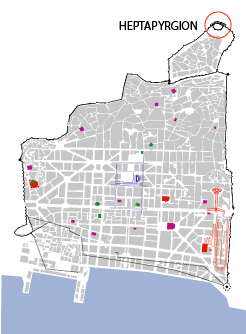
The Heptapyrgion, also known as Yedi Kule, is a Byzantine and Ottoman-era fortress situated on the northernmost point of the Acropolis of Thessaloniki. Its name, meaning 'Seven Towers,' refers to the prominent towers that define its silhouette, though the structure actually consists of ten towers integrated into the city's defensive walls.
The fortress served as the primary citadel for the city throughout the Byzantine period and was significantly modified following the Ottoman conquest in 1430. In the late 19th century, it was converted into a prison, a function it maintained until 1989. Today, it stands as a protected archaeological site offering panoramic views of the city and the Thermaic Gulf.
Key Facts
- Materials
- Stone masonry, Brick, Mortar
- Civilization
- Byzantine, Ottoman
- Accessibility
- Accessible via walking paths; some uneven terrain
- Date(s)
- 4th century CE - 15th century CE
- Condition
- Restored, archaeological site
- Original Function
- Citadel and defensive fortress
- Key Figures
- Theodosius I, John Palaiologos
Byzantine Foundations
4th - 12th centuryThe core of the fortress was constructed during the late Roman and early Byzantine periods to reinforce the city's defenses. It served as the acropolis of Thessaloniki, providing a secure refuge for the city's administration and military leadership.
Ottoman Expansion
15th - 19th centuryFollowing the Ottoman conquest of Thessaloniki in 1430, the fortress underwent significant renovations. The Ottomans reinforced the existing Byzantine walls and added new towers, solidifying its role as the Yedi Kule, the military headquarters for the local garrison.
Prison Era
1890 - 1989In the late 19th century, the fortress was repurposed as the city's main prison. During this period, the interior was heavily modified with cells and administrative buildings, housing both common criminals and political prisoners.
Modern Restoration
1989 - presentAfter the prison was closed in 1989, the site was transferred to the Ministry of Culture. Extensive archaeological excavations and restoration projects have since removed many of the prison-era additions to reveal the underlying Byzantine and Ottoman architectural layers.
Cultural Significance
The Heptapyrgion is a symbol of Thessaloniki's layered history, representing the transition from Byzantine imperial power to Ottoman administration. Its long tenure as a prison has also embedded it deeply into the collective memory of the city, particularly regarding the 20th-century political history of Greece.
As part of the Paleochristian and Byzantine Monuments of Thessaloniki, it is recognized for its architectural importance and its role in the city's urban defensive system, which has been a UNESCO World Heritage site since 1988.
Interpretive Notes
Scholarly debates and areas of uncertainty
There is ongoing academic discussion regarding the exact dating of the various tower phases. While the core is clearly Byzantine, the extent to which the Ottomans rebuilt versus merely repaired the existing structures remains a subject of architectural analysis.
Visiting Information
Entry Rules
Open to the public. Entry is free. Visitors are advised to check local municipal schedules for specific opening hours as they may vary by season.
Best Times to Visit
Late afternoon for sunset views over the Thermaic Gulf. Weekdays are generally quieter than weekends.
Photography
Photography is permitted for personal use. Commercial photography requires prior authorization from the Ephorate of Antiquities.
Preservation Notes
The site is an active archaeological zone. Visitors must stay on designated paths and refrain from climbing on the walls or entering restricted restoration areas.
Nearby POIs
11 shown- Walls of Thessaloniki0.4 km
- Church of Hosios David0.9 km
- Church of Saint Nicholas Orphanos0.9 km
- Hagios Demetrios1.3 km
- Roman Forum of Thessaloniki1.5 km
- Arch of Galerius and Rotunda1.6 km
- Bey Hamam1.7 km
- Church of Panagia Chalkeon1.8 km
- Hagia Sophia Church of Holy Wisdom1.8 km
- Thessaloniki Olympic Museum1.9 km
- Museum for the Macedonian Struggle2.1 km
Sources & Further Reading
- [1]Thessaloniki: The City and its Monuments — E. Kourkoutidou-Nikolaidou. Ekdotike Athenon (1997)
- [2]Byzantine Thessaloniki: A Guide to the Byzantine Churches and Monuments — Kalliopi Theoharidou. Archaeological Receipts Fund (2005)
Key Facts
- Materials
- Stone masonry, Brick, Mortar
- Civilization
- Byzantine, Ottoman
- Accessibility
- Accessible via walking paths; some uneven terrain
- Date(s)
- 4th century CE - 15th century CE
- Condition
- Restored, archaeological site
- Original Function
- Citadel and defensive fortress
- Key Figures
- Theodosius I, John Palaiologos
Nearby POIs
11 shown- Walls of Thessaloniki0.4 km
- Church of Hosios David0.9 km
- Church of Saint Nicholas Orphanos0.9 km
- Hagios Demetrios1.3 km
- Roman Forum of Thessaloniki1.5 km
- Arch of Galerius and Rotunda1.6 km
- Bey Hamam1.7 km
- Church of Panagia Chalkeon1.8 km
- Hagia Sophia Church of Holy Wisdom1.8 km
- Thessaloniki Olympic Museum1.9 km
- Museum for the Macedonian Struggle2.1 km