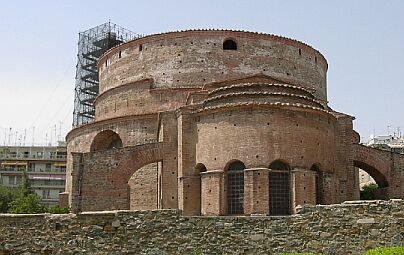
The Arch of Galerius and the Rotunda are two interconnected late 4th-century monuments located in Thessaloniki, Greece. Commissioned by the Caesar Galerius to celebrate his victory over the Sassanid Persians, the structures formed part of a grand imperial palace complex that served as a seat of power in the Eastern Roman Empire.
The Arch, originally a triple-arched gateway, features intricate marble reliefs depicting the military campaigns of the Tetrarchy. The nearby Rotunda, a massive circular structure, was originally intended as a mausoleum for Galerius but was later converted into a Christian church and subsequently an Ottoman mosque, resulting in a unique layering of architectural styles and religious history.
Key Facts
- Materials
- Brick, Marble, Mortar
- Civilization
- Roman
- Accessibility
- Ground level access to the Arch; Rotunda is accessible with some uneven surfaces
- Date(s)
- c. 298–305 CE
- Condition
- Partially preserved; Rotunda functions as a museum and monument
- Original Function
- Triumphal arch and imperial mausoleum
- Key Figures
- Galerius, Constantine the Great
Imperial Construction
305 CEThe structures were built as part of the palace complex of Galerius, who chose Thessaloniki as his imperial capital. The Arch served as a monumental entrance to the complex, while the Rotunda was designed to serve as his final resting place.
Christian Transformation
4th-5th century CEFollowing the rise of Christianity, the Rotunda was converted into a church dedicated to Saint George. During this period, the interior was decorated with high-quality early Christian mosaics, which remain some of the most significant examples of the era.
Ottoman Conversion
1590 CEDuring the Ottoman period, the Rotunda was converted into the Hortaji Suleiman Effendi Mosque. A minaret was added to the exterior, which remains the only one preserved in the city today.
Modern Preservation
20th century - presentAfter the liberation of Thessaloniki in 1912, the site was returned to Christian use, though it now functions primarily as an archaeological site and museum under the supervision of the Greek Ministry of Culture.
Cultural Significance
The site represents the transition of Thessaloniki from a Roman imperial center to a major hub of the Byzantine Empire. The Rotunda, in particular, is a rare example of a structure that has served as a pagan temple, a Christian church, and an Islamic mosque, reflecting the complex religious history of the Balkans.
Interpretive Notes
Scholarly debates and areas of uncertainty
There is ongoing academic discussion regarding the original intended purpose of the Rotunda, with some scholars arguing it was always intended as a church, while others maintain it was strictly a mausoleum for the Tetrarchs.
Visiting Information
Entry Rules
The Arch is located in a public square and is accessible at all times. The Rotunda is a ticketed archaeological site with established visiting hours; visitors should check local listings for seasonal changes.
Best Times to Visit
Early morning or late afternoon to avoid the intense heat of the Thessaloniki summer and to capture the best light on the marble reliefs of the Arch.
Photography
Personal photography is permitted. Flash and tripods are prohibited inside the Rotunda.
Preservation Notes
The Arch is exposed to urban pollution and vibration from traffic; visitors should remain behind the protective barriers. The Rotunda mosaics are highly sensitive to humidity and light.
Nearby POIs
11 shown- Hagia Sophia Church of Holy Wisdom0.4 km
- Bey Hamam0.7 km
- Museum for the Macedonian Struggle0.7 km
- Church of Saint Nicholas Orphanos0.7 km
- White Tower of Thessaloniki0.7 km
- Roman Forum of Thessaloniki0.8 km
- Hagios Demetrios0.8 km
- Archaeological Museum of Thessaloniki0.8 km
- Church of Panagia Chalkeon0.9 km
- Museum of Byzantine Culture0.9 km
- Church of Hosios David1.1 km
Sources & Further Reading
- [1]The Rotunda of Thessaloniki: A Study of its Architecture and Mosaics — H. Torp. University of Oslo Press (1963)
- [2]The Arch and Palace of Galerius at Thessaloniki — J. S. G. P. Ward. Journal of Roman Studies (1970)View
Key Facts
- Materials
- Brick, Marble, Mortar
- Civilization
- Roman
- Accessibility
- Ground level access to the Arch; Rotunda is accessible with some uneven surfaces
- Date(s)
- c. 298–305 CE
- Condition
- Partially preserved; Rotunda functions as a museum and monument
- Original Function
- Triumphal arch and imperial mausoleum
- Key Figures
- Galerius, Constantine the Great
Nearby POIs
11 shown- Hagia Sophia Church of Holy Wisdom0.4 km
- Bey Hamam0.7 km
- Museum for the Macedonian Struggle0.7 km
- Church of Saint Nicholas Orphanos0.7 km
- White Tower of Thessaloniki0.7 km
- Roman Forum of Thessaloniki0.8 km
- Hagios Demetrios0.8 km
- Archaeological Museum of Thessaloniki0.8 km
- Church of Panagia Chalkeon0.9 km
- Museum of Byzantine Culture0.9 km
- Church of Hosios David1.1 km