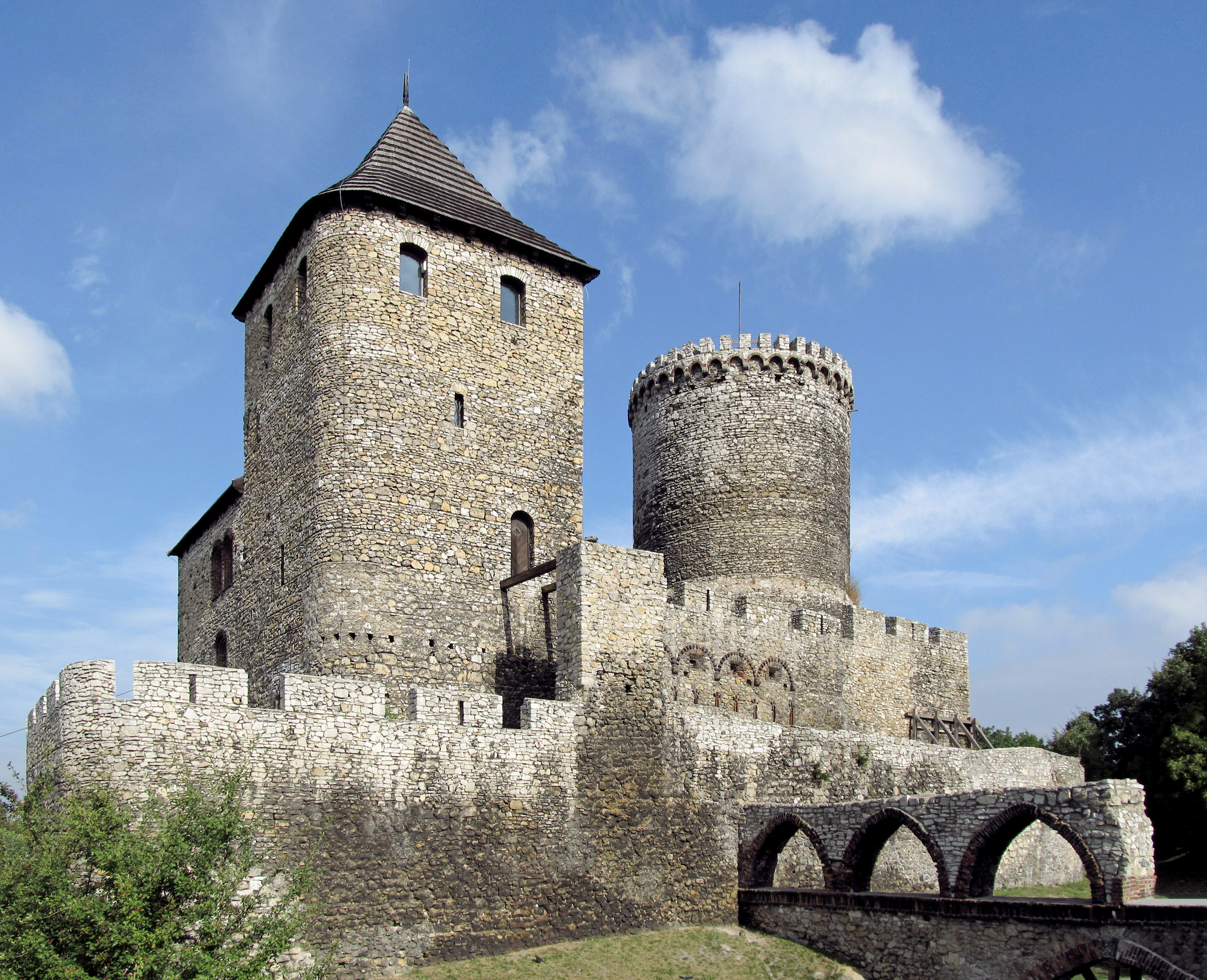
Będzin Castle is a stone fortification located in the Silesian Voivodeship of southern Poland. Originally established as a wooden structure in the 11th century, the current stone fortress was commissioned by King Casimir the Great in the 14th century as part of the 'Eagle's Nests' trail, a series of defensive castles designed to protect the Kingdom of Poland's borders and trade routes.
The castle features a cylindrical tower and a residential building, both of which have undergone various reconstructions over the centuries due to fires and military conflicts. Today, the site serves as the Zagłębie Museum, housing extensive collections related to the history of the Będzin region, including archaeological artifacts, weaponry, and historical documents.
Key Facts
- Materials
- Limestone, Brick
- Civilization
- Kingdom of Poland
- Accessibility
- Partial; some areas involve stairs
- Date(s)
- 14th century
- Condition
- Restored and active as a museum
- Original Function
- Defensive fortress and royal residence
- Key Figures
- Casimir the Great
Early Foundations
11th-13th centuryThe site began as a wooden stronghold protecting a local settlement. Its strategic location on the border of Lesser Poland and Silesia made it a critical point for regional defense.
Royal Construction
14th centuryKing Casimir the Great ordered the construction of the stone castle to replace the wooden fortifications. It became a vital link in the defensive chain protecting the kingdom against Bohemian and Silesian incursions.
Renaissance and Decline
16th-18th centuryThe castle was expanded and modernized during the Renaissance. However, it suffered significant damage during the Swedish Deluge in the 17th century and gradually fell into disrepair throughout the 18th century.
Restoration and Museum
20th century - presentFollowing extensive reconstruction efforts in the mid-20th century, the castle was opened to the public as a museum. It remains a primary cultural institution for the city of Będzin.
Cultural Significance
Będzin Castle is a symbol of the 'Eagle's Nests' defensive system, representing the consolidation of Polish statehood under the Piast dynasty. It serves as a focal point for local identity in the Zagłębie Dąbrowskie region, preserving the historical memory of the area's medieval and early modern development.
Interpretive Notes
Scholarly debates and areas of uncertainty
There is ongoing academic discussion regarding the exact layout of the original 11th-century wooden structure, as archaeological evidence is limited by the extensive 14th-century stone foundations built directly over the earlier site.
Visiting Information
Entry Rules
Open Tuesday through Sunday. Tickets are required for entry to the museum exhibitions. Visitors are expected to follow standard museum conduct.
Best Times to Visit
Late spring and early autumn offer the best conditions for exploring the castle grounds and the surrounding park area.
Photography
Personal photography is permitted in most areas. Flash and tripods are prohibited inside the museum galleries.
Preservation Notes
The structure is a protected historical monument. Visitors are requested to remain on designated paths and refrain from touching the masonry.
Nearby POIs
7 shownSources & Further Reading
- [1]The Eagle's Nests: Castles of the Polish Jura — Jacek Laberschek. Regional Museum of Będzin (2015)
- [2]Castles of the Piast Dynasty — Leszek Kajzer. Wydawnictwo Naukowe PWN (2008)
Key Facts
- Materials
- Limestone, Brick
- Civilization
- Kingdom of Poland
- Accessibility
- Partial; some areas involve stairs
- Date(s)
- 14th century
- Condition
- Restored and active as a museum
- Original Function
- Defensive fortress and royal residence
- Key Figures
- Casimir the Great