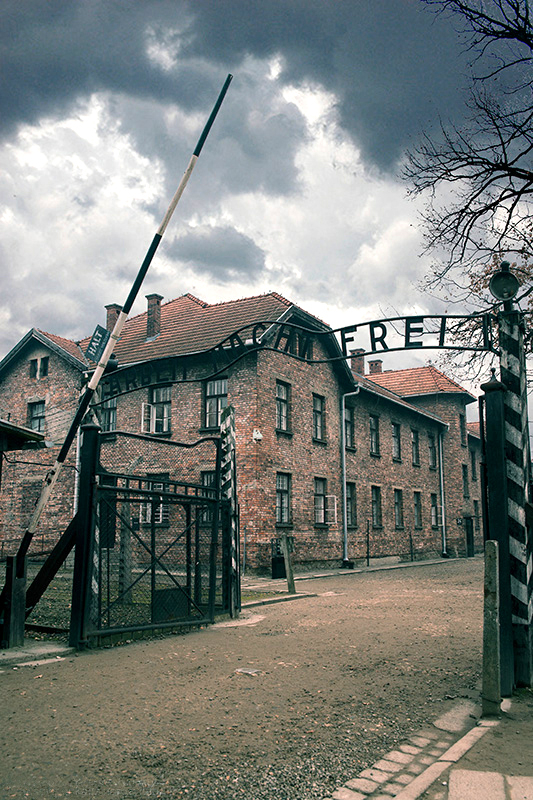
The Auschwitz-Birkenau State Museum is a memorial and museum site located in Oświęcim, Poland, on the grounds of the former Nazi concentration and extermination camp. Established in 1947, it preserves the physical remains of the camp, including the barracks, watchtowers, and the ruins of the gas chambers and crematoria, serving as a site of memory for the victims of the Holocaust.
The site encompasses two primary sections: Auschwitz I, the original administrative center, and Auschwitz II-Birkenau, the purpose-built extermination camp. It functions as both a place of historical research and a site of international commemoration, documenting the systematic genocide perpetrated by the Third Reich between 1940 and 1945.
Key Facts
- Materials
- Brick, Wood, Concrete, Barbed wire
- Civilization
- Third Reich
- Accessibility
- Partial accessibility; some areas have uneven terrain
- Date(s)
- 1940-1945
- Condition
- Preserved memorial and museum
- Original Function
- Concentration and extermination camp
- Key Figures
- Rudolf Höss, Heinrich Himmler, Primo Levi
Establishment
1940The camp was established by the SS in the former Polish army barracks in Oświęcim to serve as a detention center for Polish political prisoners.
Expansion to Extermination
1941-1942The site expanded significantly with the construction of Birkenau, which became the primary site for the mass murder of European Jews as part of the Final Solution.
Liberation and Preservation
1945-1947Soviet forces liberated the camp on January 27, 1945. In 1947, the Polish government passed an act to preserve the site as a state museum.
Cultural Significance
Auschwitz-Birkenau is the preeminent symbol of the Holocaust and the industrialization of mass murder. It serves as a global site of conscience, forcing a confrontation with the limits of human morality and the consequences of state-sponsored hatred.
Interpretive Notes
Scholarly debates and areas of uncertainty
Debates persist regarding the ethics of preservation versus restoration, specifically how to maintain the decaying physical structures without compromising their historical authenticity.
Visiting Information
Entry Rules
Entry is free but requires a pre-booked entry pass via the official website. Guided tours are highly recommended and often mandatory for individual visitors during peak seasons.
Best Times to Visit
Early spring or late autumn to avoid extreme weather and peak summer crowds. The site is solemn and requires significant time for reflection.
Photography
Photography is permitted for personal use in most areas, but flash and tripods are prohibited. Photography is strictly forbidden in the 'Block 11' basement and the room containing human hair.
Preservation Notes
Visitors are expected to maintain a respectful, quiet demeanor. Touching the ruins or artifacts is strictly prohibited to prevent further degradation.
Nearby POIs
5 shownKey Facts
- Materials
- Brick, Wood, Concrete, Barbed wire
- Civilization
- Third Reich
- Accessibility
- Partial accessibility; some areas have uneven terrain
- Date(s)
- 1940-1945
- Condition
- Preserved memorial and museum
- Original Function
- Concentration and extermination camp
- Key Figures
- Rudolf Höss, Heinrich Himmler, Primo Levi