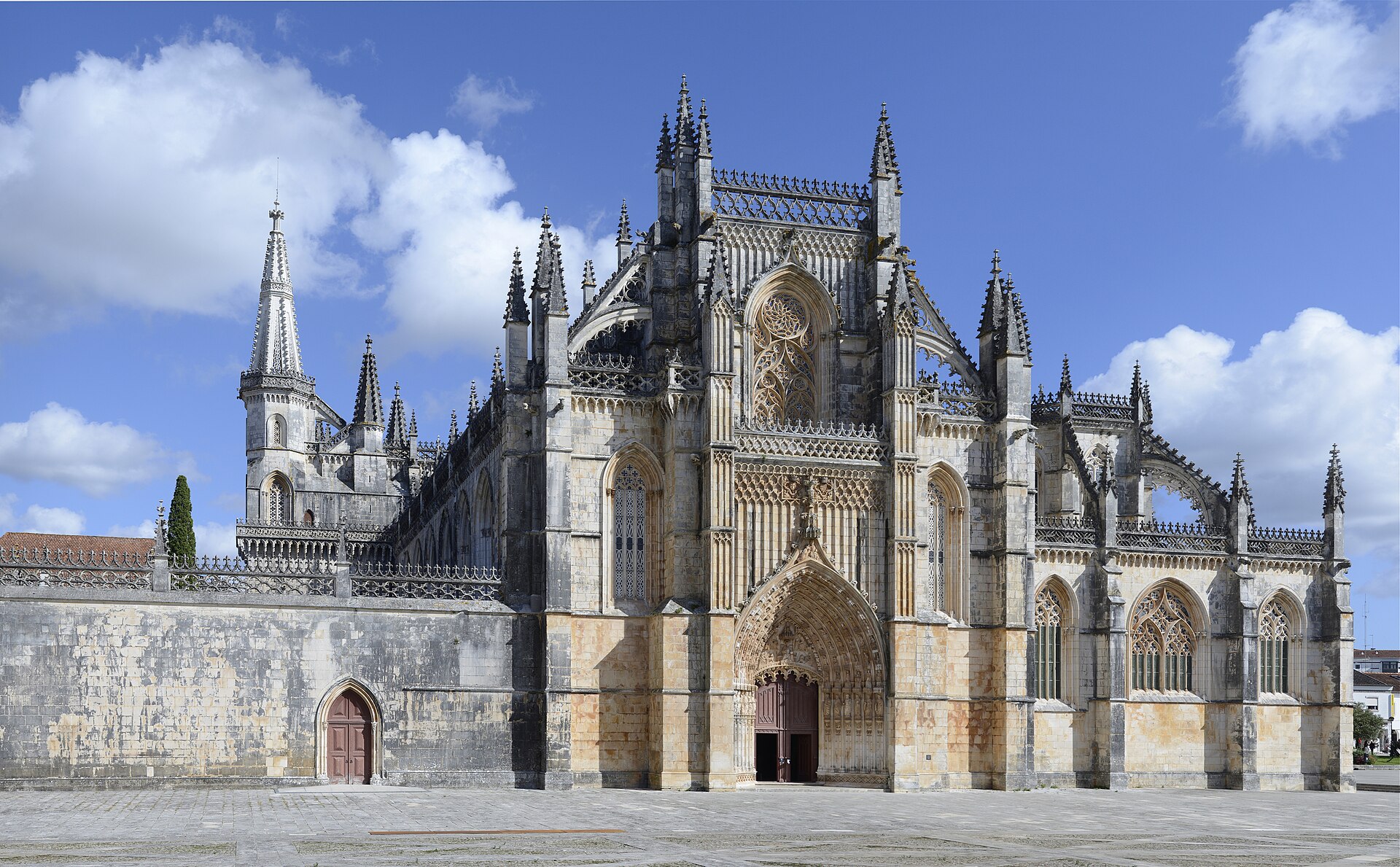
The Batalha Monastery, formally known as the Monastery of Saint Mary of the Victory, is a Dominican convent located in the municipality of Batalha, Portugal. It was commissioned by King John I to commemorate the Portuguese victory over the Castilians at the Battle of Aljubarrota in 1385, fulfilling a vow made to the Virgin Mary.
The architecture represents a synthesis of Gothic and Manueline styles, characterized by intricate stone carvings and soaring vaults. As the primary burial site for the Aviz dynasty, the monastery serves as a significant monument to Portuguese national identity and the architectural evolution of the 14th to 16th centuries.
Key Facts
- Materials
- Limestone
- Civilization
- Portuguese
- Accessibility
- Ground floor is accessible; some areas have uneven stone flooring
- Date(s)
- 1386–1517
- Condition
- Well-preserved, active monument and museum
- Original Function
- Dominican monastery and royal mausoleum
- Key Figures
- King John I, Queen Philippa of Lancaster, King Edward of Portugal, Afonso Domingues, Mateus Fernandes
Foundation and Early Construction
1386–1433Construction began in 1386 under the direction of Afonso Domingues. The initial design followed a Rayonnant Gothic style, heavily influenced by the Cistercian tradition, establishing the main church and the royal cloister.
Royal Mausoleum and Expansion
1433–1481King Edward of Portugal commissioned the 'Unfinished Chapels' (Capelas Imperfeitas) to serve as a royal pantheon. This period saw the introduction of more elaborate decorative elements, marking a transition toward the ornate Manueline style.
Manueline Flourish
1490–1517Under the patronage of King Manuel I, the monastery reached its decorative peak. Master architect Mateus Fernandes oversaw the completion of the portal of the Unfinished Chapels, featuring complex maritime and heraldic motifs.
Decline and Restoration
18th century – presentThe monastery suffered damage during the 1755 Lisbon earthquake and later during the Peninsular War. Systematic restoration efforts began in the 19th century, leading to its designation as a national monument and eventually a UNESCO World Heritage site.
Cultural Significance
The Batalha Monastery is a cornerstone of Portuguese national identity, symbolizing the independence of the kingdom following the Battle of Aljubarrota. It serves as the final resting place of the Aviz dynasty, whose reign marked the beginning of the Portuguese Age of Discovery.
Beyond its religious and royal functions, the site is celebrated as the birthplace of the Manueline architectural style. Its preservation provides a unique record of the transition from medieval Gothic traditions to the distinctively Portuguese aesthetic that defined the early modern era.
Interpretive Notes
Scholarly debates and areas of uncertainty
There is ongoing academic discussion regarding the extent of foreign influence on the monastery's design, specifically the debate between English Perpendicular Gothic influences—linked to Queen Philippa of Lancaster—and the indigenous development of the Manueline style.
Visiting Information
Entry Rules
Open daily. Tickets are required for entry to the main cloister and the Unfinished Chapels. Visitors are expected to maintain a respectful demeanor as the site is a national monument.
Best Times to Visit
Early morning or late afternoon to avoid large tour groups. The site is particularly striking during the golden hour when the limestone facade reflects the sunlight.
Photography
Personal photography is permitted without flash or tripods. Professional photography requires prior authorization from the monastery administration.
Preservation Notes
The limestone is highly porous and sensitive to environmental conditions. Visitors are requested not to touch the carvings or lean against the walls. Stay within marked visitor paths.
Nearby POIs
3 shownSources & Further Reading
- [1]The Monastery of Batalha — Joaquim Jaime B. Ferreira-Alves. IPPAR (1998)
- [2]Portuguese Manueline Architecture — Paulo Pereira. Scala Publishers (2005)
Key Facts
- Materials
- Limestone
- Civilization
- Portuguese
- Accessibility
- Ground floor is accessible; some areas have uneven stone flooring
- Date(s)
- 1386–1517
- Condition
- Well-preserved, active monument and museum
- Original Function
- Dominican monastery and royal mausoleum
- Key Figures
- King John I, Queen Philippa of Lancaster, King Edward of Portugal, Afonso Domingues, Mateus Fernandes