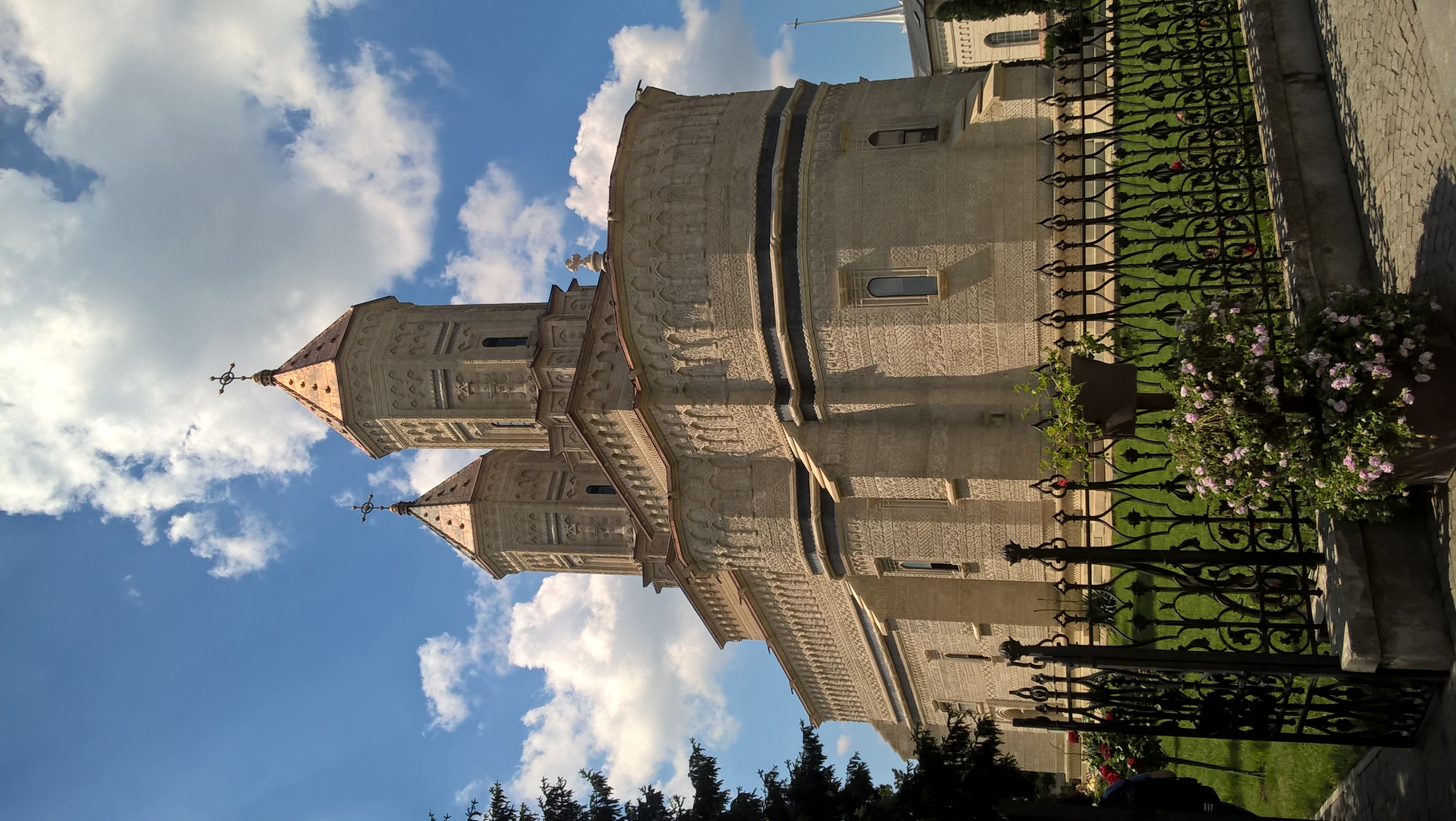
The Trei Ierarhi Monastery, located in Iași, Romania, was founded in 1637 by Vasile Lupu, the Voivode of Moldavia. It was dedicated to the Three Holy Hierarchs: Basil the Great, Gregory the Theologian, and John Chrysostom. The monastery served as a center for culture and education, housing the first printing press in Moldavia and a prestigious academy.
The structure is most famous for its elaborate exterior, which is entirely covered in intricate stone carvings. These decorative patterns combine elements of Oriental, Caucasian, and Byzantine art, featuring over 30 distinct motifs. Despite suffering damage from earthquakes and fires over the centuries, the monastery underwent extensive restoration in the late 19th century, preserving its unique architectural legacy.
Key Facts
- Materials
- Stone, Marble, Gold leaf
- Civilization
- Moldavian
- Accessibility
- Ground level accessible
- Date(s)
- 1637-1639
- Condition
- Restored and active religious site
- Original Function
- Monastery and royal necropolis
- Key Figures
- Vasile Lupu, Dimitrie Cantemir, Alexandru Ioan Cuza
Foundation and Construction
1637-1639Vasile Lupu commissioned the monastery to serve as a symbol of his power and piety. The construction was completed in 1639, and the church was consecrated by Metropolitan Varlaam.
Cultural Center
17th CenturyThe monastery became a hub for intellectual life, hosting the Vasilian Academy and the first printing press in the region, which played a crucial role in the development of the Romanian language.
Restoration
1882-1904Following significant degradation, the French architect André Lecomte du Noüy led a comprehensive restoration project that sought to return the building to its original aesthetic splendor.
Cultural Significance
The Trei Ierarhi Monastery is a cornerstone of Romanian cultural heritage, representing the pinnacle of Moldavian architectural craftsmanship. It serves as the final resting place for several notable historical figures, including Vasile Lupu and the first ruler of modern Romania, Alexandru Ioan Cuza. Its unique facade remains a subject of study for its synthesis of diverse artistic traditions.
Interpretive Notes
Scholarly debates and areas of uncertainty
The extent of the original polychromy and gilding on the exterior stone carvings remains a subject of academic discussion, as the 19th-century restoration significantly altered the original appearance of the facade.
Visiting Information
Entry Rules
Open daily to the public. Visitors are expected to dress modestly, covering shoulders and knees. Silence should be maintained inside the church as it is an active place of worship.
Best Times to Visit
Early morning or late afternoon to avoid peak tourist traffic and to appreciate the light hitting the intricate stone carvings.
Photography
Photography is permitted in the courtyard; however, flash photography is strictly prohibited inside the church.
Preservation Notes
The exterior stone carvings are fragile; visitors are requested not to touch the facade. The site is subject to ongoing maintenance to protect the delicate stone surfaces from environmental erosion.
Nearby POIs
11 shownSources & Further Reading
- [1]The Architecture of the Trei Ierarhi Monastery — Nicolae Iorga. Editura Academiei Române (1930)
- [2]Moldavian Religious Architecture — Tereza Sinigalia. Meridiane Publishing House (1998)
Key Facts
- Materials
- Stone, Marble, Gold leaf
- Civilization
- Moldavian
- Accessibility
- Ground level accessible
- Date(s)
- 1637-1639
- Condition
- Restored and active religious site
- Original Function
- Monastery and royal necropolis
- Key Figures
- Vasile Lupu, Dimitrie Cantemir, Alexandru Ioan Cuza