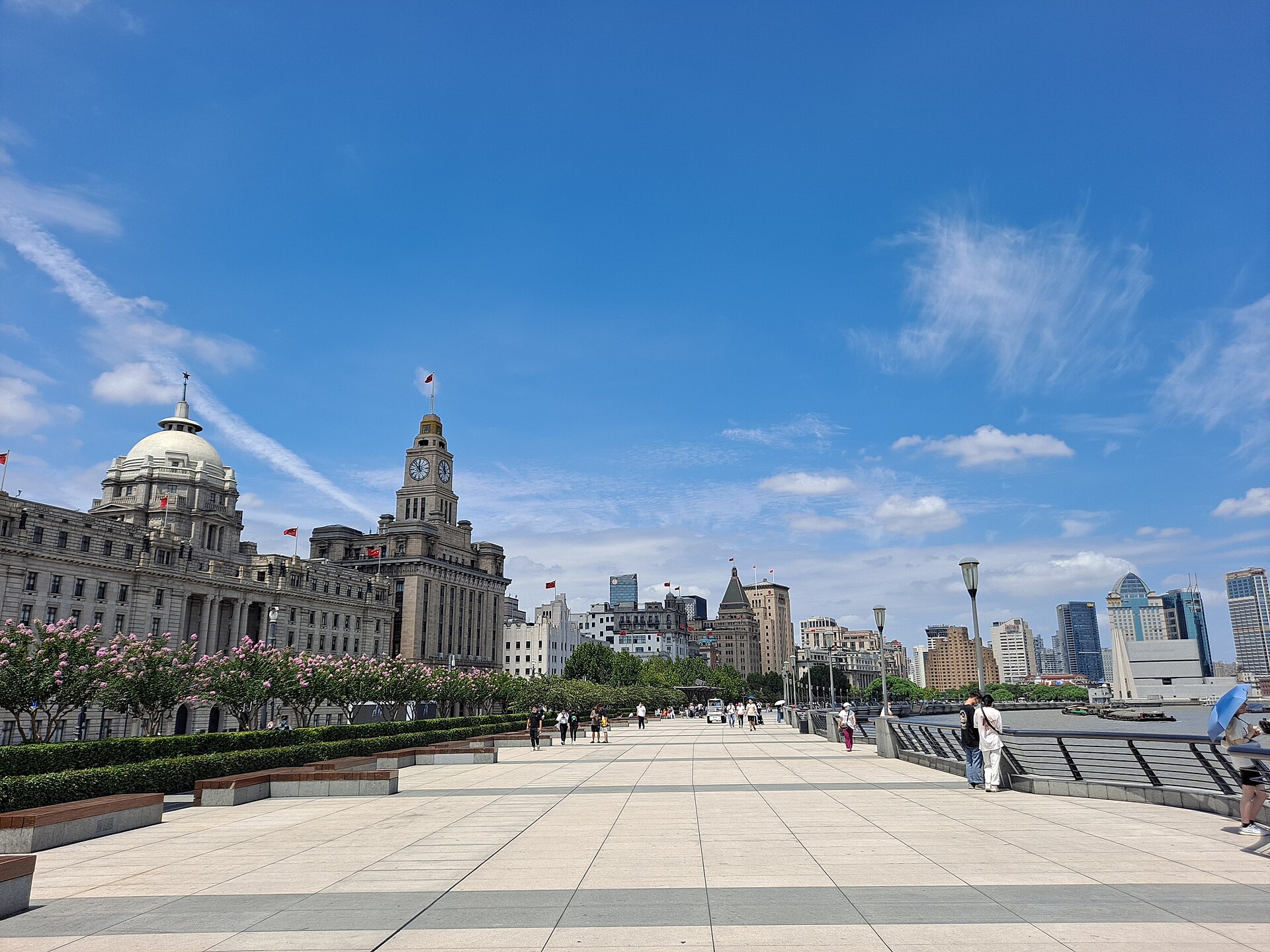
The Bund is a waterfront promenade along the Huangpu River in central Shanghai, renowned for its collection of early 20th-century colonial architecture. The area features a diverse array of styles, including Art Deco, Neoclassical, and Beaux-Arts, which reflect the city's transformation into a global financial and trade hub during the treaty port era.
Historically serving as the center of foreign influence and banking in Shanghai, the district remains a primary symbol of the city's modern development. Today, the promenade offers a distinct contrast between the historic low-rise buildings on the western bank and the contemporary skyscrapers of the Lujiazui financial district across the river.
Key Facts
- Materials
- Granite, Reinforced concrete, Steel, Limestone
- Civilization
- Modern Chinese / International Settlement
- Accessibility
- Fully accessible, pedestrian-friendly promenade
- Date(s)
- 1900s - 1940s
- Condition
- Well-preserved, active commercial and tourist district
- Original Function
- Financial and commercial district
- Key Figures
- Victor Sassoon, Sir Paul Chater
Establishment of the International Settlement
1840s-1900Following the Treaty of Nanking, the area along the Huangpu River was designated as the British Settlement. Initially a muddy towpath, it quickly developed into a bustling wharf and warehouse district for international trade.
The Golden Age of Architecture
1900-1937During the early 20th century, the Bund became the financial heart of East Asia. Major international banks and trading houses constructed grand headquarters, resulting in the dense concentration of Art Deco and Neoclassical buildings seen today.
Post-War and Modern Transformation
1949-PresentFollowing the establishment of the People's Republic of China, many buildings were repurposed for government offices. Since the 1990s, the area has undergone significant restoration and modernization, solidifying its status as a premier cultural and tourist landmark.
Cultural Significance
The Bund serves as a physical record of Shanghai's complex history as a treaty port and its subsequent rise as a global metropolis. It represents the intersection of Western architectural influence and Chinese urban development, acting as a bridge between the city's colonial past and its current status as a financial powerhouse.
Interpretive Notes
Scholarly debates and areas of uncertainty
Debates often center on the preservation of the colonial-era architecture versus the pressure for modern urban redevelopment. Scholars also discuss the extent to which the Bund's architectural identity should be categorized as 'colonial' versus a unique 'Shanghai-style' hybrid that emerged during the 1930s.
Visiting Information
Entry Rules
The promenade is open to the public 24 hours a day. No tickets are required for the waterfront area. Some individual historic buildings may have restricted access or require reservations for interior tours.
Best Times to Visit
Early morning for photography and fewer crowds; evening to view the illumination of the historic buildings and the Lujiazui skyline.
Photography
Personal photography is permitted. Commercial photography or professional filming requires prior authorization from local municipal authorities.
Preservation Notes
The area is protected under municipal heritage regulations. Visitors are requested to remain on designated pathways and respect the integrity of the historic facades.
Nearby POIs
3 shownSources & Further Reading
- [1]Shanghai: Architecture and Urbanism for Modern China — Peter G. Rowe. Prestel (2004)
- [2]The Bund: A History of Shanghai's Waterfront — Hanchao Lu. Journal of Urban History (2002)
Key Facts
- Materials
- Granite, Reinforced concrete, Steel, Limestone
- Civilization
- Modern Chinese / International Settlement
- Accessibility
- Fully accessible, pedestrian-friendly promenade
- Date(s)
- 1900s - 1940s
- Condition
- Well-preserved, active commercial and tourist district
- Original Function
- Financial and commercial district
- Key Figures
- Victor Sassoon, Sir Paul Chater