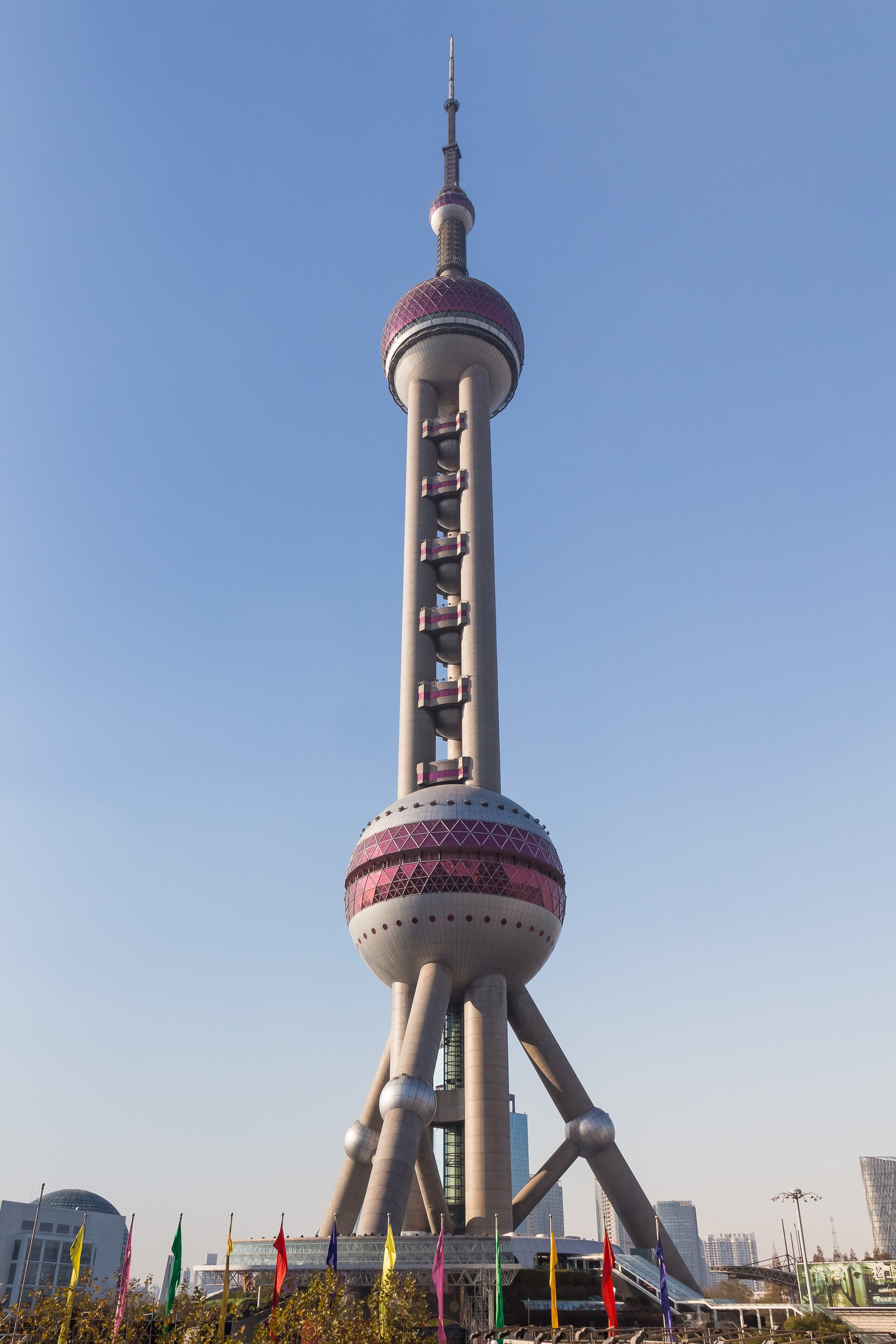
The Oriental Pearl Tower is a prominent television and radio tower located in the Lujiazui financial district of Shanghai, China. Completed in 1994, the structure stands at 468 meters and is characterized by its distinctive design, which features eleven spheres of varying sizes connected by three massive columns. The tower was designed by architects from the Shanghai Modern Architectural Design Co., Ltd. and served as a symbol of China's rapid economic modernization and urban development in the late 20th century.
Beyond its function as a broadcasting hub, the tower serves as a major tourist destination, housing observation decks, a revolving restaurant, and the Shanghai Municipal History Museum at its base. Its unique architectural silhouette, inspired by a poem describing the sound of pearls falling onto a jade plate, remains a defining feature of the Shanghai skyline along the Huangpu River.
Key Facts
- Materials
- Reinforced concrete, Steel, Glass
- Civilization
- Modern China
- Accessibility
- Elevator access to observation levels
- Date(s)
- 1991-1994
- Condition
- Active, fully operational
- Original Function
- Television and radio broadcasting
- Key Figures
- Jiang Huan Cheng
Planning and Construction
1991-1994Construction began in 1991 as part of the broader development plan for the Pudong New Area. The project was intended to provide modern broadcasting capabilities while establishing a landmark that would signal Shanghai's emergence as a global financial center.
Opening and Landmark Status
1994-2000Upon its completion in 1994, the tower became the tallest structure in China, a title it held until 2007. It quickly became the primary visual icon of the city, appearing in numerous international media representations of Shanghai's skyline.
Modern Integration
2000-PresentThe tower continues to function as a critical telecommunications node while maintaining its status as a high-traffic tourist attraction. Ongoing maintenance focuses on the structural integrity of the steel spheres and the modernization of the interior visitor facilities.
Cultural Significance
The Oriental Pearl Tower represents the 'Pudong miracle' and the rapid transformation of Shanghai from an industrial port into a global metropolis. It is deeply embedded in the local identity of Shanghai residents as a symbol of the city's 1990s economic opening and its aspirations for the future.
Culturally, the tower is frequently used as a backdrop for state-sanctioned celebrations and international events, reinforcing its role as a national monument. Its design, which blends futuristic aesthetics with traditional Chinese poetic inspiration, reflects the country's broader effort to synthesize modernity with cultural heritage.
Interpretive Notes
Scholarly debates and areas of uncertainty
Architectural critics have debated the tower's aesthetic value, with some characterizing it as an example of 'kitsch' or 'postmodern excess' due to its unconventional shape. Conversely, others argue that its bold, non-traditional form successfully broke the monotony of standard skyscraper design and provided a necessary, recognizable identity for the newly developed Pudong district.
Visiting Information
Entry Rules
Open daily. Tickets are required for access to the observation decks and the museum. Security screening is mandatory for all visitors. No specific dress code is enforced, but visitors are expected to follow standard public conduct guidelines.
Best Times to Visit
Weekdays during the morning or late evening to avoid peak tourist crowds. Clear weather is essential for visibility from the observation decks.
Photography
Personal photography is permitted throughout the tower. Commercial photography and the use of tripods require prior authorization from the management office.
Preservation Notes
The structure is subject to regular structural health monitoring due to its height and exposure to wind loads. Visitors are requested to remain within designated viewing areas and follow staff instructions regarding elevator capacity.
Nearby POIs
3 shownSources & Further Reading
- [1]Shanghai's Oriental Pearl Tower: A Symbol of Modernity — Wang, J.. Journal of Urban Architecture (2015)
- [2]The Development of Pudong: A Case Study — Zhang, L.. China Urban Planning Review (2018)
Key Facts
- Materials
- Reinforced concrete, Steel, Glass
- Civilization
- Modern China
- Accessibility
- Elevator access to observation levels
- Date(s)
- 1991-1994
- Condition
- Active, fully operational
- Original Function
- Television and radio broadcasting
- Key Figures
- Jiang Huan Cheng