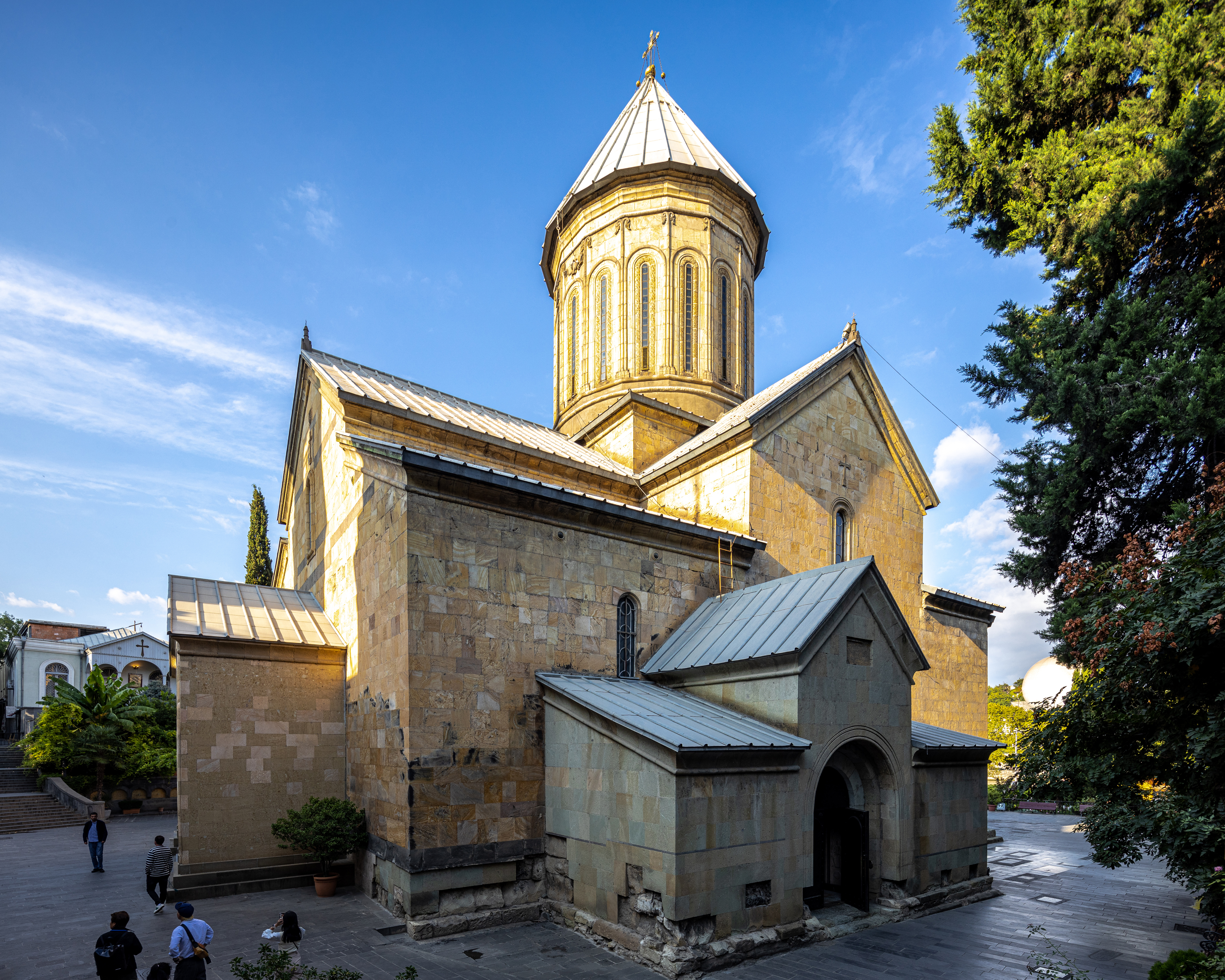
The Sioni Cathedral of the Dormition is a historic Georgian Orthodox cathedral located in the old town of Tbilisi. Its name is derived from Mount Zion in Jerusalem, reflecting a common tradition in medieval Georgia of naming churches after holy sites in the Holy Land.
The current structure is a result of various reconstructions spanning from the 13th to the 19th centuries. It serves as the seat of the Catholicos-Patriarch of All Georgia and remains one of the most significant religious landmarks in the country, housing the sacred Cross of Saint Nino, which is said to have been used by the saint to convert Georgians to Christianity.
Key Facts
- Materials
- Tuff, Stone
- Civilization
- Georgian
- Accessibility
- Ground level access, cobblestone surroundings
- Date(s)
- 6th-7th century (original), 13th century (reconstruction)
- Condition
- Active religious site, well-preserved
- Original Function
- Cathedral
- Key Figures
- Saint Nino, King David the Builder
Foundations
6th-7th CenturyThe original church was founded by Guaram I, the presiding prince of Iberia, in the late 6th century. It was later completed by his successor, Adarnase I, in the 7th century.
Medieval Reconstruction
13th CenturyThe cathedral was largely destroyed by foreign invasions, most notably by the Khwarazmian Empire. It was rebuilt in the 13th century, establishing the core architectural form seen today.
Later Modifications
17th-19th CenturyThe cathedral underwent significant renovations in the 17th century and again in the 19th century, when the interior was painted with frescoes by the Russian artist Grigory Gagarin.
Cultural Significance
The Sioni Cathedral is a cornerstone of Georgian national identity and religious life. As the primary cathedral of Tbilisi for centuries, it has witnessed the coronation and burial of Georgian monarchs and remains the symbolic heart of the Georgian Orthodox Church.
Interpretive Notes
Scholarly debates and areas of uncertainty
There is ongoing academic discussion regarding the exact extent of the original 6th-century foundations versus the 13th-century rebuild, as the site has been heavily modified by successive restorations.
Visiting Information
Entry Rules
Open daily. Free entry. Modest dress is required; women should cover their heads and men should remove hats. Photography is generally discouraged inside during services.
Best Times to Visit
Early morning or late afternoon to avoid peak tourist crowds and to experience the atmosphere of daily liturgical services.
Photography
Photography is permitted in the exterior; interior photography is restricted during religious services.
Preservation Notes
The cathedral is an active place of worship; please maintain silence and respect the sanctity of the space. Do not touch the frescoes or historical artifacts.
Nearby POIs
11 shownSources & Further Reading
- [1]The Christian Monuments of Georgia — Nodar Shoshiashvili. Georgian Academy of Sciences (1998)
- [2]Tbilisi: A Guide to the History and Architecture — Giorgi Beridze. Tbilisi University Press (2005)
Key Facts
- Materials
- Tuff, Stone
- Civilization
- Georgian
- Accessibility
- Ground level access, cobblestone surroundings
- Date(s)
- 6th-7th century (original), 13th century (reconstruction)
- Condition
- Active religious site, well-preserved
- Original Function
- Cathedral
- Key Figures
- Saint Nino, King David the Builder