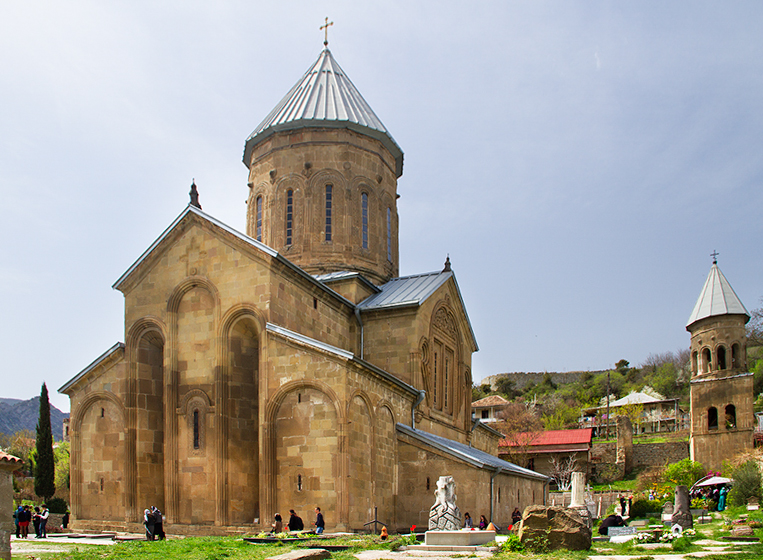
Samtavro's Convent is a significant religious complex located in Mtskheta, the ancient capital of Georgia. The site is centered around the Samtavro Transfiguration Church, a major architectural monument dating back to the 11th century, commissioned by King George I and Catholicos-Patriarch Melchizedek I. The complex is historically revered as the site where King Mirian III and Queen Nana, the first Christian monarchs of Georgia, were baptized and subsequently buried.
The convent grounds also house the smaller 4th-century St. Nino Church, which marks the spot where Saint Nino, the enlightener of Georgia, lived in a blackberry bush while preaching Christianity. As part of the Historical Monuments of Mtskheta, the site is recognized for its profound role in the Christianization of the Georgian kingdom and remains an active center of monastic life today.
Key Facts
- Materials
- Sandstone, Tuff, Limestone
- Civilization
- Medieval Georgian
- Accessibility
- Ground level access, some uneven terrain
- Date(s)
- 11th century (main church)
- Condition
- Active convent and well-preserved monument
- Original Function
- Monastic complex and royal burial site
- Key Figures
- King Mirian III, Queen Nana, Saint Nino, Gabriel Urgebadze
Early Foundations
4th centuryThe site originated with the construction of a small church by King Mirian III following his conversion to Christianity. It is traditionally associated with Saint Nino, who resided in the vicinity during her missionary work in the region.
The Great Cathedral
11th centuryThe current main church was built in the 11th century to replace earlier structures. It represents the classic Georgian cross-in-square architectural style, characterized by its high dome and ornate stone carvings on the exterior facades.
Modern Era and Canonization
20th century - presentIn recent decades, the convent gained renewed prominence as the final resting place of Archimandrite Gabriel Urgebadze, a widely venerated Georgian Orthodox saint. His grave has become a major site of pilgrimage, drawing thousands of visitors annually.
Cultural Significance
Samtavro serves as a cornerstone of Georgian national and religious identity. It links the early adoption of Christianity in the 4th century to the medieval golden age of Georgian architecture. The presence of the royal tombs and the relics of modern saints makes it a vital site for both historical study and contemporary spiritual practice.
Interpretive Notes
Scholarly debates and areas of uncertainty
Debates exist regarding the exact structural evolution of the site, specifically the extent to which 11th-century builders incorporated foundations from the original 4th-century church. Archaeological investigations continue to clarify the layout of the early monastic cells.
Visiting Information
Entry Rules
Open daily. As an active convent, visitors are expected to dress modestly; women should cover their heads and wear skirts, and men should wear long trousers. Entry is free, but visitors should remain respectful of ongoing services and the monastic community.
Best Times to Visit
Early morning or late afternoon to avoid peak tourist groups. Spring and autumn offer the most comfortable weather for exploring the grounds.
Photography
Photography is generally permitted in the courtyard, but strictly prohibited inside the churches during services. No flash photography allowed.
Preservation Notes
The site is part of a UNESCO World Heritage property; visitors should stay on designated paths and avoid touching the historic stone carvings or frescoes.
Nearby POIs
11 shown- Museum Of Mtskheta0.2 km
- Svetitskhoveli Cathedral0.6 km
- Bebristsikhe1.1 km
- Jvari Monastery1.6 km
- Zedazeni Monastery4.8 km
- Armazi Citadel5.4 km
- Shiomgvime Monastery6.7 km
- Chronicles of Georgia11.4 km
- Georgian State Silk Museum15 km
- Art Palace of Georgia15.3 km
- Giorgi Chitaia Open Air Museum of Ethnography16.2 km
Sources & Further Reading
- [1]
- [2]Georgian Architecture: A History — Rusudan Beridze. Georgian National Museum Press (2015)
Key Facts
- Materials
- Sandstone, Tuff, Limestone
- Civilization
- Medieval Georgian
- Accessibility
- Ground level access, some uneven terrain
- Date(s)
- 11th century (main church)
- Condition
- Active convent and well-preserved monument
- Original Function
- Monastic complex and royal burial site
- Key Figures
- King Mirian III, Queen Nana, Saint Nino, Gabriel Urgebadze
Nearby POIs
11 shown- Museum Of Mtskheta0.2 km
- Svetitskhoveli Cathedral0.6 km
- Bebristsikhe1.1 km
- Jvari Monastery1.6 km
- Zedazeni Monastery4.8 km
- Armazi Citadel5.4 km
- Shiomgvime Monastery6.7 km
- Chronicles of Georgia11.4 km
- Georgian State Silk Museum15 km
- Art Palace of Georgia15.3 km
- Giorgi Chitaia Open Air Museum of Ethnography16.2 km