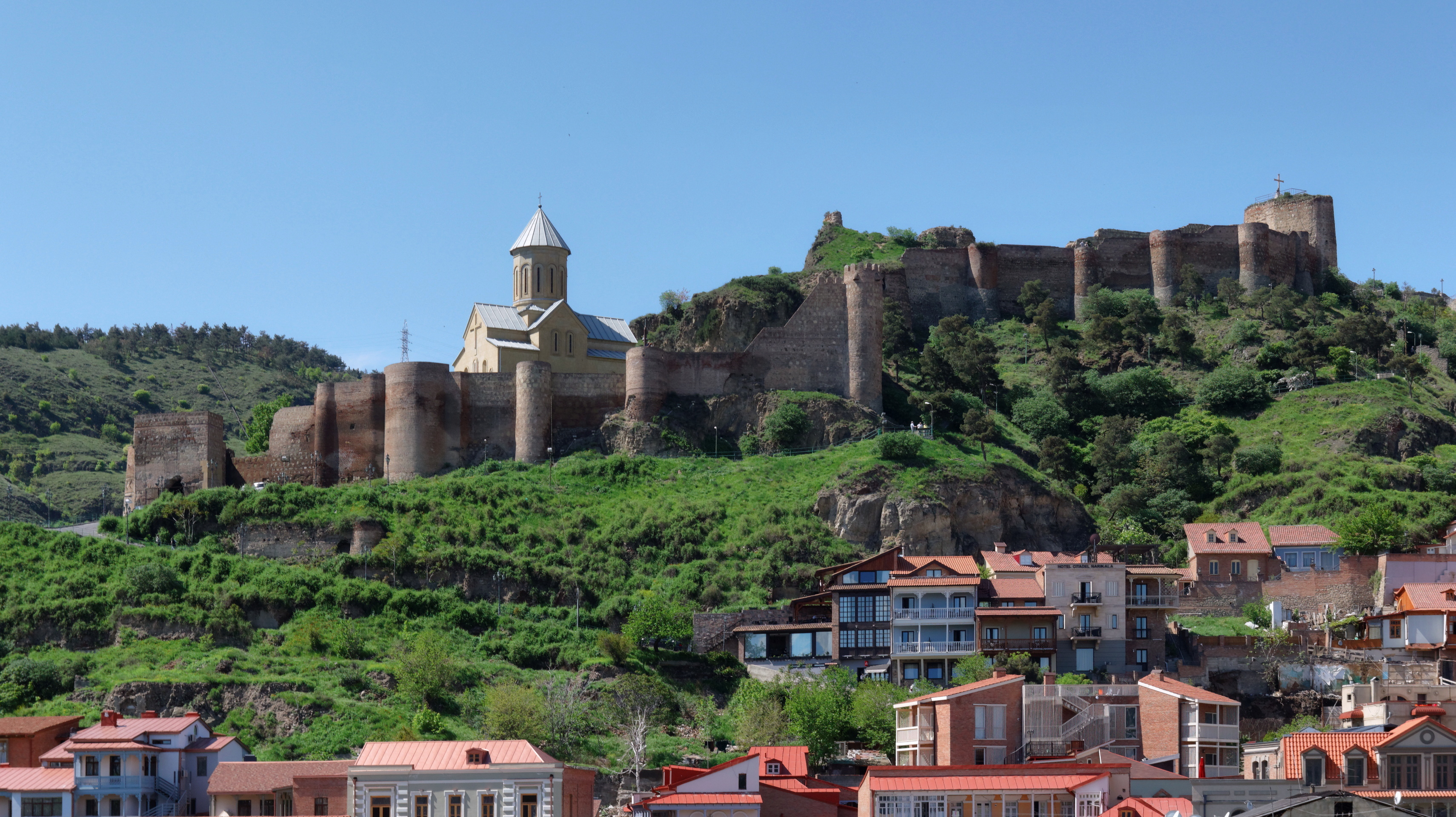
Narikala is an ancient fortress overlooking Tbilisi, the capital of Georgia, and the Kura River. The defensive complex consists of two walled sections on a steep hill between the sulfur baths and the botanical gardens of Tbilisi. The lower court contains the recently reconstructed St. Nicholas Church, which serves as a prominent landmark visible from much of the city.
While the earliest fortifications date back to the 4th century, the majority of the existing walls were constructed during the 8th century by the Umayyads and subsequently expanded by the kings of Georgia. The site has undergone numerous sieges and reconstructions throughout its history, reflecting the strategic importance of Tbilisi as a crossroads between empires.
Key Facts
- Materials
- Stone, Brick
- Civilization
- Georgian
- Accessibility
- Accessible via cable car or steep hiking path; uneven terrain
- Date(s)
- 4th century CE
- Condition
- Partially restored, ruins accessible to the public
- Original Function
- Defensive fortification
- Key Figures
- King David the Builder, King Rostom of Kartli
Foundations
4th centuryOriginally known as Shuris-tsikhe (Invidious Fort), the site was established as a Persian citadel to protect the growing settlement of Tbilisi.
Expansion and Conflict
8th-17th centuryThe fortress was significantly expanded by the Umayyad Caliphate in the 8th century. It served as the primary defensive stronghold for the Kingdom of Georgia, enduring repeated invasions by Mongols, Persians, and Ottomans.
Modern Reconstruction
1990s-presentFollowing the collapse of the Soviet Union, the St. Nicholas Church was reconstructed on the site of the original medieval church, which had been destroyed by fire in the 13th century.
Cultural Significance
Narikala is a symbol of Tbilisi's resilience and historical endurance. It represents the city's long history as a contested territory and a center of trade along the Silk Road. The fortress remains a central point for cultural tourism and provides a panoramic vantage point for understanding the urban development of the city.
Interpretive Notes
Scholarly debates and areas of uncertainty
The exact extent of the original 4th-century foundations remains a subject of archaeological investigation, as subsequent layers of construction have obscured the earliest defensive layouts.
Visiting Information
Entry Rules
Open 24 hours. Free admission to the fortress grounds. Modest dress is required for entry into the St. Nicholas Church.
Best Times to Visit
Early morning or sunset for optimal lighting and cooler temperatures. Avoid midday during summer months due to lack of shade.
Photography
Photography is permitted throughout the site. Commercial filming requires prior authorization from local authorities.
Preservation Notes
The site features steep drops and uneven stone surfaces; visitors are advised to stay on marked paths. Restoration work is ongoing in various sections of the walls.
Nearby POIs
11 shownSources & Further Reading
- [1]Tbilisi: A History of the City — B. G. Hewitt. Oxford University Press (2004)
- [2]The Fortress of Narikala: Archaeological Perspectives — Giorgi Lortkipanidze. Georgian National Museum Press (2015)
Key Facts
- Materials
- Stone, Brick
- Civilization
- Georgian
- Accessibility
- Accessible via cable car or steep hiking path; uneven terrain
- Date(s)
- 4th century CE
- Condition
- Partially restored, ruins accessible to the public
- Original Function
- Defensive fortification
- Key Figures
- King David the Builder, King Rostom of Kartli