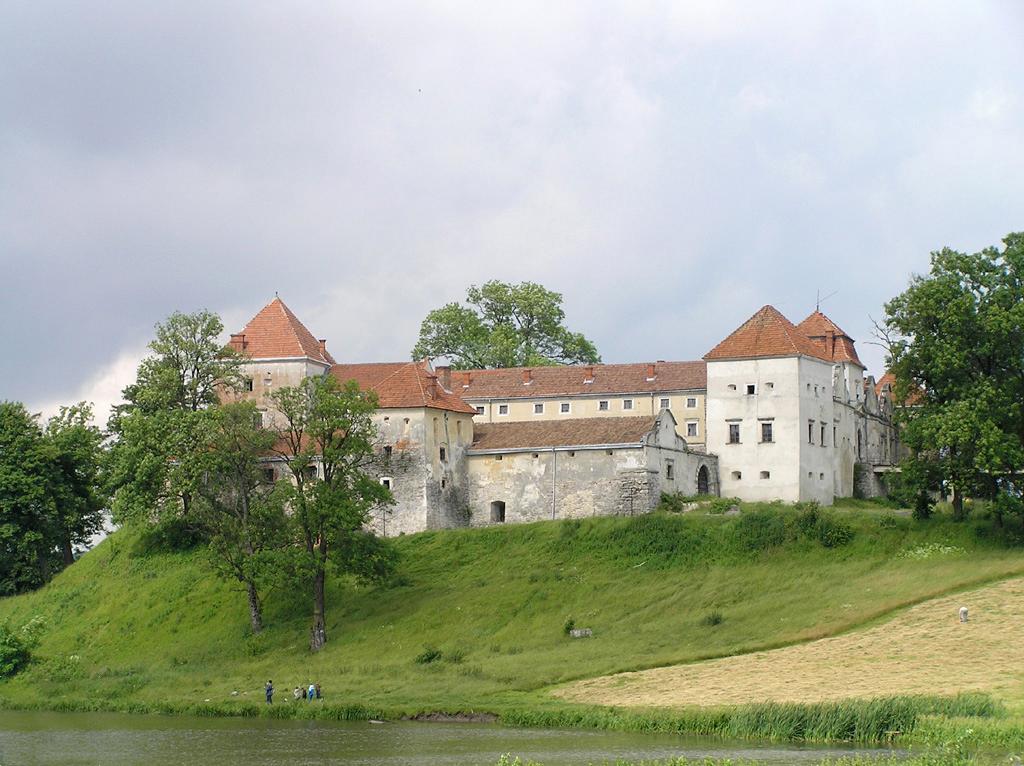
Svirzh Castle is a fortified structure located in the village of Svirzh, Lvov Oblast, Ukraine. Originally constructed in the 15th century as a defensive stronghold, the castle underwent significant architectural modifications in the 17th century, transitioning from a purely military fortification into a residential palace complex.
The site is situated on a hill surrounded by a lake and parkland, which historically served as part of its defensive perimeter. While the castle has suffered from various conflicts and periods of neglect throughout its history, it remains a notable example of the transition between defensive architecture and aristocratic residence in the region.
Key Facts
- Materials
- Stone, Brick
- Civilization
- Polish-Lithuanian Commonwealth
- Accessibility
- Limited; exterior grounds accessible, interior access restricted
- Date(s)
- 15th century
- Condition
- Partially restored, currently under state management
- Original Function
- Defensive fortress
- Key Figures
- Count Aleksander Cetner
Origins and Early Fortifications
15th centuryThe castle was established as a defensive outpost to protect the surrounding lands. Its initial design focused on military utility, featuring thick walls and a strategic position overlooking the Svirzh River.
Renaissance Transformation
17th centuryUnder the ownership of Count Aleksander Cetner, the fortress was extensively rebuilt. The structure was transformed into a fortified palace, incorporating Renaissance architectural elements and decorative features while maintaining its defensive capabilities.
Modern Era and Cinematic Use
20th century - presentFollowing periods of damage during the World Wars, the castle gained fame in the late 20th century as a popular filming location for Soviet and Ukrainian cinema, most notably appearing in the film 'D'Artagnan and Three Musketeers'. Recent years have seen ongoing efforts to preserve the structure.
Cultural Significance
Svirzh Castle serves as a significant landmark of the Lvov region, representing the architectural evolution of noble residences in the borderlands of the Polish-Lithuanian Commonwealth. It is deeply embedded in the local cultural consciousness, largely due to its frequent use as a backdrop in historical films, which has helped maintain its profile despite its remote location.
Interpretive Notes
Scholarly debates and areas of uncertainty
There is ongoing discussion among architectural historians regarding the extent of the original 15th-century layout versus the 17th-century additions, as many records were lost during the 20th-century conflicts.
Visiting Information
Entry Rules
The castle grounds are generally accessible to the public, but the interior is often closed for restoration. Visitors should check local tourism boards for current access status before traveling.
Best Times to Visit
Late spring and early autumn offer the best conditions for viewing the surrounding parkland and lake.
Photography
Personal photography is permitted on the grounds. Commercial filming requires prior authorization from the regional administration.
Preservation Notes
The structure is fragile; visitors are advised to stay on marked paths and avoid entering areas marked as under construction or structurally unstable.
Nearby POIs
11 shown- Shevchenkivskyi Hai34 km
- Bernardine Church35.4 km
- Dominican Church35.6 km
- Cathedral Basilica of the Assumption35.7 km
- Palazzo Bandinelli35.7 km
- Pharmacy Museum35.7 km
- Potocki Palace35.7 km
- Borys Voznytsky Lvov National Art Gallery35.8 km
- Saints Peter and Paul Garrison Church35.8 km
- Armenian Cathedral of Lvov35.9 km
- Andrey Sheptytsky National Museum36 km
Sources & Further Reading
- [1]Castles and Fortresses of Ukraine — Orest Matsyuk. Center of Europe Publishing (2005)
- [2]Architectural Heritage of the Lviv Region — Hryhoriy Lohvyn. Mistetstvo (1998)
Key Facts
- Materials
- Stone, Brick
- Civilization
- Polish-Lithuanian Commonwealth
- Accessibility
- Limited; exterior grounds accessible, interior access restricted
- Date(s)
- 15th century
- Condition
- Partially restored, currently under state management
- Original Function
- Defensive fortress
- Key Figures
- Count Aleksander Cetner
Nearby POIs
11 shown- Shevchenkivskyi Hai34 km
- Bernardine Church35.4 km
- Dominican Church35.6 km
- Cathedral Basilica of the Assumption35.7 km
- Palazzo Bandinelli35.7 km
- Pharmacy Museum35.7 km
- Potocki Palace35.7 km
- Borys Voznytsky Lvov National Art Gallery35.8 km
- Saints Peter and Paul Garrison Church35.8 km
- Armenian Cathedral of Lvov35.9 km
- Andrey Sheptytsky National Museum36 km