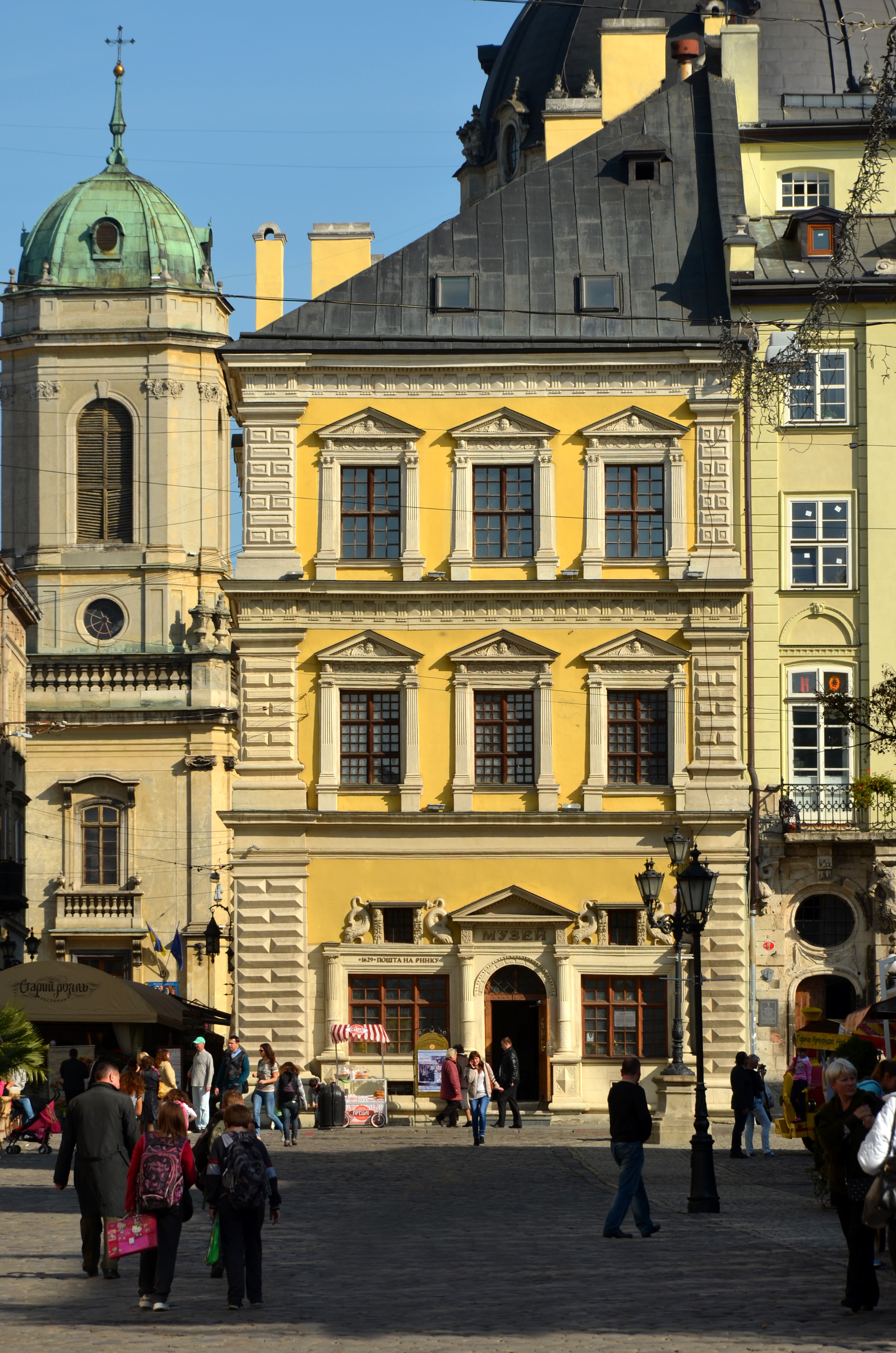
The Bandinelli Palace is a prominent Renaissance-style merchant house located on Rynok Square in the historic center of Lvov, Ukraine. Originally constructed in the late 16th century, the building is renowned for its elaborate stone carvings and its historical significance as the site of the city's first official post office, established in 1629 by the Italian merchant Roberto Bandinelli.
The structure underwent significant modifications in the 18th century, which introduced Baroque elements to its facade and interior layout. Today, the palace serves as a museum and cultural space, housing the Lvov Historical Museum's collection of royal portraits and historical artifacts, while maintaining its status as a key architectural landmark within the UNESCO-listed Lvov Old Town.
Key Facts
- Materials
- Stone, Brick, Plaster
- Civilization
- Polish-Lithuanian Commonwealth
- Accessibility
- Ground floor accessible; upper floors via stairs
- Date(s)
- 1589
- Condition
- Restored and active as a museum
- Original Function
- Residential merchant house and post office
- Key Figures
- Roberto Bandinelli
Construction and Early Ownership
1589The building was originally commissioned by the pharmacist Jarosz Wedelski. Its early architecture reflected the late Renaissance style prevalent among the wealthy merchant class of Lvov during the late 16th century.
The Bandinelli Era
1629Roberto Bandinelli, a merchant of Italian descent, acquired the property and established the first regular postal service in Lvov. This innovation connected the city to major European trade routes, cementing the building's role in regional commerce.
Baroque Reconstruction
18th centuryFollowing a period of decline and structural damage, the palace underwent a major reconstruction in the 18th century. This phase added the characteristic Baroque decorative elements to the facade and reorganized the interior spaces.
Modern Restoration
20th-21st centuryAfter decades of neglect during the Soviet era, the building underwent extensive restoration work in the early 2000s. The project successfully preserved the original stone carvings and restored the interior to house the Lvov Historical Museum.
Cultural Significance
The Bandinelli Palace is a symbol of Lvov's historical identity as a multicultural trade hub. Its association with the first post office highlights the city's early integration into European communication networks. The building's architecture serves as a physical record of the transition from Renaissance merchant wealth to the later Baroque aesthetic that defines much of the Rynok Square ensemble.
Interpretive Notes
Scholarly debates and areas of uncertainty
There is minor academic discussion regarding the extent of the original 16th-century facade versus the 18th-century modifications, as some decorative elements were heavily reconstructed during the 2005 restoration process.
Visiting Information
Entry Rules
Open Tuesday through Sunday. Tickets can be purchased at the entrance. Photography is permitted for personal use.
Best Times to Visit
Weekday mornings are recommended to avoid the heavy tourist foot traffic on Rynok Square.
Photography
Flash photography is prohibited inside the museum galleries to protect sensitive artifacts.
Preservation Notes
Visitors are requested to refrain from touching the stone carvings on the exterior facade and to follow designated paths within the museum.
Nearby POIs
11 shown- Pharmacy Museum
- Dominican Church0.1 km
- Armenian Cathedral of Lvov0.2 km
- Cathedral Basilica of the Assumption0.2 km
- Saints Peter and Paul Garrison Church0.3 km
- Andrey Sheptytsky National Museum0.3 km
- Bernardine Church0.4 km
- Potocki Palace0.6 km
- Borys Voznytsky Lvov National Art Gallery0.8 km
- House of Scientists0.8 km
- St. George's Cathedral1.5 km
Sources & Further Reading
- [1]Lviv: A Guide to the City — Grzegorz Rąkowski. Rewasz (2008)
- [2]The Architecture of Lviv — Yuriy Biryulov. Centrum Europy (2005)
Key Facts
- Materials
- Stone, Brick, Plaster
- Civilization
- Polish-Lithuanian Commonwealth
- Accessibility
- Ground floor accessible; upper floors via stairs
- Date(s)
- 1589
- Condition
- Restored and active as a museum
- Original Function
- Residential merchant house and post office
- Key Figures
- Roberto Bandinelli
Nearby POIs
11 shown- Pharmacy Museum
- Dominican Church0.1 km
- Armenian Cathedral of Lvov0.2 km
- Cathedral Basilica of the Assumption0.2 km
- Saints Peter and Paul Garrison Church0.3 km
- Andrey Sheptytsky National Museum0.3 km
- Bernardine Church0.4 km
- Potocki Palace0.6 km
- Borys Voznytsky Lvov National Art Gallery0.8 km
- House of Scientists0.8 km
- St. George's Cathedral1.5 km