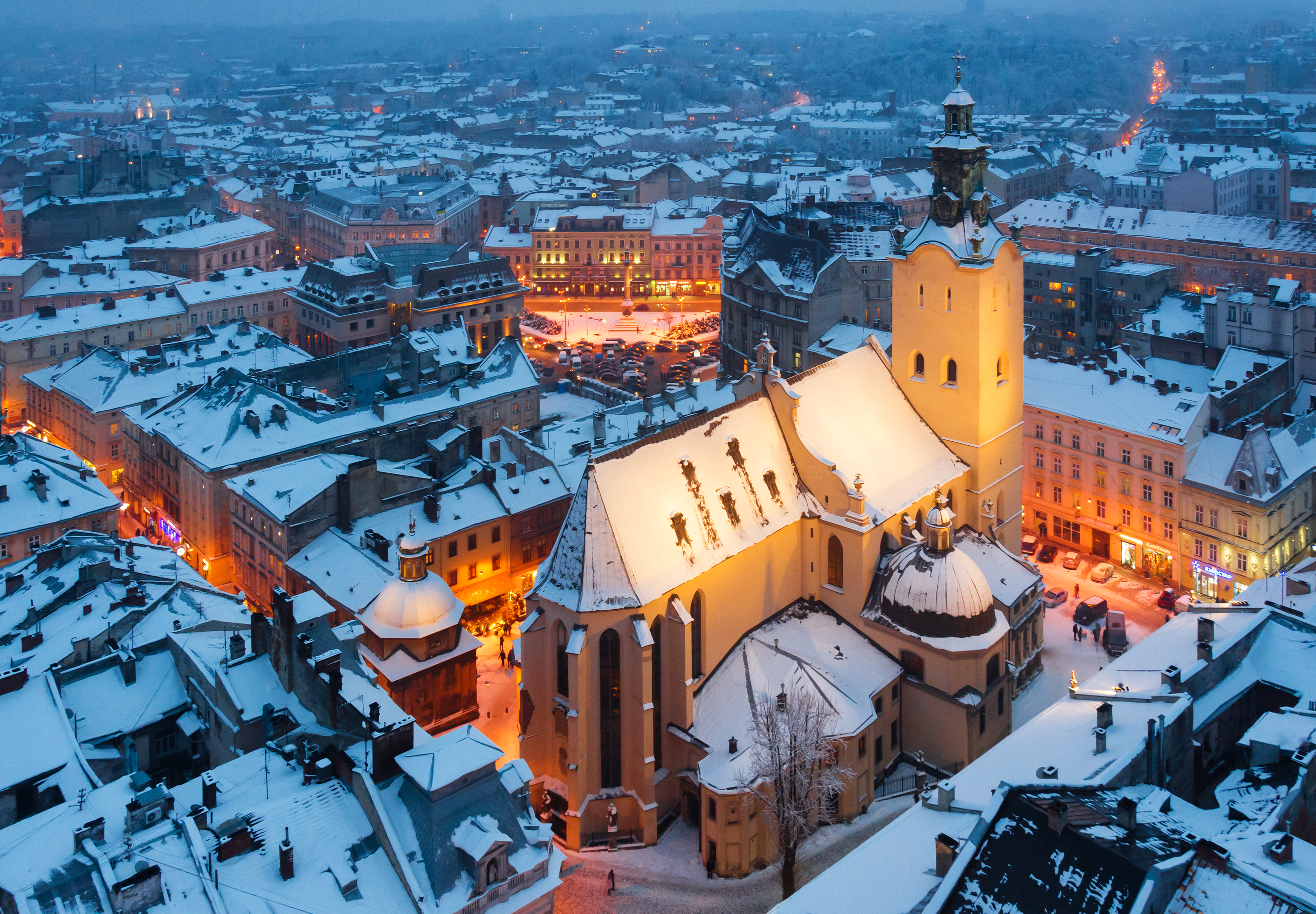
The Cathedral Basilica of the Assumption, also known as the Latin Cathedral, is a Roman Catholic cathedral located in the historic center of Lvov, Ukraine. Construction began in the 14th century, with the building evolving over several centuries to incorporate a complex blend of Gothic, Renaissance, and Baroque architectural elements. It serves as the seat of the Roman Catholic Archdiocese of Lvov.
The structure is characterized by its imposing bell tower and a series of chapels added during the 17th and 18th centuries. The interior features elaborate frescoes, ornate altars, and stained glass, reflecting the diverse cultural and religious history of the region. As a central landmark of the Lvpv Old Town, it remains an active place of worship and a significant site for historical and architectural study.
Key Facts
- Materials
- Stone, Brick
- Civilization
- Polish-Lithuanian Commonwealth
- Accessibility
- Ground level access available
- Date(s)
- 1360–1481
- Condition
- Active religious site, well-preserved
- Original Function
- Cathedral
- Key Figures
- Casimir III the Great, Pope John Paul II
Foundation and Early Gothic Period
14th CenturyThe construction of the cathedral was initiated by King Casimir III the Great around 1360. The initial structure was built in the Gothic style, serving the growing Roman Catholic community in Lvov.
Renaissance and Baroque Expansion
17th-18th CenturyFollowing a major fire in 1527, the cathedral underwent significant reconstruction. During the 17th and 18th centuries, the interior was heavily remodeled in the Baroque style, adding numerous side chapels and decorative elements.
Modern Era and Restoration
20th Century - PresentThe cathedral survived the turbulent 20th century and underwent extensive restoration efforts in the post-Soviet period. In 2001, it was visited by Pope John Paul II, marking a significant moment in its modern history.
Cultural Significance
The cathedral is a cornerstone of Lvov's religious and cultural identity, representing the historical presence of the Roman Catholic Church in Western Ukraine. It stands as a testament to the city's multi-ethnic and multi-confessional heritage, having served as a focal point for the Polish and Latin-rite communities for centuries.
Interpretive Notes
Scholarly debates and areas of uncertainty
There is ongoing academic discussion regarding the extent of the original Gothic layout versus the modifications introduced during the Baroque period, particularly concerning the structural integrity of the older foundations during the 18th-century renovations.
Visiting Information
Entry Rules
Open to the public daily. Visitors are requested to maintain silence and dress modestly. Access may be restricted during liturgical services.
Best Times to Visit
Weekday mornings are generally quieter for visitors. The cathedral is particularly significant during major Catholic feast days.
Photography
Photography is permitted without flash. Tripods and professional equipment require prior permission from the parish office.
Preservation Notes
The site is part of the UNESCO World Heritage Lvov Ensemble. Visitors should refrain from touching historical frescoes and stone carvings.
Nearby POIs
11 shown- Saints Peter and Paul Garrison Church0.1 km
- Palazzo Bandinelli0.2 km
- Pharmacy Museum0.2 km
- Armenian Cathedral of Lvov0.3 km
- Andrey Sheptytsky National Museum0.3 km
- Bernardine Church0.3 km
- Dominican Church0.3 km
- Potocki Palace0.4 km
- Borys Voznytsky Lvov National Art Gallery0.6 km
- House of Scientists0.7 km
- St. George's Cathedral1.3 km
Sources & Further Reading
- [1]Lviv: A Guide to the City — Grzegorz Rąkowski. Rewasz (2008)
- [2]The Architecture of Lviv — Yurii Biryulov. Lviv Polytechnic Publishing (2005)
Key Facts
- Materials
- Stone, Brick
- Civilization
- Polish-Lithuanian Commonwealth
- Accessibility
- Ground level access available
- Date(s)
- 1360–1481
- Condition
- Active religious site, well-preserved
- Original Function
- Cathedral
- Key Figures
- Casimir III the Great, Pope John Paul II
Nearby POIs
11 shown- Saints Peter and Paul Garrison Church0.1 km
- Palazzo Bandinelli0.2 km
- Pharmacy Museum0.2 km
- Armenian Cathedral of Lvov0.3 km
- Andrey Sheptytsky National Museum0.3 km
- Bernardine Church0.3 km
- Dominican Church0.3 km
- Potocki Palace0.4 km
- Borys Voznytsky Lvov National Art Gallery0.6 km
- House of Scientists0.7 km
- St. George's Cathedral1.3 km