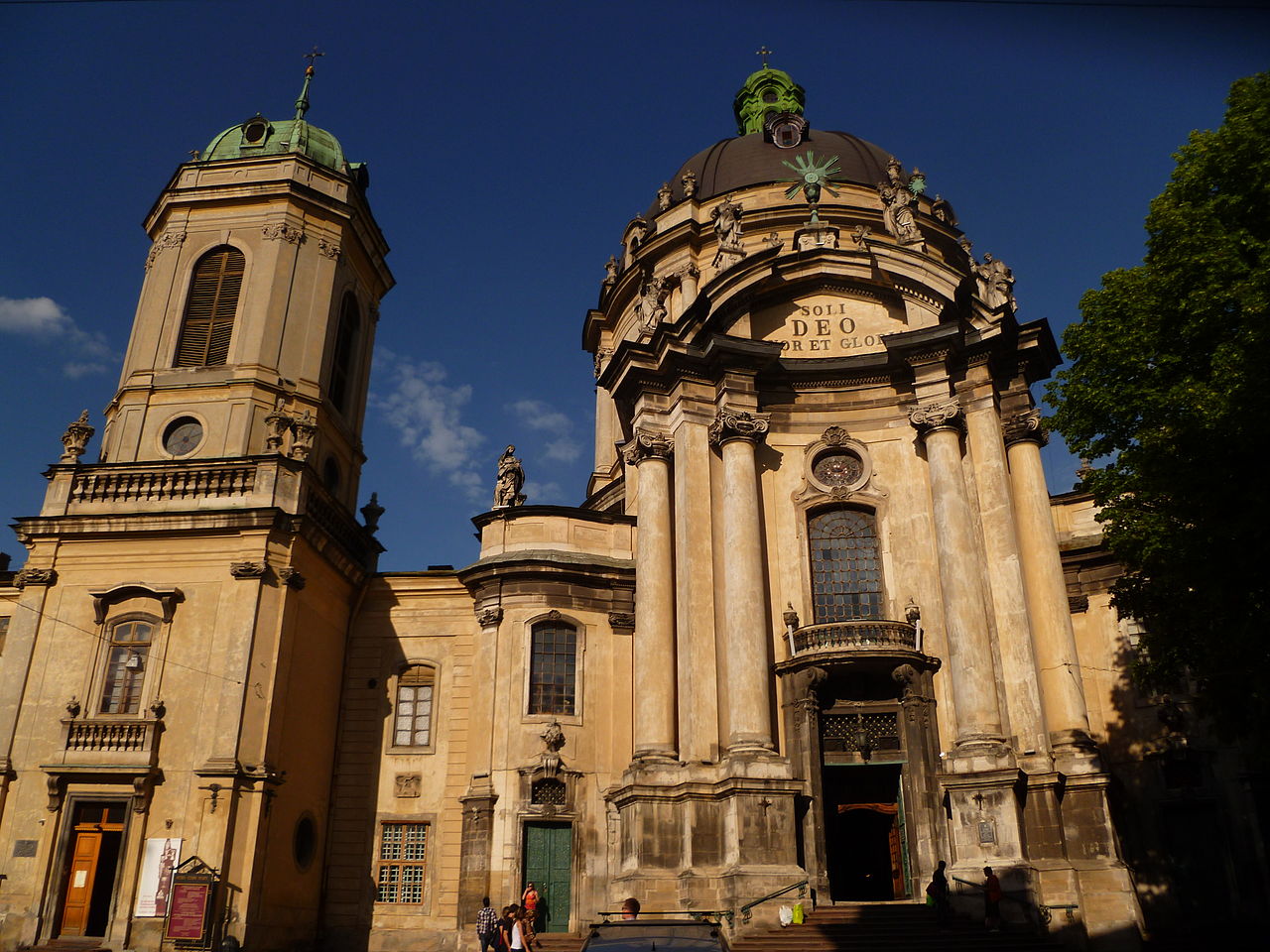
The Dominican Church in Lvov, dedicated to the Holy Eucharist, is a prominent architectural landmark located in the city's historic center. Originally constructed as a Roman Catholic church for the Dominican Order, the building is renowned for its late Baroque design, characterized by a massive elliptical dome and a highly decorative facade.
The structure was built on the site of an earlier Gothic church, with the current edifice completed in the mid-18th century. Following the Soviet era, during which it served as a museum of religion and atheism, the church was returned to religious use and now functions as a Greek Catholic cathedral, serving as a focal point for the local community and a key component of the Lvov UNESCO World Heritage site.
Key Facts
- Materials
- Stone, Brick, Plaster
- Civilization
- Polish-Lithuanian Commonwealth
- Accessibility
- Ground level access with some uneven historic paving
- Date(s)
- 1749-1764
- Condition
- Active Greek Catholic Cathedral
- Original Function
- Roman Catholic Church
- Key Figures
- Jan de Witte, Józef Potocki
Early Foundations
14th centuryThe Dominican Order established a presence in Lvov shortly after the city's founding. The initial Gothic church served as the spiritual center for the Dominican friars for several centuries before structural instability necessitated a complete reconstruction.
Baroque Reconstruction
1749-1764The current church was commissioned by Józef Potocki and designed by military engineer Jan de Witte. The design was heavily influenced by the Karlskirche in Vienna, utilizing a grand elliptical plan and a prominent dome that dominates the Lvov skyline.
Soviet Era Transformation
1946-1990Following the incorporation of Lvov into the Soviet Union, the church was closed for religious services. It was repurposed as the Museum of the History of Religion and Atheism, which led to significant interior modifications but ensured the preservation of the building's exterior shell.
Restoration and Current Use
1990-presentWith the independence of Ukraine, the building was returned to the Greek Catholic Church. Extensive restoration efforts have been undertaken to repair the interior frescoes and structural elements, restoring its status as both a place of worship and a cultural monument.
Cultural Significance
The Dominican Church is a symbol of Lvov's multi-confessional history and its architectural evolution. Its transition from a Roman Catholic stronghold to a Greek Catholic cathedral reflects the shifting demographics and religious landscape of Western Ukraine over the last three centuries.
Beyond its religious role, the church is a cornerstone of the Lvov Old Town UNESCO World Heritage site. It serves as a venue for classical music concerts and is frequently cited as one of the finest examples of late Baroque architecture in Eastern Europe.
Interpretive Notes
Scholarly debates and areas of uncertainty
There is ongoing academic discussion regarding the extent of the influence of the Karlskirche in Vienna on Jan de Witte's design. While the similarities in the dome and facade are clear, some scholars argue that the local Lvov architectural tradition played a more significant role in the specific spatial configuration of the interior than previously acknowledged.
Visiting Information
Entry Rules
Open daily to the public. As an active cathedral, visitors are requested to remain quiet and respectful during services. Modest dress is recommended.
Best Times to Visit
Morning hours are best for viewing the interior lighting. The church is particularly significant during major religious holidays in the Greek Catholic calendar.
Photography
Personal photography is permitted without flash. Professional photography or video recording requires prior permission from the church administration.
Preservation Notes
The building is a protected monument. Visitors should avoid touching the historic frescoes and interior sculptures. Restoration work may occasionally restrict access to certain side chapels.
Nearby POIs
11 shown- Palazzo Bandinelli0.1 km
- Pharmacy Museum0.1 km
- Armenian Cathedral of Lvov0.2 km
- Cathedral Basilica of the Assumption0.3 km
- Bernardine Church0.4 km
- Saints Peter and Paul Garrison Church0.4 km
- Andrey Sheptytsky National Museum0.4 km
- Potocki Palace0.7 km
- Borys Voznytsky Lvov National Art Gallery0.9 km
- House of Scientists0.9 km
- St. George's Cathedral1.6 km
Sources & Further Reading
- [1]Lviv: A Guide to the City — Grzegorz Rąkowski. Rewasz (2008)
- [2]The Architecture of Lviv — Bohdan Cherkes. Lviv Polytechnic Publishing House (2015)
Key Facts
- Materials
- Stone, Brick, Plaster
- Civilization
- Polish-Lithuanian Commonwealth
- Accessibility
- Ground level access with some uneven historic paving
- Date(s)
- 1749-1764
- Condition
- Active Greek Catholic Cathedral
- Original Function
- Roman Catholic Church
- Key Figures
- Jan de Witte, Józef Potocki
Nearby POIs
11 shown- Palazzo Bandinelli0.1 km
- Pharmacy Museum0.1 km
- Armenian Cathedral of Lvov0.2 km
- Cathedral Basilica of the Assumption0.3 km
- Bernardine Church0.4 km
- Saints Peter and Paul Garrison Church0.4 km
- Andrey Sheptytsky National Museum0.4 km
- Potocki Palace0.7 km
- Borys Voznytsky Lvov National Art Gallery0.9 km
- House of Scientists0.9 km
- St. George's Cathedral1.6 km