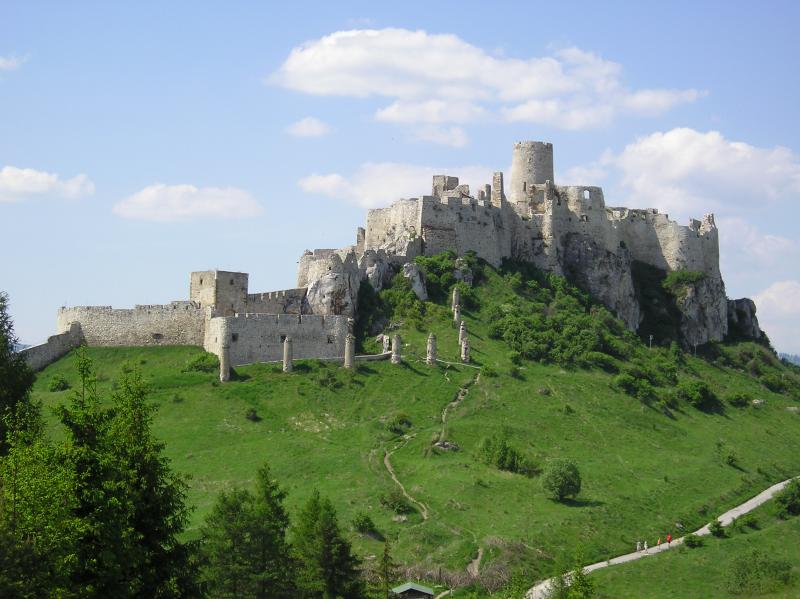
Spiš Castle is one of the largest castle complexes in Central Europe, situated on a travertine hill overlooking the town of Spišské Podhradie. Established in the 12th century on the site of an earlier fortification, the castle served as a significant political, economic, and administrative center for the Kingdom of Hungary.
The site evolved through several architectural phases, transitioning from a Romanesque stone castle to a sprawling Gothic fortress, and eventually incorporating Renaissance residential wings. Despite a devastating fire in 1780, the extensive ruins remain a prominent example of medieval defensive architecture and a symbol of the region's historical importance.
Key Facts
- Materials
- Travertine, Stone, Brick
- Civilization
- Kingdom of Hungary
- Accessibility
- Partial; steep terrain and uneven surfaces
- Date(s)
- 12th century - 18th century
- Condition
- Extensive ruins, partially restored
- Original Function
- Royal castle and administrative center
- Key Figures
- King Stephen I, Zápolya family, Csáky family
Foundation and Early Development
12th centuryThe castle was established in the 12th century on a strategic hill, replacing an older Slavic fortification. It served as the seat of the Spiš County and a vital border defense for the Kingdom of Hungary.
Gothic Expansion
13th - 15th centuryDuring the 13th century, the castle was significantly expanded with Romanesque and early Gothic elements. In the 15th century, the Zápolya family transformed the site into a sophisticated late-Gothic residential palace, adding a chapel and fortified walls.
Renaissance Transformation and Decline
16th - 18th centuryThe castle underwent Renaissance modifications under the Thurzó and Csáky families. However, its military importance waned, and following a major fire in 1780, the structure was abandoned and fell into disrepair.
Modern Preservation
20th century - presentIn 1993, the castle and its surrounding monuments were inscribed as a UNESCO World Heritage site. Extensive archaeological research and conservation efforts have been ongoing to stabilize the ruins and provide public access.
Cultural Significance
Spiš Castle is a cornerstone of Slovak national heritage, representing the complex feudal history of the Spiš region. It serves as a primary example of the evolution of medieval fortification techniques and residential luxury in the Carpathian basin.
Beyond its architectural value, the castle is deeply linked to the history of the Spiš towns and the cultural identity of the local population. It remains a focal point for historical tourism and academic study regarding medieval European administrative centers.
Interpretive Notes
Scholarly debates and areas of uncertainty
There is ongoing academic discussion regarding the exact layout and function of the earliest 12th-century structures, as the subsequent massive Gothic and Renaissance reconstructions significantly obscured the original Romanesque foundations.
Visiting Information
Entry Rules
Open daily from April to November. Tickets can be purchased at the entrance. Visitors are advised to wear sturdy footwear due to the steep, uneven terrain of the castle grounds.
Best Times to Visit
Late spring and early autumn offer the best weather for exploring the outdoor ruins. Early morning visits are recommended to avoid peak tourist crowds during the summer months.
Photography
Personal photography is permitted throughout the site. Commercial photography requires prior authorization from the museum administration.
Preservation Notes
The site is a protected monument; visitors must stay within marked paths. Some areas are restricted due to ongoing structural stabilization and archaeological excavations.
Nearby POIs
9 shownSources & Further Reading
- [1]Spiš Castle: A History of the Fortress — Dvořáková, D.. Slovak National Museum (2012)
- [2]UNESCO World Heritage: Levoča, Spiš Castle and the Associated Cultural Monuments — UNESCO World Heritage Centre. UNESCO (1993)View
Key Facts
- Materials
- Travertine, Stone, Brick
- Civilization
- Kingdom of Hungary
- Accessibility
- Partial; steep terrain and uneven surfaces
- Date(s)
- 12th century - 18th century
- Condition
- Extensive ruins, partially restored
- Original Function
- Royal castle and administrative center
- Key Figures
- King Stephen I, Zápolya family, Csáky family