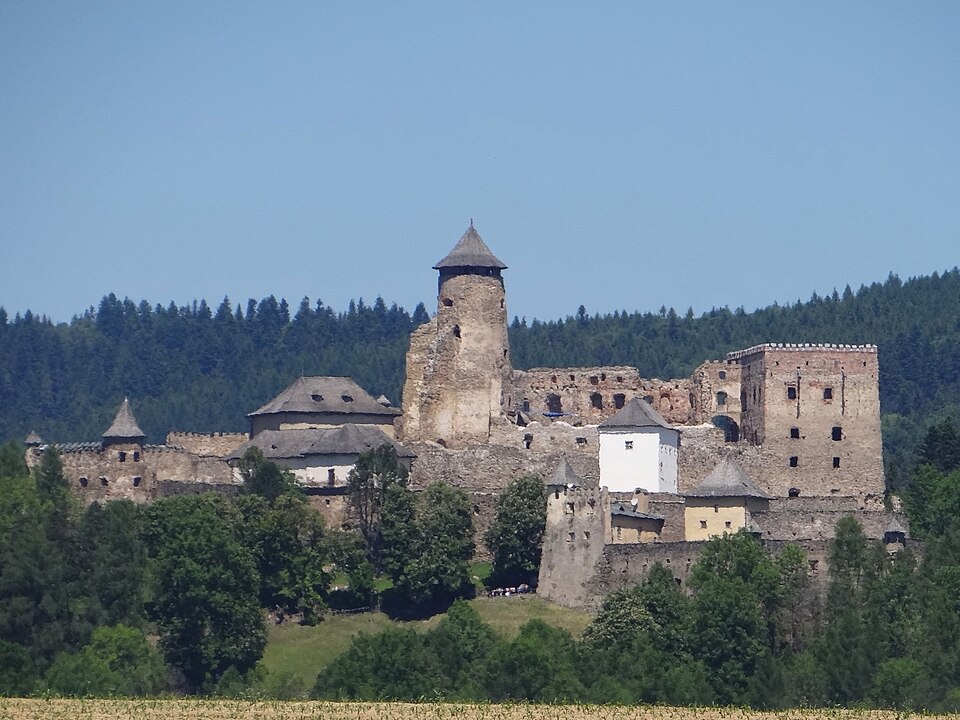
Ľubovňa Castle is a medieval stone fortress situated on a limestone hill overlooking the town of Stará Ľubovňa in northeastern Slovakia. Originally constructed in the late 13th century to protect the northern border of the Kingdom of Hungary and the trade route to Poland, the castle underwent significant architectural expansions over several centuries, incorporating Gothic, Renaissance, and Baroque elements.
The site is notable for its well-preserved residential tower, which served as a residence for the Lubomirski family, and its strategic role in the administration of the Spiš region. Following a period of decline in the 18th century, the castle has undergone extensive restoration and currently functions as a museum, housing historical exhibitions that detail the military and social history of the region.
Key Facts
- Materials
- Limestone, Sandstone, Brick
- Civilization
- Kingdom of Hungary
- Accessibility
- Steep terrain; limited access for mobility-impaired visitors
- Date(s)
- Late 13th century
- Condition
- Partially restored and active museum
- Original Function
- Border fortress and administrative center
- Key Figures
- King Andrew III, Lubomirski family, Sigismund of Luxembourg
Foundation and Early History
13th centuryThe castle was established in the late 13th century, likely under the reign of King Andrew III, to secure the northern frontier of the Kingdom of Hungary. It served as a vital strategic point for controlling trade routes between Hungary and Poland.
The Polish-Hungarian Pledge
1412–1772In 1412, King Sigismund of Luxembourg pledged the castle and 13 Spiš towns to the Polish King Władysław II Jagiełło as security for a loan. For over 360 years, the castle served as the seat of the Polish starostas, becoming a center of diplomatic meetings between Polish and Hungarian monarchs.
Renaissance and Baroque Expansion
16th–17th centuryDuring the period of Polish administration, the castle was significantly fortified and expanded. The Lubomirski family, who held the castle for generations, oversaw the construction of a Renaissance bastion and a comfortable Baroque palace, transforming the military fortress into a representative noble residence.
Decline and Modern Restoration
18th century–presentFollowing the return of the Spiš towns to Hungary in 1772, the castle lost its strategic importance and began to fall into disrepair. Systematic restoration efforts began in the 20th century, focusing on the residential tower and the fortification walls, leading to its current status as a major regional museum.
Cultural Significance
Ľubovňa Castle serves as a symbol of the historical interconnectedness between Slovakia and Poland. Its unique position as a pledged territory for several centuries left a distinct mark on the local culture, architecture, and administrative traditions of the Spiš region.
Today, the castle is a focal point for regional heritage, hosting annual historical festivals and reenactments that celebrate the medieval and early modern history of the area. It remains one of the most visited historical sites in the Prešov Region.
Interpretive Notes
Scholarly debates and areas of uncertainty
The exact extent of the original 13th-century layout remains a subject of archaeological investigation, as subsequent Renaissance and Baroque reconstructions significantly altered the medieval foundations. Additionally, the precise architectural influence of the Polish starostas on the castle's interior design compared to contemporary Hungarian styles is frequently discussed in regional architectural studies.
Visiting Information
Entry Rules
Open daily during the main tourist season (April–October). Tickets can be purchased at the entrance. Guided tours are available for the interior palace and the residential tower.
Best Times to Visit
Late spring and early autumn offer the best weather for exploring the outdoor fortifications and the surrounding castle grounds.
Photography
Personal photography is permitted in outdoor areas. Flash photography is generally prohibited inside the museum exhibitions and historical interiors.
Preservation Notes
The site includes steep stairs and uneven stone surfaces. Visitors are advised to wear appropriate footwear. Restoration work is ongoing in various sections of the castle; please respect all safety barriers.
Nearby POIs
4 shownSources & Further Reading
- [1]Ľubovniansky hrad: Dejiny a architektúra — Martin Furmaník. Vydavateľstvo Prešov (2015)
- [2]Castles of the Spiš Region — Ivan Chalupecký. Slovak Academic Press (2008)
Key Facts
- Materials
- Limestone, Sandstone, Brick
- Civilization
- Kingdom of Hungary
- Accessibility
- Steep terrain; limited access for mobility-impaired visitors
- Date(s)
- Late 13th century
- Condition
- Partially restored and active museum
- Original Function
- Border fortress and administrative center
- Key Figures
- King Andrew III, Lubomirski family, Sigismund of Luxembourg