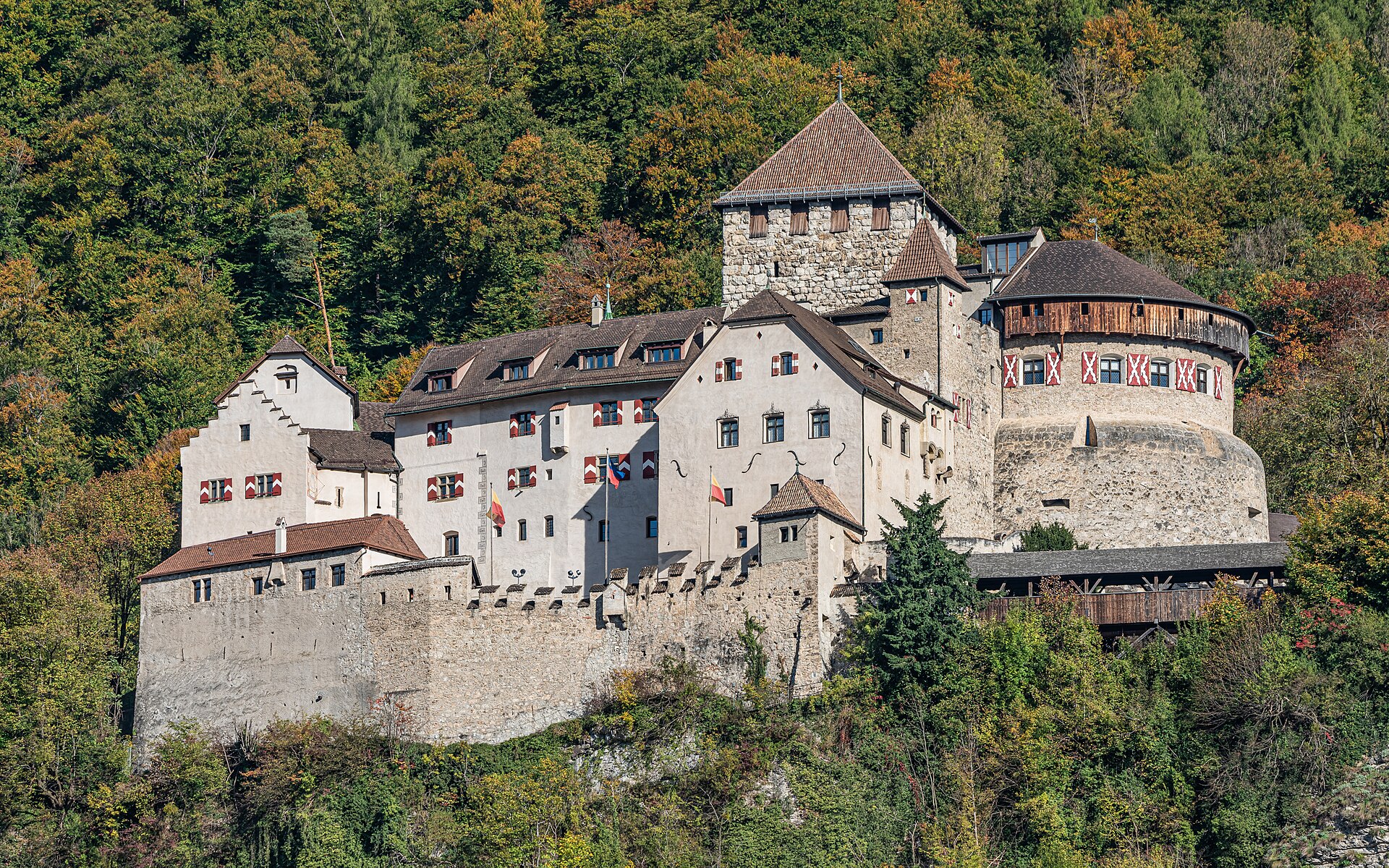
Schloss Vaduz is a medieval fortress perched on a steep rocky terrace 120 meters above the capital city of Vaduz, Liechtenstein. Originally constructed in the 12th or 13th century, the castle serves as the official residence of the Prince of Liechtenstein and remains a primary symbol of the nation's sovereignty.
The structure has undergone significant expansions and renovations throughout its history, most notably during the 16th and early 20th centuries. While the castle dominates the landscape of the Rhine Valley, it remains a private residence for the Princely Family and is not open to the public for interior tours.
Key Facts
- Materials
- Stone, Timber
- Civilization
- Holy Roman Empire
- Accessibility
- Viewable from public hiking trails; no interior access
- Date(s)
- 12th century
- Condition
- Well-preserved, private residence
- Original Function
- Fortress and administrative center
- Key Figures
- Counts of Werdenberg-Sargans, Prince Franz Josef II
Origins and Early History
12th-13th centuryThe keep, the oldest part of the castle, dates back to the 12th century. It was likely built by the Counts of Werdenberg-Sargans as a defensive fortification overlooking the strategic Rhine valley trade routes.
Expansion and Ownership
14th-16th centuryThe castle underwent significant expansion during the 16th century under the rule of the Counts of Sulz. The western side of the castle was enlarged, and the chapel of St. Anna was constructed during this period.
Princely Residence
18th century-presentThe House of Liechtenstein acquired the castle in 1712. After falling into disrepair, it underwent a major restoration between 1905 and 1920. In 1939, Prince Franz Josef II moved his permanent residence to the castle, establishing it as the official home of the Princely Family.
Cultural Significance
Schloss Vaduz is the preeminent symbol of the Principality of Liechtenstein. It represents the continuity of the monarchy and the nation's independence. The castle is the focal point of the annual National Day celebrations, where the Prince addresses the citizens from the castle grounds.
Interpretive Notes
Scholarly debates and areas of uncertainty
There is limited scholarly debate regarding the castle, as it remains a private residence. Historical discussions primarily focus on the architectural evolution of the keep and the defensive capabilities of the site during the medieval period.
Visiting Information
Entry Rules
The castle grounds are private property and are closed to the public. Visitors may view the exterior from the surrounding public hiking trails.
Best Times to Visit
Late afternoon for photography, as the sun illuminates the castle facade from the west. August 15th (National Day) offers a unique cultural perspective, though the castle remains closed to visitors.
Photography
Exterior photography is permitted from public areas. Drone usage is strictly prohibited without authorization from the Princely administration.
Preservation Notes
The site is maintained as a private residence. Visitors are requested to respect the privacy of the Princely Family and remain on designated public paths.
Nearby POIs
6 shownSources & Further Reading
- [1]The Princely House of Liechtenstein — Liechtenstein Princely Family. Official Website of the Princely House (2023)View
- [2]Vaduz Castle: A History — Cornelius Goop. Liechtenstein National Museum (2015)
Key Facts
- Materials
- Stone, Timber
- Civilization
- Holy Roman Empire
- Accessibility
- Viewable from public hiking trails; no interior access
- Date(s)
- 12th century
- Condition
- Well-preserved, private residence
- Original Function
- Fortress and administrative center
- Key Figures
- Counts of Werdenberg-Sargans, Prince Franz Josef II