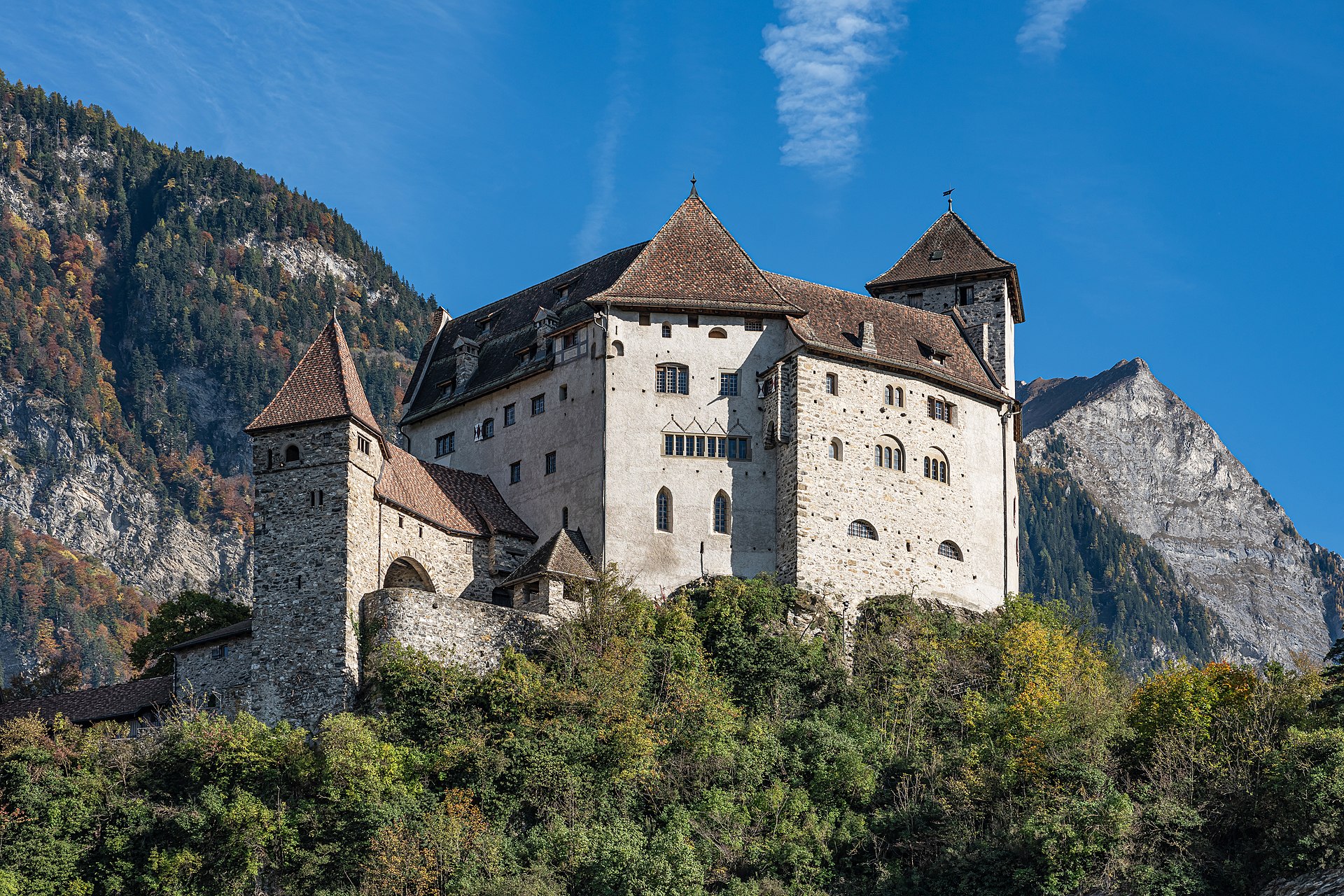
Burg Gutenberg is a well-preserved hilltop castle located in the municipality of Balzers, Liechtenstein. Situated on a rocky outcrop overlooking the Rhine Valley, the fortress has served as a strategic defensive position since the Middle Ages. Its architecture features a prominent central keep (bergfried) and a high perimeter wall that follows the natural contours of the hill.
While the site has undergone several phases of reconstruction, particularly during the early 20th century, it remains one of the most significant historical landmarks in the region. The castle grounds are currently maintained as a public park, offering views of the surrounding valley and the nearby border with Switzerland.
Key Facts
- Materials
- Stone, Mortar
- Civilization
- Holy Roman Empire
- Accessibility
- Accessible via steep pedestrian path; limited vehicle access
- Date(s)
- 12th-13th century
- Condition
- Restored, public park and cultural site
- Original Function
- Fortress and defensive stronghold
- Key Figures
- Barons of Frauenberg, Egon Rheinberger
Origins and Medieval Period
12th-13th centuryThe earliest foundations of the castle date back to the 12th century. It served as a strategic fortification for the Barons of Frauenberg, controlling the trade routes and river crossings along the Rhine.
Decline and Ruin
16th-19th centuryFollowing several centuries of use, the castle suffered significant damage during the Swabian War and subsequent conflicts. By the 18th century, it had fallen into disrepair and served primarily as a ruin, losing its military utility.
Restoration and Modern Era
1905-1912In the early 20th century, the sculptor Egon Rheinberger purchased the ruins and undertook an extensive restoration project. His work stabilized the structure and reconstructed the keep, transforming the site into a private residence and cultural landmark.
Cultural Significance
Burg Gutenberg serves as a primary symbol of Liechtenstein's medieval heritage. It is deeply integrated into the local identity of Balzers and is frequently used for cultural events, concerts, and public gatherings, bridging the gap between its military past and its current role as a community asset.
Interpretive Notes
Scholarly debates and areas of uncertainty
There is ongoing discussion among regional historians regarding the extent of the 20th-century reconstruction and how much of the original medieval masonry remains versus the romanticized additions made by Egon Rheinberger.
Visiting Information
Entry Rules
The castle courtyard and grounds are open to the public free of charge. Access to the interior of the keep is generally restricted and reserved for special events or guided tours.
Best Times to Visit
Spring and autumn offer the best weather for the steep walk up to the castle. Weekdays are recommended to avoid local weekend crowds.
Photography
Personal photography is permitted throughout the grounds. Commercial photography requires prior authorization from the municipal authorities.
Preservation Notes
Visitors are requested to stay on designated paths and refrain from climbing on the historic perimeter walls. The site is monitored to prevent vandalism.
Nearby POIs
6 shownSources & Further Reading
- [1]Historisches Lexikon des Fürstentums Liechtenstein — Liechtenstein Institute. Chronos Verlag (2013)View
- [2]Die Burgen und Schlösser Liechtensteins — Paul Vogt. Liechtenstein Verlag (1999)
Key Facts
- Materials
- Stone, Mortar
- Civilization
- Holy Roman Empire
- Accessibility
- Accessible via steep pedestrian path; limited vehicle access
- Date(s)
- 12th-13th century
- Condition
- Restored, public park and cultural site
- Original Function
- Fortress and defensive stronghold
- Key Figures
- Barons of Frauenberg, Egon Rheinberger