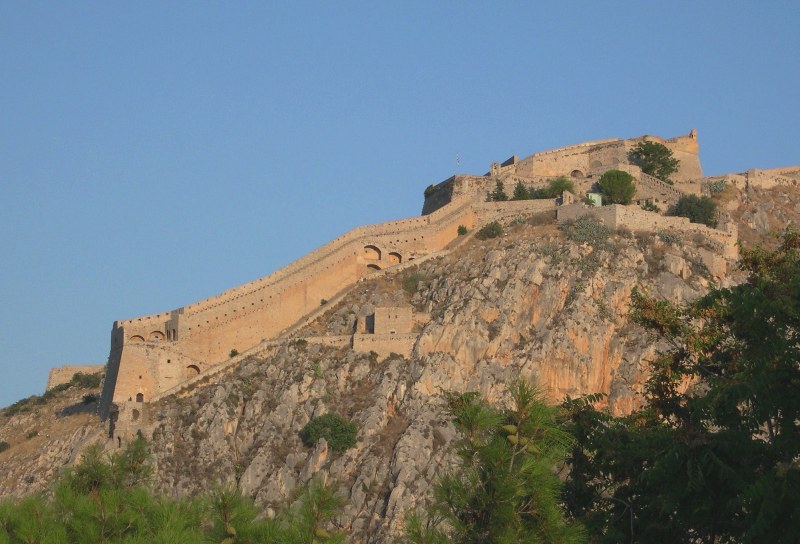
The Palamidi Fortress is a large military fortification located on a 216-meter high hill overlooking the city of Nafplio in the Peloponnese, Greece. Constructed primarily during the second period of Venetian rule in the early 18th century, the fortress is a masterpiece of Baroque military architecture, designed by engineers Giaxich and Lasalle.
The structure consists of eight distinct, self-contained bastions connected by a complex system of walls and gates. Its strategic position provided total control over the Argolic Gulf and the surrounding plains, serving as a critical defensive point for the Venetian Republic before falling to Ottoman forces in 1715. Today, it remains one of the best-preserved examples of Venetian fortification in the Mediterranean.
Key Facts
- Materials
- Limestone, Mortar
- Civilization
- Venetian
- Accessibility
- Accessible via road or 999 stone steps
- Date(s)
- 1711-1714
- Condition
- Well-preserved, open-air monument
- Original Function
- Military fortification
- Key Figures
- Agostino Sagredo, Theodoros Kolokotronis
Venetian Construction
1711-1714Following the Treaty of Karlowitz, the Venetians sought to fortify Nafplio against potential Ottoman incursions. Under the supervision of Proveditor General Agostino Sagredo, the fortress was completed in an remarkably short period of three years.
Ottoman Occupation
1715-1822The fortress fell to the Ottoman Empire in 1715 after a brief siege. It served as a key administrative and military hub for the Ottomans in the Morea for over a century, maintaining its defensive integrity.
Greek War of Independence
1822-1823During the Greek Revolution, the fortress was captured by Greek forces led by Staikos Staikopoulos on the night of November 30, 1822. Its capture was a pivotal moment in the liberation of Nafplio, which became the first capital of the modern Greek state.
Modern Era
19th century - presentFollowing independence, the fortress was used as a prison, most notably housing the revolutionary hero Theodoros Kolokotronis. It was eventually decommissioned as a military site and opened to the public as a historical monument.
Cultural Significance
Palamidi is a symbol of the resilience and strategic history of Nafplio. It represents the transition of power in the Peloponnese from the maritime empires of the Renaissance to the formation of the modern Greek nation. The site is deeply linked to the memory of the Greek War of Independence, serving as a site of both military triumph and political imprisonment.
Interpretive Notes
Scholarly debates and areas of uncertainty
There is ongoing discussion regarding the exact number of steps leading to the fortress. While local tradition insists on 999, modern surveys suggest the number has fluctuated due to 19th-century road construction and path modifications.
Visiting Information
Entry Rules
Open daily. Ticket required for entry. The site involves significant walking on uneven stone surfaces; comfortable footwear is strongly recommended.
Best Times to Visit
Early morning or late afternoon to avoid peak heat and to capture the best light over the Argolic Gulf.
Photography
Personal photography is permitted. Commercial photography requires prior authorization from the Ephorate of Antiquities of Argolida.
Preservation Notes
The site is a protected archaeological monument. Visitors must remain on designated paths and are prohibited from climbing on the bastion walls.
Nearby POIs
3 shownSources & Further Reading
- [1]The Fortifications of Nafplio — Tassos Tanoulas. Hellenic Ministry of Culture (2005)
- [2]Venetian Fortresses in the Peloponnese — S. P. Vryonis. Journal of Mediterranean Archaeology (1998)
Key Facts
- Materials
- Limestone, Mortar
- Civilization
- Venetian
- Accessibility
- Accessible via road or 999 stone steps
- Date(s)
- 1711-1714
- Condition
- Well-preserved, open-air monument
- Original Function
- Military fortification
- Key Figures
- Agostino Sagredo, Theodoros Kolokotronis