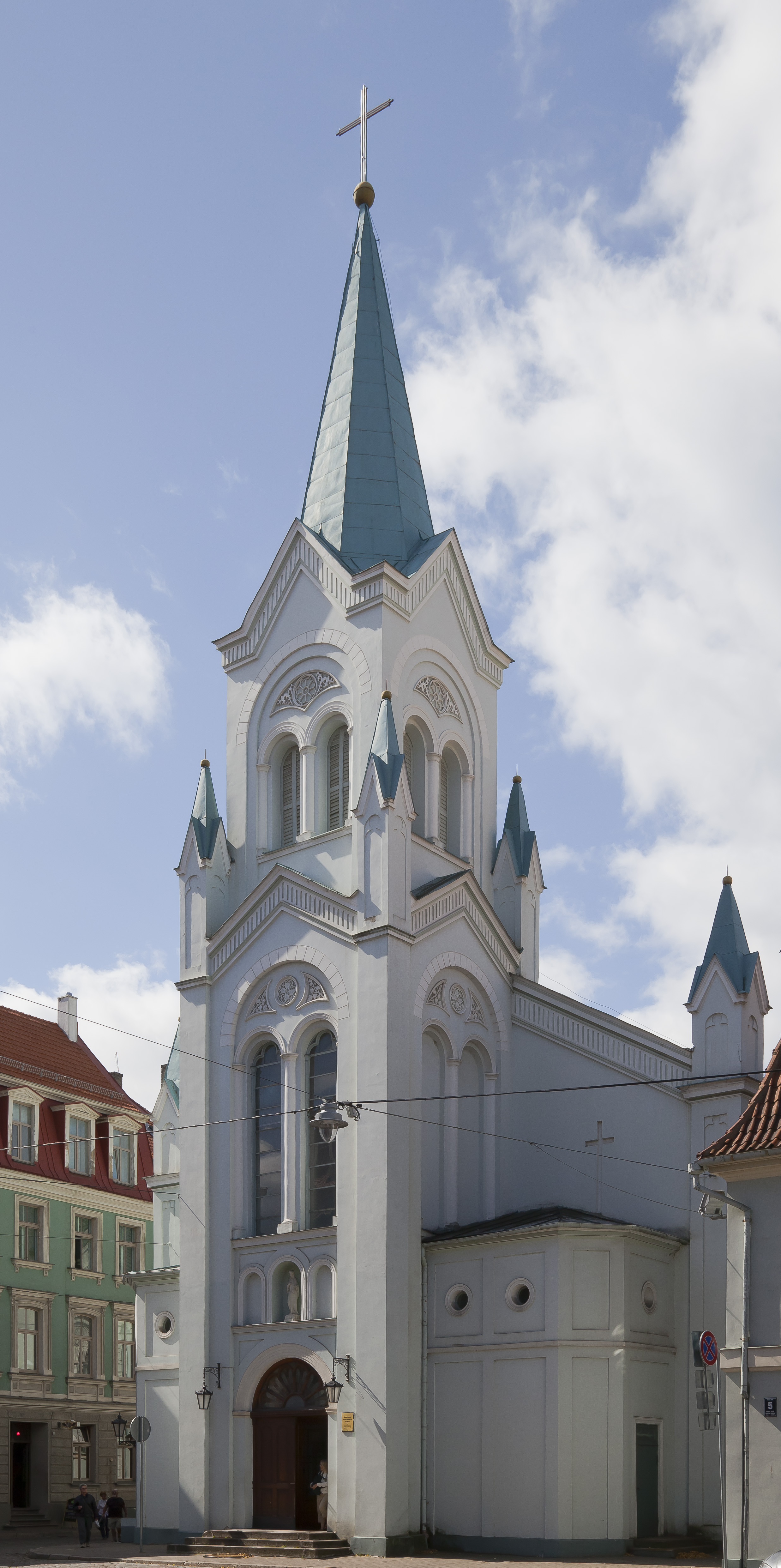
Our Lady of Sorrows Church (Latvian: Sāpju Dievmātes Romas katoļu baznīca) is a prominent Roman Catholic parish church located in the historic center of Riga. It holds the distinction of being the first stone building constructed in the city following the end of Swedish rule, serving as a symbol of the re-establishment of Catholic presence in the region during the late 18th century.
The structure exhibits a transition between late Baroque and early Classical architectural styles. Commissioned by the Polish-Lithuanian Commonwealth and designed by architect Christoph Haberland, the church was intended to serve the local Catholic community, including the Polish and Lithuanian populations residing in Riga at the time.
Key Facts
- Materials
- Stone, Brick, Plaster
- Civilization
- Latvian
- Accessibility
- Ground level access available
- Date(s)
- 1785
- Condition
- Active place of worship
- Original Function
- Catholic parish church
- Key Figures
- Christoph Haberland
Establishment
1785The church was built on the site of a former wooden chapel. Its construction was authorized by the Russian authorities, reflecting a shift in religious policy that allowed for the building of a permanent Catholic stone structure in the city.
Architectural Development
18th-19th centuryDesigned by the notable Riga architect Christoph Haberland, the building features a facade that blends Baroque ornamentation with the emerging symmetry of the Classical style. It served as the primary center for the Catholic community in Riga for many decades.
Modern Era
20th century - presentThe church survived the various political upheavals of the 20th century, including the Soviet occupation, during which it remained an active religious site. It continues to serve the local Catholic congregation and is recognized as a significant architectural landmark in Old Riga.
Cultural Significance
The church represents a pivotal moment in Riga's religious history, marking the return of institutional Catholicism to a city that had been predominantly Lutheran since the Reformation. It stands as a testament to the multicultural history of Riga, having historically served the Polish, Lithuanian, and Latvian Catholic communities.
Interpretive Notes
Scholarly debates and areas of uncertainty
There is minor scholarly discussion regarding the extent of Christoph Haberland's original design versus subsequent 19th-century renovations, as some interior elements were modified to align with changing liturgical requirements.
Visiting Information
Entry Rules
Open to the public for prayer and services. Visitors are expected to maintain silence and dress modestly. Entry is free.
Best Times to Visit
Weekday mornings or during scheduled Sunday masses. The area is less crowded during the early morning hours.
Photography
Photography is permitted for personal use without flash. Professional photography requires prior permission from the parish office.
Preservation Notes
The building is a protected cultural monument. Visitors should refrain from touching the altars or historical wall decorations.
Nearby POIs
11 shown- Riga Castle0.1 km
- Three Brothers0.2 km
- Riga Cathedral0.2 km
- Museum of the Occupation of Latvia0.5 km
- House of the Black Heads0.5 km
- St. Peter's Church0.6 km
- St. John's Church0.6 km
- Freedom Monument0.7 km
- Latvian National Museum of Art0.9 km
- Riga Nativity of Christ Orthodox Cathedral0.9 km
- Riga Art Nouveau Center1.1 km
Sources & Further Reading
- [1]The Architecture of Riga — Jānis Krastiņš. Latvijas Architektūra (2005)
- [2]Catholicism in the Baltic States — Toivo U. Raun. Journal of Baltic Studies (1998)
Key Facts
- Materials
- Stone, Brick, Plaster
- Civilization
- Latvian
- Accessibility
- Ground level access available
- Date(s)
- 1785
- Condition
- Active place of worship
- Original Function
- Catholic parish church
- Key Figures
- Christoph Haberland
Nearby POIs
11 shown- Riga Castle0.1 km
- Three Brothers0.2 km
- Riga Cathedral0.2 km
- Museum of the Occupation of Latvia0.5 km
- House of the Black Heads0.5 km
- St. Peter's Church0.6 km
- St. John's Church0.6 km
- Freedom Monument0.7 km
- Latvian National Museum of Art0.9 km
- Riga Nativity of Christ Orthodox Cathedral0.9 km
- Riga Art Nouveau Center1.1 km