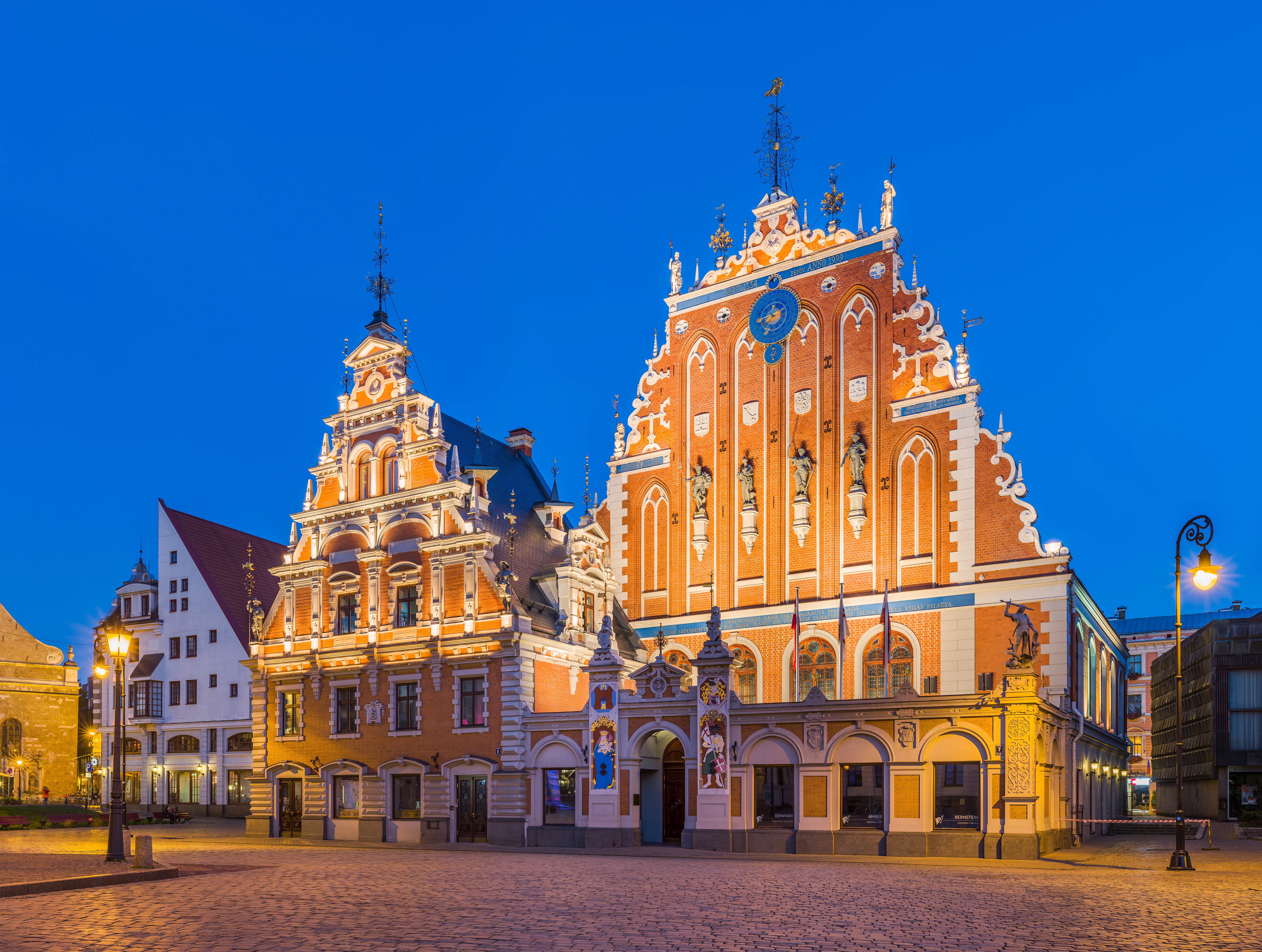
The House of the Black Heads is a landmark building located in the heart of Riga's Old Town. Originally constructed in the 14th century for the Brotherhood of Blackheads, a guild for unmarried merchants, shipowners, and foreigners, the structure served as a central hub for the city's social and commercial life for centuries.
The original building was severely damaged during World War II and subsequently demolished by Soviet authorities in 1948. The current structure is a meticulous reconstruction completed in 1999, which restored the ornate facade to its 17th-century appearance, incorporating Dutch Renaissance and Mannerist architectural elements.
Key Facts
- Materials
- Brick, Sandstone, Copper
- Civilization
- Hanseatic League
- Accessibility
- Wheelchair accessible with elevator access to upper floors
- Date(s)
- 1334 (original), 1996-1999 (reconstruction)
- Condition
- Fully reconstructed and operational as a museum and event venue
- Original Function
- Guildhall and social club
- Key Figures
- Brotherhood of Blackheads
Origins and the Brotherhood
14th CenturyThe building was first mentioned in 1334 as a meeting place for the Brotherhood of Blackheads. The guild was named after their patron saint, Saint Maurice, whose head is depicted in the guild's coat of arms.
Architectural Evolution
17th CenturyDuring the 17th century, the building underwent significant renovations, gaining its characteristic Mannerist facade. It became one of the most decorative buildings in Riga, reflecting the wealth and influence of the merchant class.
Destruction and Reconstruction
1941-1999The building was bombed by German forces in 1941 and later razed by the Soviet administration. Following Latvia's restoration of independence, the city undertook a massive reconstruction project based on original plans, finishing in time for Riga's 800th anniversary.
Cultural Significance
The House of the Black Heads is a symbol of Riga's historical identity as a major Hanseatic trading port. It represents the legacy of the merchant guilds that shaped the city's economic and cultural landscape. Today, it serves as a museum and a site for official state functions, including hosting visiting heads of state.
Interpretive Notes
Scholarly debates and areas of uncertainty
Debates have historically centered on the authenticity of the 1990s reconstruction. While some architectural historians praise the fidelity of the exterior, others discuss the ethical implications of reconstructing destroyed heritage sites versus preserving ruins.
Visiting Information
Entry Rules
Open daily for museum tours. Tickets can be purchased at the entrance or online. No specific dress code is required for general visitors.
Best Times to Visit
Weekdays during the morning hours to avoid large tour groups. The building is particularly notable during the winter months when the Christmas tree—a tradition linked to the Brotherhood—is displayed in the square.
Photography
Personal photography is permitted in all public areas. Professional photography or filming requires prior authorization from the museum administration.
Preservation Notes
The building is a modern reconstruction; visitors are asked to respect the interior exhibits and refrain from touching historical artifacts on display.
Nearby POIs
11 shown- Museum of the Occupation of Latvia
- St. Peter's Church0.2 km
- St. John's Church0.2 km
- Riga Cathedral0.3 km
- Three Brothers0.4 km
- Our Lady of Sorrows Church0.5 km
- Riga Castle0.6 km
- Freedom Monument0.6 km
- Riga Nativity of Christ Orthodox Cathedral0.9 km
- Latvian National Museum of Art1 km
- Riga Art Nouveau Center1.4 km
Sources & Further Reading
- [1]
- [2]Hanseatic Architecture in the Baltic — J. P. Stradiņš. Latvian Academy of Sciences (2001)
Key Facts
- Materials
- Brick, Sandstone, Copper
- Civilization
- Hanseatic League
- Accessibility
- Wheelchair accessible with elevator access to upper floors
- Date(s)
- 1334 (original), 1996-1999 (reconstruction)
- Condition
- Fully reconstructed and operational as a museum and event venue
- Original Function
- Guildhall and social club
- Key Figures
- Brotherhood of Blackheads
Nearby POIs
11 shown- Museum of the Occupation of Latvia
- St. Peter's Church0.2 km
- St. John's Church0.2 km
- Riga Cathedral0.3 km
- Three Brothers0.4 km
- Our Lady of Sorrows Church0.5 km
- Riga Castle0.6 km
- Freedom Monument0.6 km
- Riga Nativity of Christ Orthodox Cathedral0.9 km
- Latvian National Museum of Art1 km
- Riga Art Nouveau Center1.4 km